

Every day, Mamadou Diallo, a 21-year-old Guinean asylum seeker, used to ride his e-bike around the East Village to drop off deliveries for Uber Eats and DoorDash. On average, he said he would earn $110 daily, which he used to pay rent, buy food, take care of his 18-year-old brother in New York and send remittances home to his mother back in Guinea, where he migrated from in December 2023.
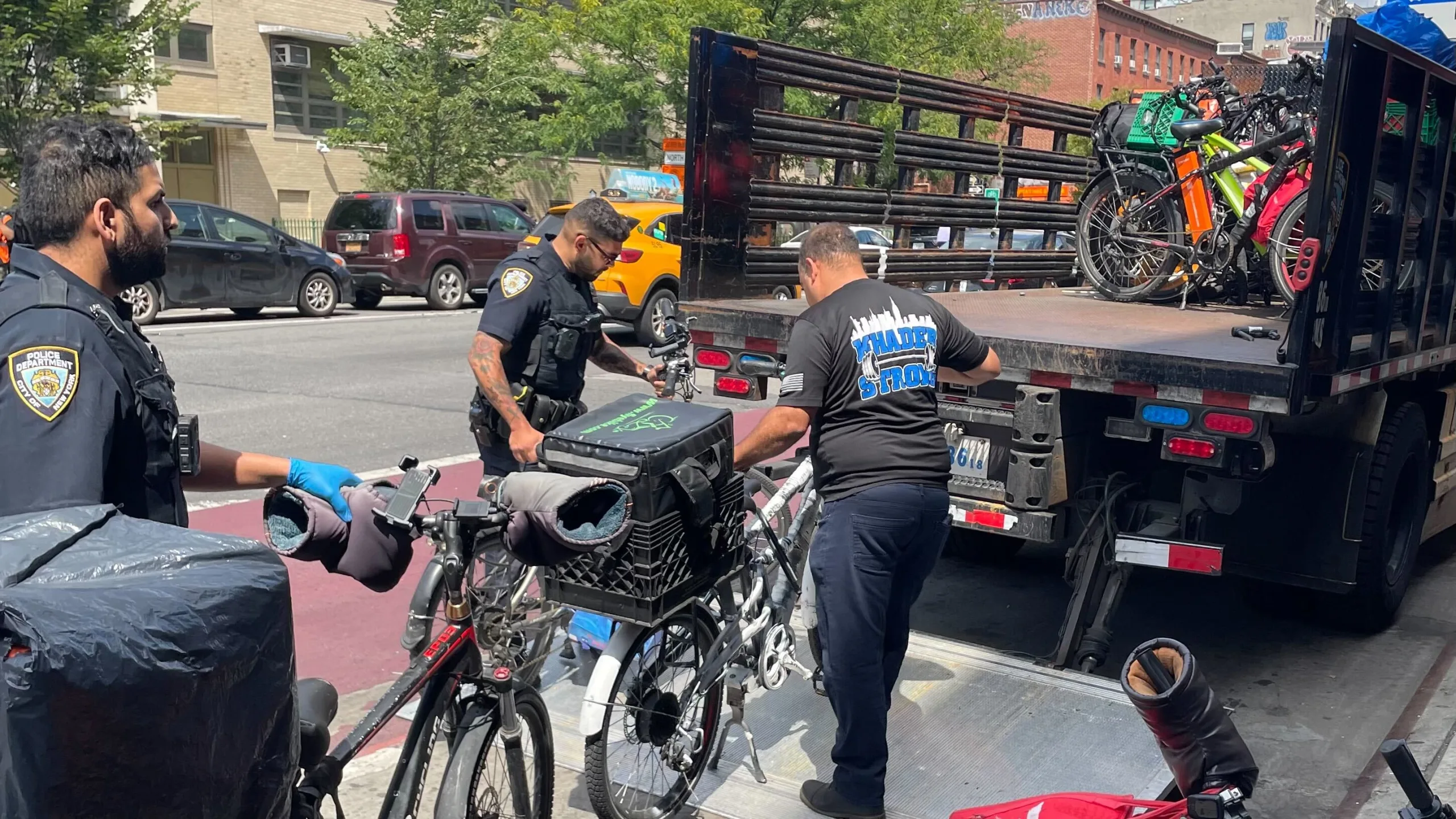
For the past 40 days, however, Diallo has had to borrow his friend’s e-bike to make his deliveries, and only during his friend’s time off from work. Diallo’s bike has been sitting in the NYPD’s 9th precinct after it was confiscated during a sweep in the East Village on July 30, after Diallo said he and other Guinean immigrant delivery workers had parked their bikes near a mosque after a long day of work. They often leave them there, trusting the nearby Fulani community to watch their bikes when they’re not around. Police seized the bikes around midnight, he said.
“We park our bikes next to the mosque. On the day of street cleaning, we weren’t informed, and the police came and took all the bikes,” Diallo told Documented in French, adding that losing his e-bike has cost him more than $2,000 in lost salary.

The NYPD confiscated a total of 53 e-bikes during sweeps on July 30 and August 28 after residents in the East Village submitted 311 complaints which cited “hazardous conditions” related to e-bikes. Several delivery workers from West African countries told Documented that they were not given notice before the first sweep and said losing their e-bikes cost them wages. Some of those same workers also believed that retrieving their bikes could lead to receiving a criminal summons — a claim the NYPD denied.
Advocates say the sweeps are yet another example of the Adams administration’s criminalization of the estimated 65,000 delivery workers in the city — the majority of whom are foreign born. They argue that the city has failed to address the lack of infrastructure that is needed to sustain the growing delivery workforce.
Diallo said that when his friend retrieved his bike, he ended up with a pink ticket used to issue a criminal summons. “I couldn’t go there because I know when a criminal ticket is not good for you,” Diallo said.
A spokesperson for the NYPD denied claims that the department was issuing criminal summons.
“Leaving their moveable property attached to city property unattended is a violation of the Sanitation Code,” the spokesperson told Documented in a statement. “Upon proving ownership of the bike, they are issued a summons for said violation. It is a civil violation; it does not give a criminal record.”
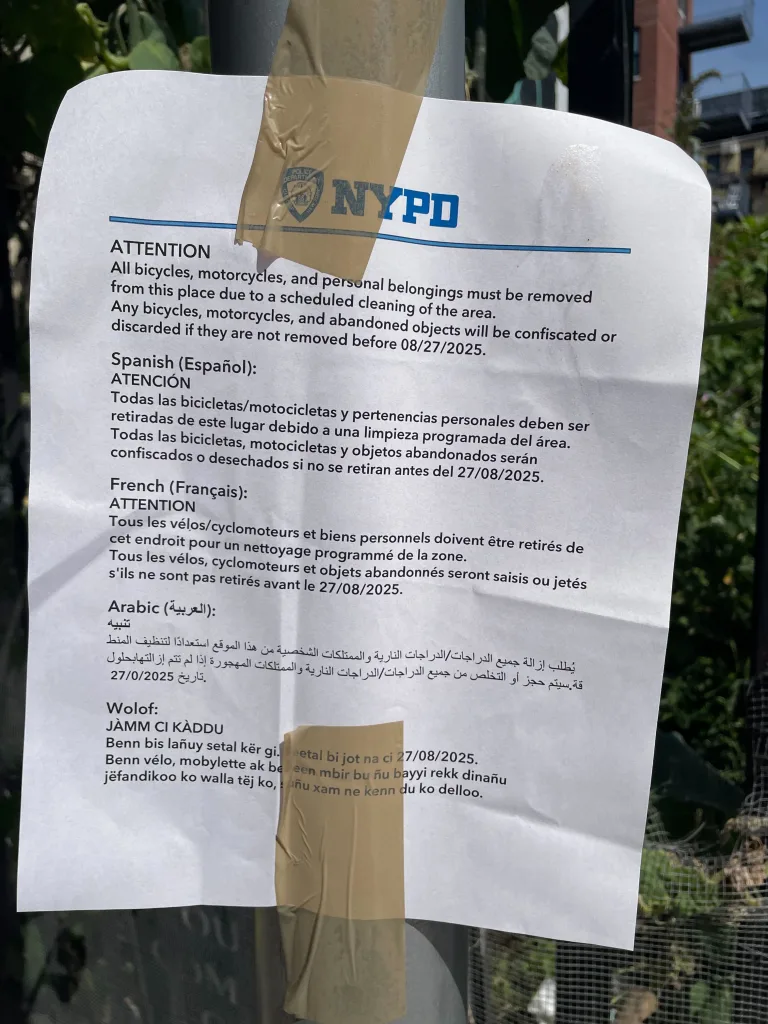
The spokesperson added that translators had been on the scene during the sweep operation to help explain the process of how one should retrieve a bike if it were confiscated. They also explained that 311 reported having received 28 calls about “hazardous conditions” related to the e-bikes being parked on sidewalks and said that the 9th Precinct’s Community Affairs and Crime Prevention team conducted outreach in the area in an effort to notify residents in advance of the sweep — posting signs in different languages alerting them to the upcoming operation.
“Once they adjudicate the summons, the bike is returned to them,” the spokesperson said.
But Tyler Hefferon, executive director of Cafewal, a resource center helping West African migrants in the East Village, said the interpreters were not provided by the NYPD, but rather that the service was provided by volunteers brought by local organizations, like Cafewal and Los Deliveristas Unidos. While Hefferon said Cafewal has helped retrieve more than six bikes to date which were caught in the sweeps, he noted that some immigrant workers were still afraid to visit the local precinct to pick up their bikes because they were worried about getting a criminal summons, something that could show up in their records and impact their immigration status.
Hefferon said the tickets the migrants received had “criminal summons” written at the top of the ticket but that the actual code of violation as well as the location of the assigned court was actually an administrative court, also known as civil court.
Since the first sweep in July, communication with the Precinct’s Community Affairs department and the community organizations that have been assisting the deliveristas in the East Village has evolved and improved, Hefferon said.
“[The first time] they wanted to see a purchase receipt. How many people carry around a receipt for their bike? Like, it’s kinda hard to find, especially these guys who are buying them in cash from random people,” he said. “In this most recent round, there was some kind of update, thanks to some elected officials getting involved, where they’re able to use the keys to the bikes as proof of ownership.”
Ligia Guallpa, executive director and co-founder of Los Deliveristas Unidos — which advocates for more of 65,000 delivery workers in New York City — said the NYPD’s sweep operations do not address the root problem: the lack of infrastructure and space for delivery workers’ bikes on the streets of New York.
“What we are seeing with this situation in the Lower East Side is that the sweeps are not isolated, they are part of a broader trend of criminalizing immigrant workers in disguise of public safety or, quote unquote, ‘quality of life enforcement’,” she said.
Guallpa said Black immigrant delivery workers are serving the neighborhood from morning to night, adding that the community is accepting their labor— ordering food deliveries, groceries, and other items — but not their presence as human beings.
“The fact is, the work they do in the community requires the need of e-bikes,” she said. “[The sweeps] also speak to the issue of how the administration is willing to dehumanize workers and ignore the root causes of the issue that exist in that community by only trying to address the quality of life with more NYPD enforcement that targets people of color.”
你知道吗?非公民办理驾照时的这个错误可能会导致选民欺诈
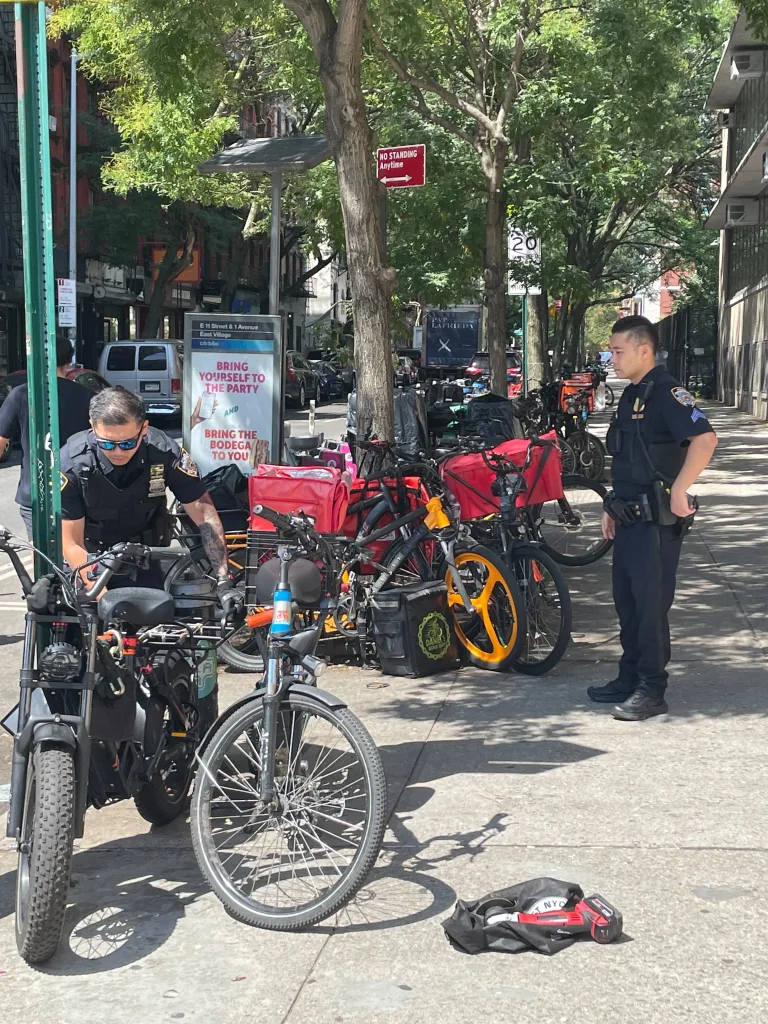
The spokesperson for the NYPD told Documented that they had been working with the Department of Transportation (DOT) to provide dedicated parking for bicycles, adding that the e-bikes would be held at the 9th Precinct for up to 30 days or until true ownership can be determined. Guallpa and Hefferon told Documented that Community Board 3, which represents the neighborhood, is currently in talks with the DOT to install corrals in the area.
Still, in the meantime, Diallo is considering buying a new bike. “You need about a thousand dollars,” he said, adding that it is a lot of money to spend but that he would rather save up for a new bike than to risk getting a ticket on his record.
“If we want to get the bike back, the only solution is to get the ticket,” he said “I prefer not to take it because of the [immigration] situation we are in. It’s not easy.”