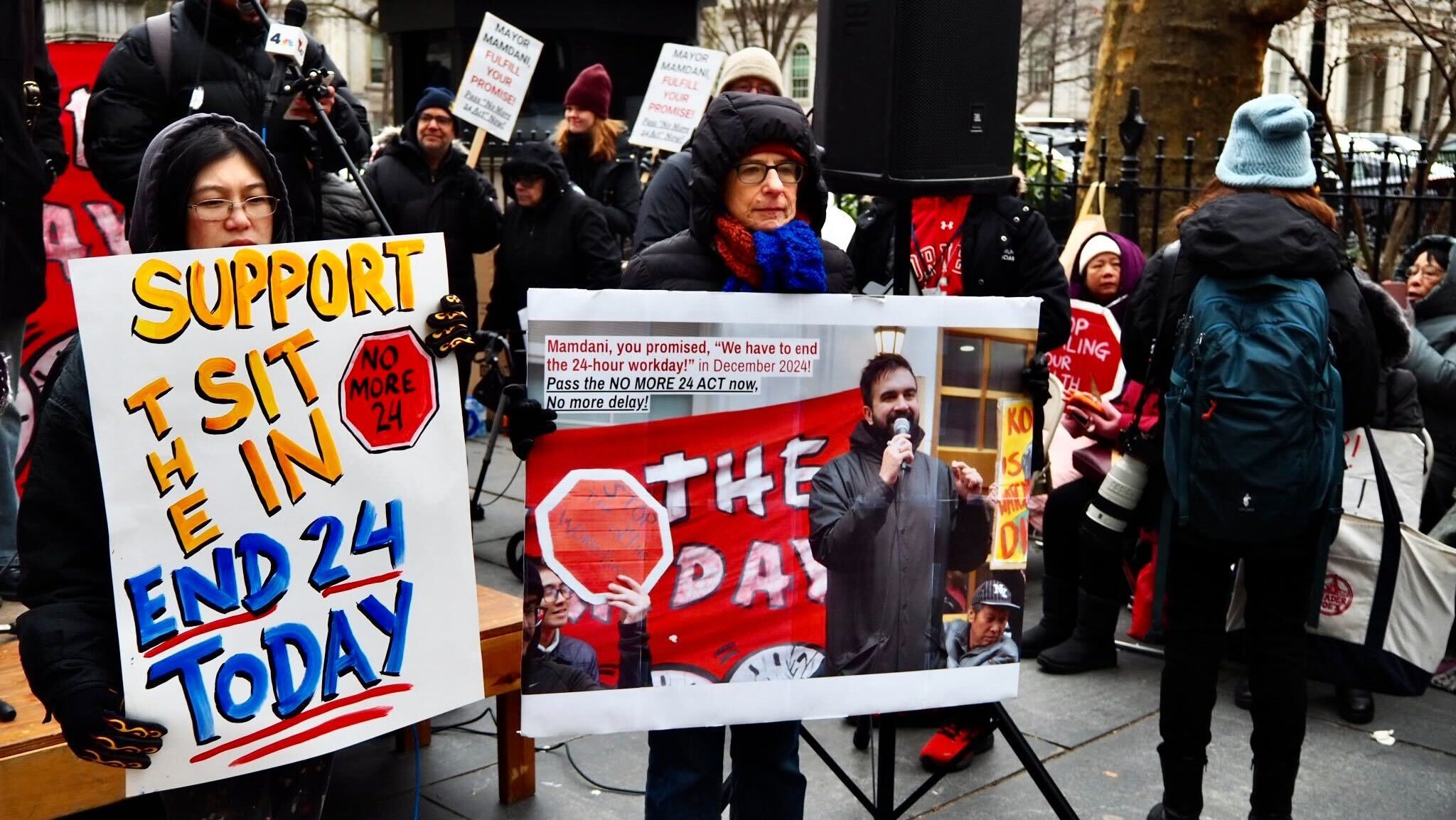


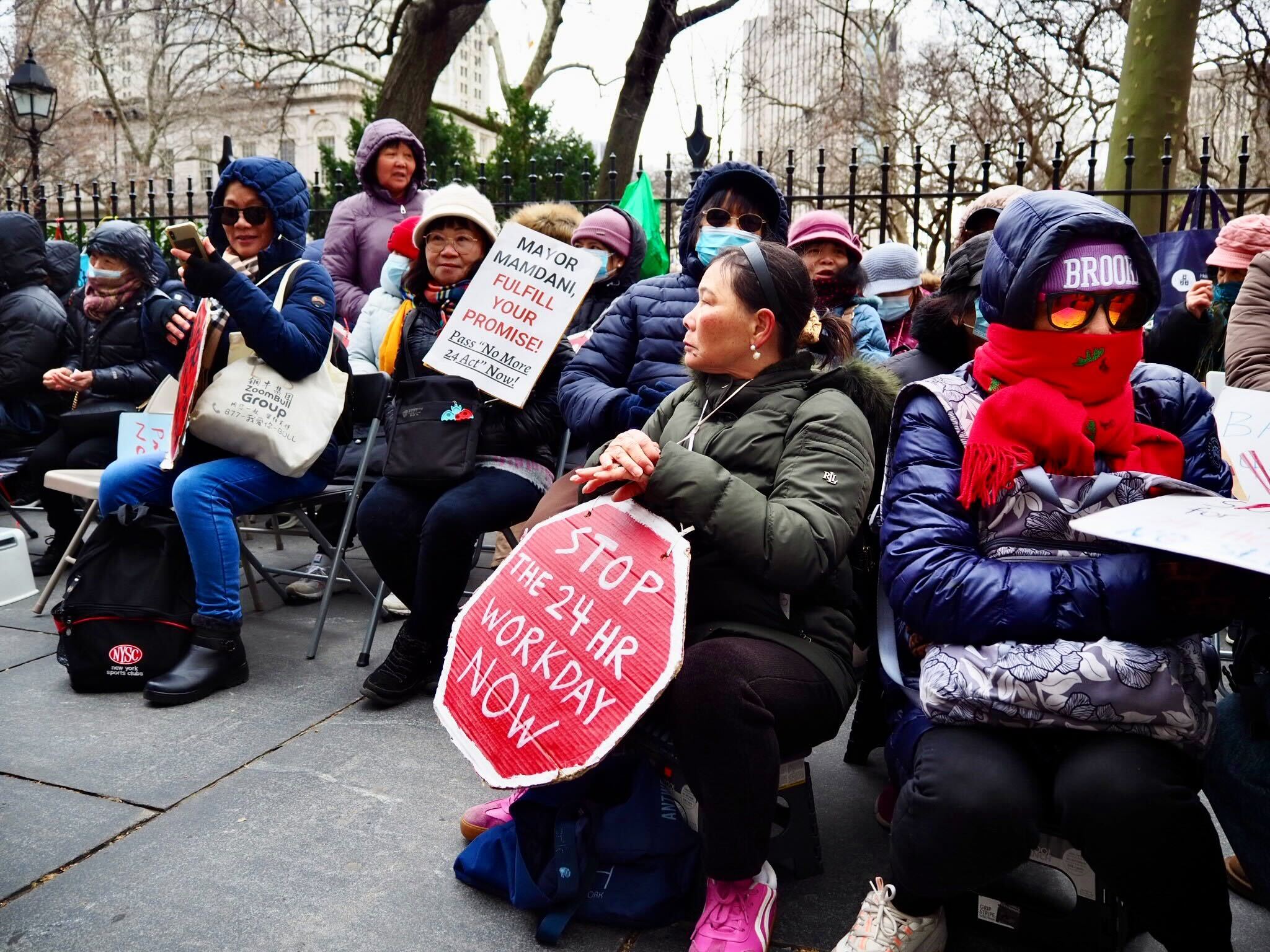
Nearly a hundred mostly immigrant home care workers gathered outside City Hall on Wednesday, wrapped in hats, scarves, and huddled beneath blankets to stage a sit-in and demand that the City Council pass the “No More 24” Act. Just two weeks earlier, the bill, which would abolish back-breaking 24-hour shifts for home care workers, appeared to be on a path to becoming law.
However, with the bill set to be voted on by the City Council on Mar. 26, Mayor Zohran Mamdani has signaled his opposition to the bill in its current form.
Introduced by City Councilmember Christopher Marte in December 2025, the legislation would effectively abolish 24-hour shifts in the home care industry by splitting overnight home care hours into two distinct shifts and cap the total number of hours home health care aids could work to no more than 56 hours a week.

A previous version of the bill, introduced by Marte in 2022, failed to make any headway due to opposition from then City Council Speaker Adrienne Adams as well as the union 1199SEIU, which represents home healthcare workers. Key to their opposition was the fact that the original cap on hours prevented home care aids from working over 50 hours per week, which the union argued would limit workers’ flexibility in working overtime shifts.

The revised bill appeared to have the backing of both current City Council Speaker Julie Menin and 1199SEIU, which many thought cleared the way for the bill’s passage.
But according to multiple sources who spoke to Documented on the condition of anonymity, Mayor Mamdani has intervened behind the scenes to block the bill’s passage as written. Influenced by the Legal Aid’s Society’s opposition to the bill, sources say the mayor has proposed amending the bill’s language so that it would not ban 24-hour shifts outright but give workers the option to work a 24-hour shift if they so choose.
The mayor’s office did not deny that Mamdani had concerns that the language of the bill, as written, would pose significant legal challenges that could have negative implications for workers and patients, if state law comes into conflict with city law. They also confirmed that the mayor was exploring the option of giving home health aides a choice to work a 24-hour shift if they so choose.
Sarah Ahn, an organizer with the Chinese Staff and Workers’ Association, as part of their “Ain’t I a Woman?!” campaign blasted the mayor and the Legal Aid Society for their last-minute opposition to the bill.
“Shame on the Legal Aid Society and anyone who will listen to them, including Mayor Mamdani,” she told Documented in a statement. “They have never done a day of a 24-hour workday in their lives and don’t know the torture these women sitting outside city hall have suffered. Rich lawyers sitting behind computers should not dictate the lives of women of color, forcing them to endure more physical and mental stress. Does the mayor agree or not agree? No one should be working a 24-hour workday. Especially immigrant women and women of color. No more delays, pass No More 24 now.”
Mayor Mamdani’s supposed position on the bill stands in stark contrast to the stance he took as a State Assemblymember, where he co-sponsored similar state legislation that would ban 24-hour shifts for home care aides. That bill ultimately stalled in committee.
According to Belkys Garcia, Staff Attorney in The Legal Aid Society’s Civil Law Reform Unit, the bill, as written, could potentially harm patients who rely on 24-hour care.
“The Legal Aid Society is deeply concerned that, if enacted without corresponding state action, this bill could cause New Yorkers to lose desperately needed care,” she told Documented. “People who rely on 24-hour live-in care are not authorized for two 12-hour shifts, so coverage cannot simply be split without changes to state law and reimbursement, risking immediate gaps in care for seniors and people with disabilities.”
Garcia added that abolishing 24-hour shifts throughout the city would contradict state law. Currently, the law requires home care workers in New York City, Westchester, and Long Island to be paid a minimum wage of $19.10 an hour. Home care attendants who work 24-hour shifts are only required to be paid for 13 hours of their shift, so long as they are given at least eight hours of sleep time, with five of those hours being uninterrupted sleep. They must also be given an additional three hours of meal breaks.
“While we support efforts to protect home care workers, meaningful reform requires alignment between city action and state authority,” she said. “The current system, rooted in state law, leaves aides paid for just 13 hours of a 24-hour shift. Without coordinated state reforms and adequate funding, local legislation risks destabilizing care. Policymakers must work together to ensure workers are paid for all hours worked while preserving uninterrupted, community-based care.”
Still, home care workers and their advocates have been arguing for years that abolishing 24-hour shifts is necessary because they are routinely forced to work the entirety of a 24-hour shift without sleep or meal breaks, but are still only paid for 13 hours.
Despite the mayor’s alleged concerns regarding the bill, Council Member Christopher Marte is still hopeful that Mamdani will have a change of heart.
“I know the mayor really cares about these workers,” he told Documented. “He’s been out there with us, and hopefully we can work together to get to a place, so then we can vote and move forward with this.”
When asked about the mayor’s attempt to change the bill’s language, Benjamin Fang-Estrada, Deputy Communications Director for Speaker Menin, reiterated the speaker’s support for home health care workers.
“Home health aides are essential to the care and dignity of so many New Yorkers, yet they are too often expected to work excessive hours that lead to fatigue and burnout,” he said in a statement. “Speaker Menin has long fought for strong worker protections and believes more must be done to prevent exploitation and ensure safe working conditions.”
Cassio Mendoza, Deputy Press Secretary for Economic Justice at the Office of the Mayor, says that the mayor is committed to easing the plight of home care workers.

你知道吗?非公民办理驾照时的这个错误可能会导致选民欺诈
“This legislation is currently in front of the City Council, which controls if and when this bill moves to a full vote,” he said in a statement. “The Mayor is committed to working alongside home care workers, the Council, and the state government to pass stronger protections that improve working conditions for caregivers and ensure they can provide the high-quality care their patients deserve.”
Sarah Ahn contends, however, that the mayor could show his support for home care workers by passing the bill they have long been fighting for.
“If he’s committed to it, he should pass “No More 24” and listen to what the workers are saying.”