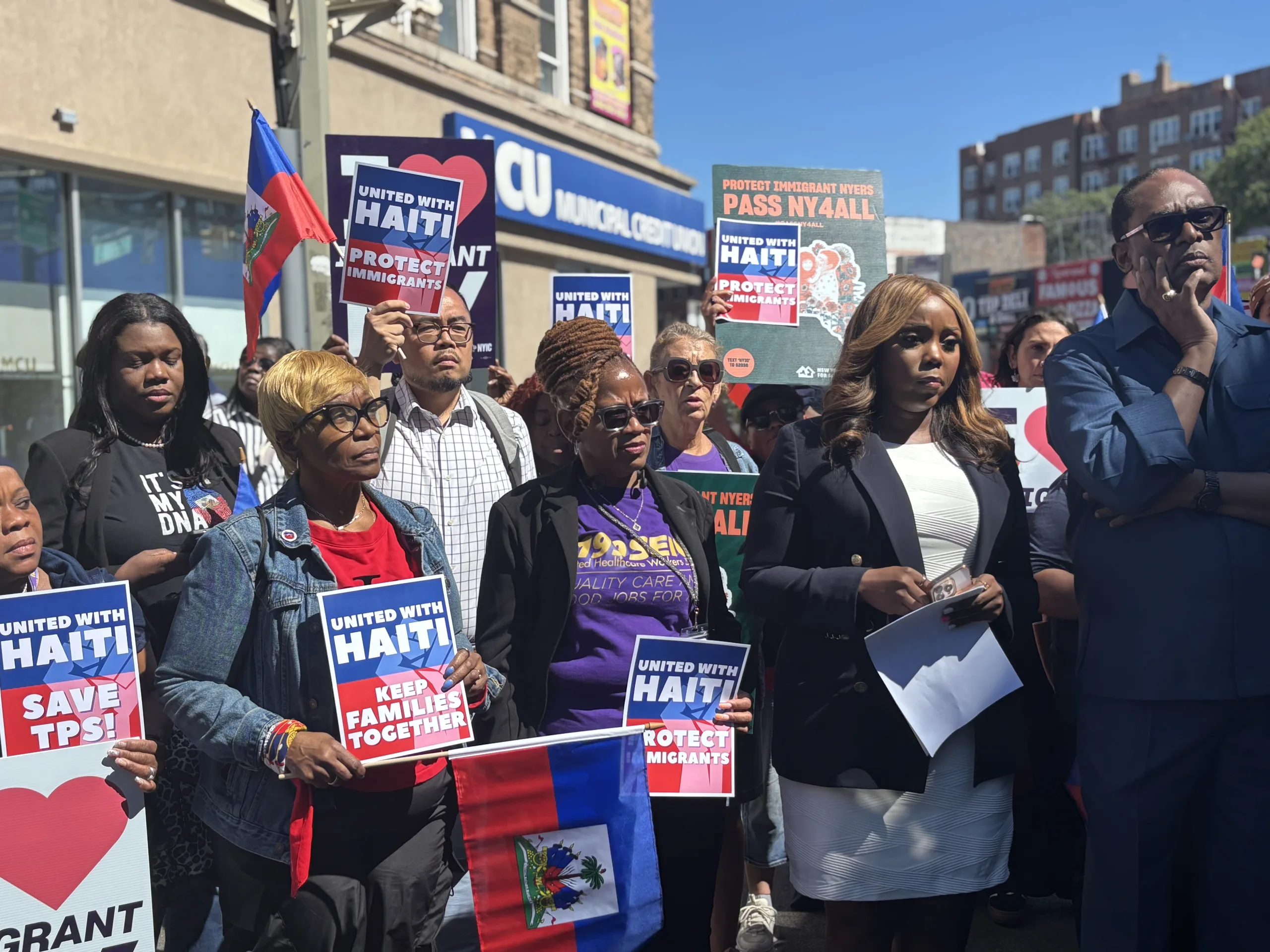


Local lawmakers gathered in Flatbush, Brooklyn, to call on the Trump administration to extend the Temporary Protected Status (TPS) designation for the estimated 500,000 Haitians who lack permanent legal status in the U.S., including thousands in New York City.
The rally on Aug 27 in Little Haiti was organized by Brooklyn Borough President Antonio Reynoso.
“We’re going to be here for the Haitian community in Brooklyn because the Haitian community has been here for us,” said Reynoso in an address to the crowd. “Our neighbors from Haiti came here in need of refuge from an intense string of disaster, crisis, and political instability, and we stand proudly by their side in calling for an end to the Trump administration’s effort to revoke TPS for Haiti,” he added in a press release after the event.

The rally came only days before September 2, the date the Trump administration had initially scheduled to end the TPS designation for Haiti. That plan, announced on July 1, was blocked by a federal judge in the U.S. District Court for the Eastern District of New York. The court upheld the validity of the TPS designation through February 2026.
The rally featured speeches from New York City councilmembers Farah Louis, Rita Joseph, Chi Ossé and Alexa Avilés, Public Advocate Jumaane Williams, as well as New York State assemblymembers Phara Souffrant Forrest and Monique Chandler-Waterman.
Also in attendance were representatives of Haitian community organizations, including Life of Hope, Haitian Americans United for Progress, and the Haitian Evangelical Clergy Association.
Temporary Protected Status (TPS) is a form of relief the government can provide to immigrants of certain countries it deems temporarily unsafe. It allows citizens of those countries to stay and work in the United States, but does not provide a path to citizenship.
Haitians have benefited from TPS in the U.S. since 2010, after a 7.0 magnitude earthquake caused widespread damage and casualties in the Caribbean nation. Since then, it has been extended by multiple federal administrations as the country continued to experience political instability and environmental disasters.
Following the U.S. Department of Homeland Security (DHS) Secretary Kristi Noem’s attempt at ending the designation in July, five Haitian TPS holders filed a class action lawsuit in a federal court in D.C. in an attempt to block the administration from ending the designation in February. Plaintiffs say DHS’s decision ignored ongoing danger in the country and was based on racist motivations.
DHS Secretary Kristi Noem recognized the situation in Haiti was dangerous, but said allowing Haitians to stay in the country would go against U.S. national interest. Noem argued that Haitian TPS recipients posed a threat to national security.
Haitian community members and advocates disagree.
“What is in America’s best interest? Tens of thousands of Haitian TPS holders are not a burden. They are a benefit. They are legal. They are working. They are our neighbors. They are co-workers and taxpayers who contribute to our economy every single day,” said Jocelyn McCalla, executive director of the Haitian-American Foundation for Democracy, in his speech during Monday’s rally.
New York City is home to the second largest Haitian-American population in the country after Miami, with over 150,000 Haitian residents. A significant portion of the community is concentrated in Brooklyn, particularly in Flatbush, a neighborhood commonly known as “Little Haiti.”
Speakers on Monday highlighted the importance of the Haitian diaspora in shaping the neighborhood’s culture and history, and emphasized Haitian TPS holders’ contribution to the healthcare system.
Speaking during the rally, Stephanie Delia, an immigration attorney and executive director of Little Haiti BK, framed TPS as an economic issue. “TPS recipients work, pay taxes, own property, buy from all of the stores and keep those stores alive,” she told Documented.
The economic impact of the administration’s immigration policies has already been felt in Flatbush. Since January, when President Donald Trump accelerated his immigration crackdown, immigrant neighborhoods across the country have reported declines in foot traffic and business activity. Delia said Flatbush has been no exception, with the situation worsening after the Trump administration’s move to end TPS.
“Everybody has seen a decline in traffic and a decline in sales as a result of the new immigration policies,” said Glenda Elie, co-owner of Anba Tonèl Restaurant Group, which operates a Haitian cafe and restaurant in Flatbush. She estimates her sales have dropped at least 30 percent since January, attributing the losses both to customers’ losing income when they can no longer work legally, and to others staying home out of fear of ICE raids.
Sony Sauveur, owner of Golden Blue Bar and Restaurant on Flatbush Avenue, said he has lost many of his regular Haitian clients. “When you call them, they say, ‘Oh, I miss your food, but I don’t want to go out,’” he said, adding that he isn’t sure how much longer his business can survive.
Documented spoke with Haitian TPS holders who expressed similar concerns but declined to go on the record by fear of retaliation from immigration authorities.
你知道吗?非公民办理驾照时的这个错误可能会导致选民欺诈
Farah Louis, city council member representing the 45th Council District in Brooklyn, which encompasses parts of Flatbush and Little Haiti, said she has been hearing the same reports coming from her constituents, many of which now refuse to leave their homes out of fear of an encounter with U.S. Immigration and Customs Enforcement (ICE). “A lot of them want to know if they should self-deport, if they should leave. And we’re telling everybody, stay in place,” she said.
Louis said her office has been holding Zoom meetings with her constituents to discuss their rights, and distributing literature on how to interact with law enforcement.
“We need everybody to come together to make sure we’re pushing back,” she said.