

22-year-old Venezuelan musician Angel Blanco Marin didn’t give up songwriting while inside one of the world’s most feared prisons: the Terrorism Confinement Center (CECOT) in El Salvador. The rest of what he remembers from that place is closer to a nightmare — beatings, kicks, and abuse.
Now back home in Valles del Tuy, Venezuela, Ángel spoke to Documented via video call about the exact day he arrived at El Salvador’s notorious mega-prison. He says he was shackled hand and foot, aboard a plane carrying dozens of Venezuelan migrants who were being deported from the United States to El Salvador under a $6 million agreement. Ángel didn’t want to get off the plane — but officers made him, with forceful blows.
“They wouldn’t stop beating and kicking us,” he told Documented, shortly after returning home to his family. “They hit us every day — if we didn’t shower, or if we made noise. That memory is going to stay in my head forever.”

Following recent negotiations between Venezuelan President Nicolás Maduro, Salvadoran President Nayib Bukele, and President Donald Trump’s administration, Ángel arrived at Simón Bolívar International Airport in Maiquetía around 7 p.m. on Friday, July 18. When Venezuelan minister Diosdado Cabello welcomed the hundreds of released detainees in Caracas, about a 30 minute drive from the airport, he told them they had been exchanged for “murderers.” He was referring to the 10 jailed U.S. citizens the Venezuelan government offered to Trump’s administration in exchange for the release of more than 200 Venezuelans held at CECOT.
Among the Venezuelans released was 20-year-old Merwil Gutiérrez, whose case has drawn the attention of New York lawmakers. On February 24, Merwil and Ángel were arrested, along with their friend Joen Suárez Fuentes, 23, in front of a building on Fordham Road in the Bronx. They were later transferred to CECOT on March 15.
From the moment the plane landed in El Salvador, a violent chapter began in Ángel’s life. He says he was the first to be forced off the aircraft, immediately kicked as he was dragged toward a bus. Once on the bus, the officers began beating him with a baton. Everyone else met the same brutal fate. And no one knew what was going to happen to them next.
“We never knew where we were or where we were going — the entire trip we were forced to keep our heads down,” Ángel said. As soon as they arrived at CECOT, their heads were shaved, they were stripped naked, and given prison uniforms. “They wouldn’t stop beating and kicking us,” he alleges.
They eventually arrived at the cells where they would spend the next several months of their lives — a place where they were forced to sleep on aluminum sheets, without mattresses.
Every day was like clockwork. The inmates were woken at 4 a.m. and made to shower. They were given breakfast at 5:30 a.m., lunch at 11:30 a.m., and dinner at 3:30 p.m. The rest of the time, Ángel says he was just very hungry. At first, they were given only tortillas and beans, but a few days later the food improved significantly. What never changed, however, were the incessant beatings.
They endured four months of terrifying uncertainty, not knowing when or if they would ever be released. On July 17, the day before their return to Venezuela, they were given razors to shave and bundles of clothes to change into. They already suspected something was happening. Later, they found out they were going home.
“When they gave us the news, we started singing the Venezuelan national anthem,” Ángel recalls.
The memory of an arrest in the Bronx
Although it remains difficult for him, Ángel remembers the night authorities arrested him on February 24 in the Bronx — a scene Documented originally reconstructed using witness statements. But now, Ángel can tell his story firsthand.
He had arrived with Merwil and Joen in Joen’s car at 2348 University Avenue building. When Ángel and Merwil got out of the car and crossed the street, two officers approached them. “They grabbed us and handcuffed us. We asked for an explanation — why were they taking us, was it a mistake? But they didn’t respond,” Ángel recalls.
Then, according to Ángel, several patrol cars quickly arrived on the scene. The officers approached Joen and asked for his driver’s license, which he did not have. They then took all three to Police Precinct 52, located on Webster Avenue.
“We said we wanted an explanation, but they wouldn’t tell us anything,” Ángel says.
Like the other Venezuelans who were sent to El Salvador, Ángel was accused of belonging to the criminal gang, Tren de Aragua. The only evidence authorities cited were the tattoos on his body.
“I kept telling them I didn’t belong to any gang, but the officers slammed their fists on the table and told me not to lie,” Ángel says.
Also Read: Arrested by the NYPD but Not Prosecuted, They’re Now Imprisoned in El Salvador
The next morning, Ángel says he was taken to Precinct 44, near Yankee Stadium, where he was released — but his cellphone was not returned. He went out onto the street, took the train, arrived home, showered, had dinner, and went to bed. The following day, he went back to the precinct to retrieve his phone. When he left the building, some officers started staring at him intently.
“I started walking fast, out of fear, and when I looked back, I realized they were chasing me,” he said.
Ángel was eventually detained, but when he asked for the reason, the officers did not respond. Instead, they asked about his immigration status. Ángel said he was a beneficiary of Temporary Protected Status (TPS), a program that has helped over 600,000 Venezuelans in the U.S. — a program that Donald Trump halted on his first day in the White House.
He was transferred to the Federal Plaza building in Manhattan, where he was accused of being part of theHijos de Dios gang. “I told them it was a lie,” Ángel says.
He later learned that he was also accused of car theft and armed robbery, but Ángel denies any involvement in such incidents. Public records show he was facing charges in Brooklyn Criminal Court from a November 2024 incident of reckless driving in a vehicle that caused a collision and was allegedly stolen.
Venezuelan minister Diosdado Cabello stated that out of the group of detainees, only seven have serious criminal records in Venezuela. Ángel was not one of them.
Ángel was then transferred to a detention center in Pennsylvania and later to the El Valle Detention Center in Texas. On March 15, he boarded a plane reportedly bound for Venezuela. At the time, his father told Documented that he was waiting for him with balloons and that he had painted the room where Ángel used to sleep and lovingly compose his songs.
His father went to the Caracas airport to wait for his son, but Ángel never arrived. Later, it emerged that a group of Venezuelans had been sent to El Salvador, bypassing a court order that had temporarily blocked deportations. The Trump administration, it turns out, had resorted to the 1798 Alien Enemies Act to justify the expulsion of immigrants it considered “enemies of the country.”
Ángel’s father only learned that his son was among those sent to CECOT when he saw a list of names published by CBS News. The U.S. government never published an official list of the individuals deported to El Salvador, nor did it notify any of their families. Throughout all of this time, neither Ángel nor anyone else being held at CECOT, was able to communicate with their relatives or lawyers.
“I’m going to try here, in Venezuela”
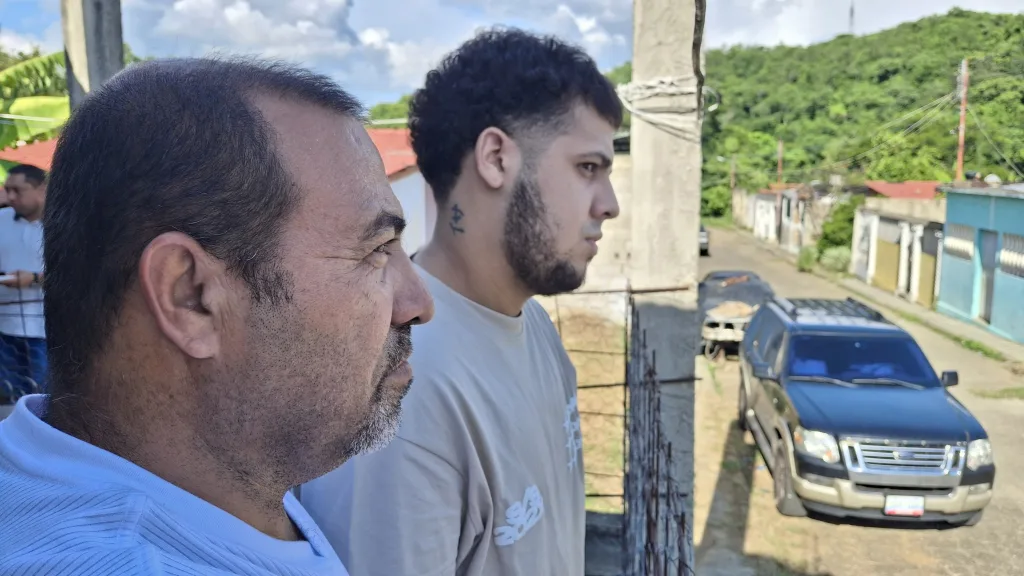
Ángel’s father, Ángel Blanco, who has been fighting for his son’s release since the moment he knew he had been taken, learned of his return mere hours before the plane landed.
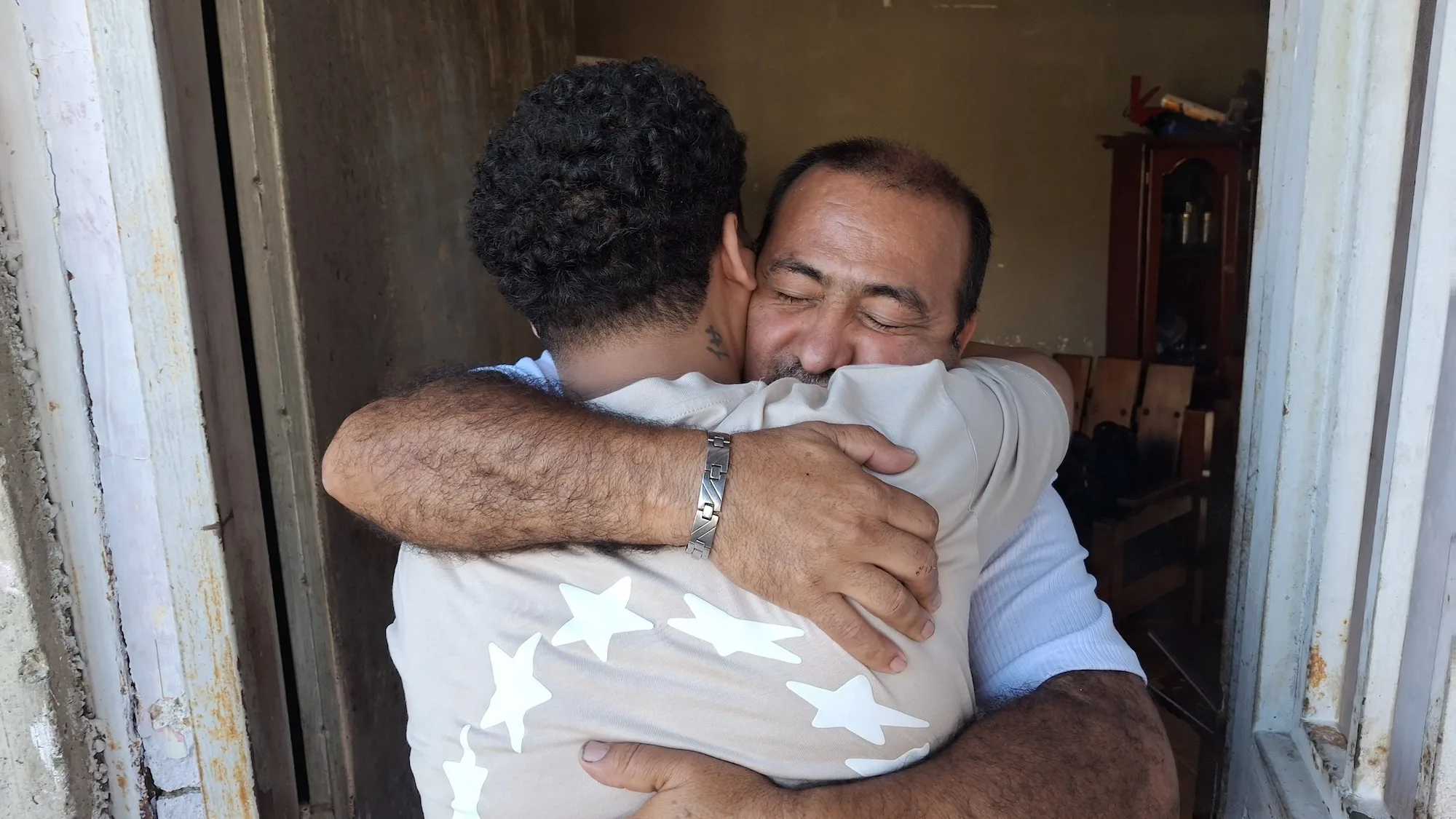
“I’m very happy,” Ángel’s father told Documented. “I was able to see my son, hold him tight, kiss him, and I cried a lot with him. I thanked God.”
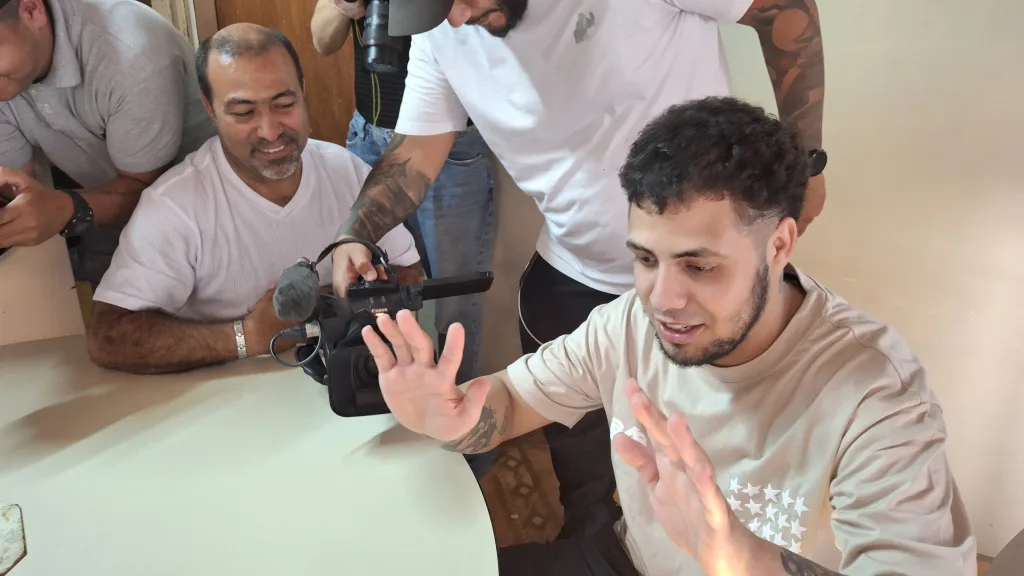
Several videos, which were shared with Documented, capture the emotional moment when Ángel and his father reunited for the first time in years. This was also the first time in months since before Ángel was apprehended that the two of them had been able to have a conversation.
Now, from his home in Valles del Tuy, Ángel appears calm. “I’m happy and grateful to be back home, thank God,” he says.
His father hurried to prepare the room where Ángel would sleep. He bought a new air conditioner because the old one was worn out. He put up new curtains and even got a more comfortable mattress.
Even so, Ángel doesn’t deny that he’s still struggling to come to terms with everything he’s experienced. “I’m still in shock,” he said. “One day I was in New York, then I was at CECOT, and today I’m in Venezuela. I never thought I’d come back home.”
He misses New York, his friends, and his job as an Uber Eats delivery driver.
“I’m happy because I wanted to see my family, but I’m also sad — I have to start over again. I was doing well in New York, I had my money, my home,” Ángel says. “I miss the city so much. I loved my life there, I miss the people — I felt that was my home.”

你知道吗?非公民办理驾照时的这个错误可能会导致选民欺诈
For several weeks while at CECOT, Ángel dreamt about returning to the United States and picking up the life he left behind. But not anymore.
“After the beatings, after everything that happened, I changed my mind. I’m going to try here, in Venezuela,” Ángel says.“