

In the wake of the state’s failure to pass workplace heat protections this legislative session, labor rights advocates are calling a memo that urged lawmakers to vote against the bill racist.
The memo, which was exclusively shared with Documented, was penned by the New York Farm Bureau (NYFB), the state’s largest agricultural industry lobbying group in 2024. In it, the NYFB claimed that claimed that the Temperature Extreme Mitigation Program (T.E.M.P.) Act, legislation that would require employers to adhere to heat-specific standards for employees in outdoor and indoor worksites that experience a heat stress threshold of eighty degrees Fahrenheit or more, would set “impractical standards” for the agricultural industry.
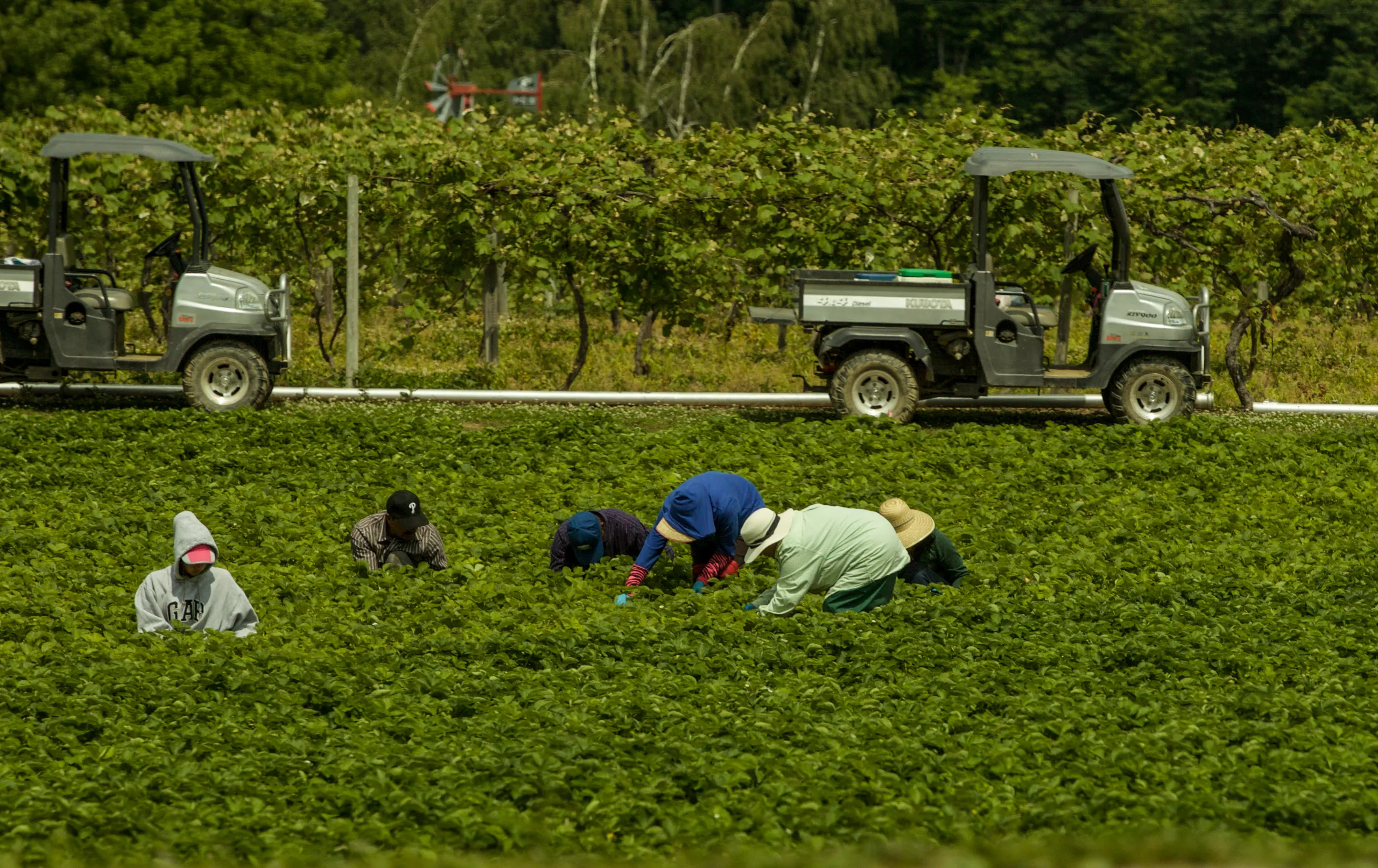
In the memo, NYFB also argued that because many of the state’s agricultural workers migrated from warmer countries, they would be able to tolerate New York’s summer climate.

“It must be mentioned that many agricultural workers come from very weather countries (sic), via the federal H2A program, such as Mexico and Jamaica, and working (sic) and would feel very comfortable working in New York in the summertime,” the memo stated.
Gabriella Szpunt, the New York Organizing Coordinator for the United Farm Workers (UFW), which has organized over 500 farmworkers into their union at five farms across the state, found the language used in the bill to be racially charged.
“Workers from Jamaica and Mexico are human beings like everyone else, which means they need what has been proven to save lives: shade, water, and paid rest breaks, to be safe, while performing physically strenuous work during dangerously high temperatures,” she said in a statement to Documented. “Any suggestion otherwise is racist.”
Charlene Obernauer, executive director of the New York Committee for Occupational Safety and Health (NYCOSH), who was one of the Temp Act’s main supporters, also condemned NYFB’s statement.
“An organization whose main argument against life-saving worker protections is based on scientifically inaccurate racial pseudoscience should have no credibility with the NYS Legislature,” she said in a statement to Documented.
Amanda Powers, the New York Farm Bureau’s Director of Communications, pushed back on accusations of racism.
“It is deeply disturbing to the New York Farm Bureau to hear untrue allegations of racism,” she said in a statement to Documented. “We strongly denounce racism, as supported by our longtime record of support for immigrant farmworkers and farmworkers of color.”
Despite NYFB’s assertion that immigrant farm workers can tolerate New York summers, studies have shown that heat stress-related injuries disproportionately affect immigrant workers who are often employed in outdoor, physically-demanding industries like agriculture.
A 2024 report released by New York City Comptroller Brad Lander found that in New York City alone, 580 people prematurely die from heat-related causes annually. Lander’s report also found that a third of the city’s workforce worked outdoors for prolonged periods, with a vast majority of those workers being non-citizen immigrants.
The NYFB’s claims are nothing new. Pseudoscientific theories about non-white laborers’ ability to withstand extreme heat date back centuries. In 1851, Samuel Cartwright, a Louisiana physician, justified the enslavement of Africans in a letter to U.S. Secretary of State Daniel Webster, claiming that white people are naturally unsuited to work on hot cotton and sugar plantations but for the enslaved Africans the work “proves to be only a wholesome and beneficial exercise to the negro.”
Chinese laborers in Hawaii sugarcane fields were also viewed as being more adaptable to the harsh climate than white laborers. Japanese fruit pickers in California were believed to “endure the heat found in a few localities better than most other races.” Mexican laborers who worked in the smoldering Pennsylvania steel mills in the 1920s were also believed to “endure heat well.”

你知道吗?非公民办理驾照时的这个错误可能会导致选民欺诈
Yet, a 2019 study by the American Journal of Industrial Medicine found that Black construction workers were 51% more likely to die from heat, while Latino workers were 91% more likely to die from heat-related illnesses.
Emma Kreyche, Director of Advocacy, Outreach, and Education for the Worker Justice Center of New York, says that outdated racial views about immigrant workers are an example of why the passage of the Temp Act is important.
“The notion that workers’ race or national origin somehow negates the need for basic protections in the face of extreme temperatures is patently absurd,” she said in a statement. “The TEMP bill calls for very common-sense measures to prevent heat-related illness among vulnerable workers, requiring that they have the opportunity to rest in the shade and hydrate throughout the day.”