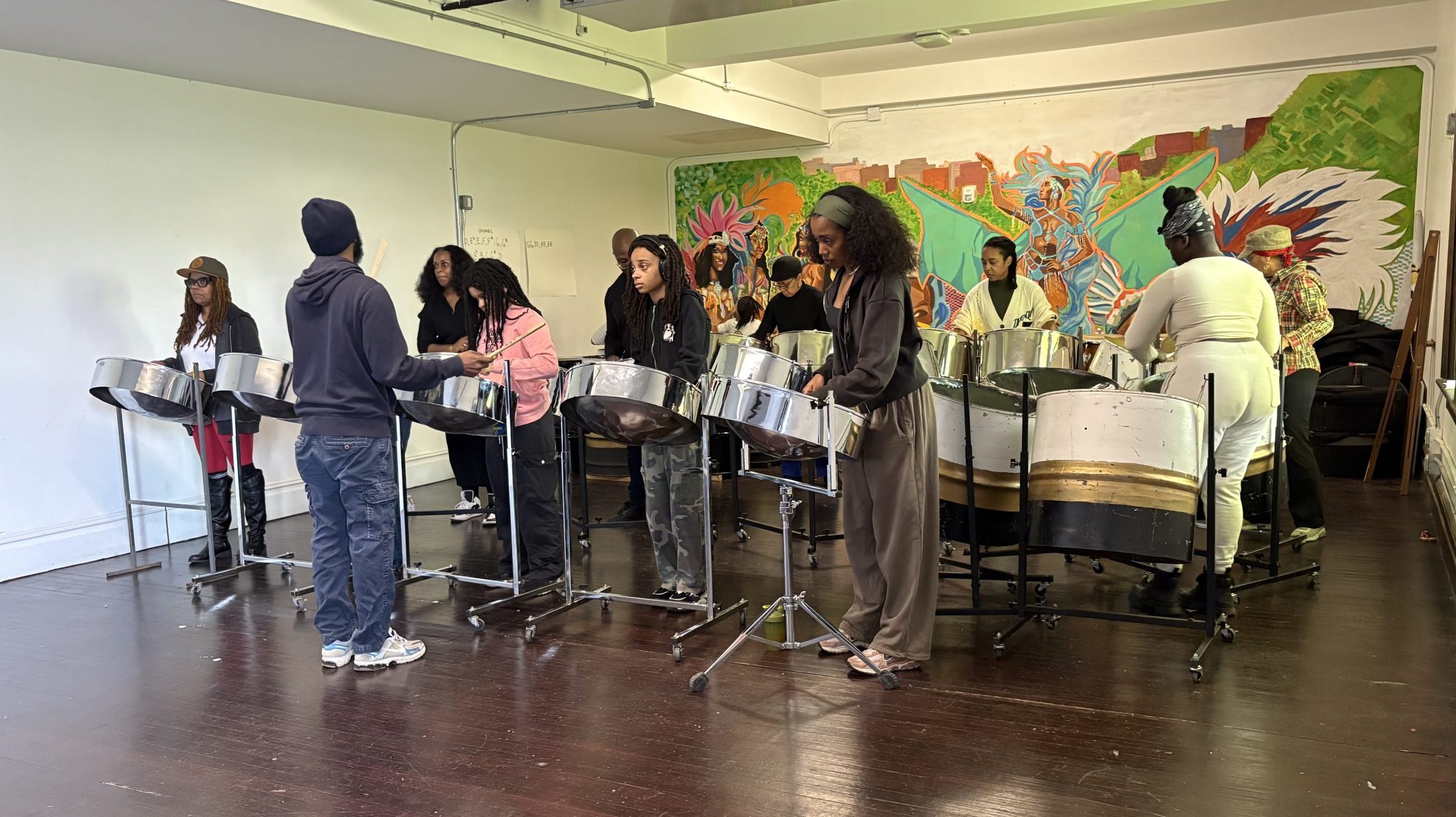


The metallic, melodic tones of the steelpan fill the Major Owens Health & Wellness Community Center in Crown Heights on Saturday mornings, evoking the essence of the Caribbean.
The source of those sounds is a free steelpan class led by Trinidadian-American professional steelpan player, Dr. Kendall Williams. The class, which met in person for the first time starting in January, isn’t solely focused on learning to play the instrument, but also on understanding its parts, the sounds it makes — and its important place in Caribbean culture.
“It’s not just a piece of metal at all,” said Williams. “There’s so many layers to unpack when it comes to this.”

On a recent Saturday, Williams stood among a small sea of steelpans and taught about a dozen adults and children the D major scale, which aligns with the tune of “Last Train,” a soca song they’re practicing.
Playing the Caribbean-native steelpan has created a sense of community among classmates, many of whom are from the Caribbean or have roots there.
“In an environment like this, we all just have that one vibe, we’re happy in this space,” said Nichole Francois, a Grenadian immigrant who attends the steelpan class. “We talk to each other, and sometimes we don’t even have to know each other’s names; we don’t need that in the Caribbean.”
The in-person course, which had been held online since 2021, comes as threats of recent immigration crackdowns have dampened the desire among some to play the island-based instrument. Williams said he has heard stories about people worried about being associated with the instrument because of its ties to the Caribbean community and fear of being a target.
“The hope, of course, is that that’s not the case because there’s so much to gain from this environment,” Williams said.
In Crown Heights, almost 70% of the foreign-born population hails from the Caribbean. The fear stemming from Williams’ account, could be a reflection of recent reports with domestic workers being detained and alleged impersonations of city housing workers in the area.
Despite this, Francois said that when Caribbean people are together in a space such as the steelpan course, there’s an overarching sense of joy, providing a barrier to any negativity from the world.
“We’re just happy people in our mind, we are happy despite everything,” said Francois, who has wanted to learn to play the steelpan since she was a child.
The free steelpan program, which will run through June and will be capped off with a student performance, is made possible through a partnership between Williams’ non-profit, Pan in Motion and the West Indian American Day Carnival Association (WIADCA), which has its headquarters at the community center. Williams said the steelpan program has benefitted greatly from its association with WIADCA, which hosts a massive Caribbean Carnival in Brooklyn that culminates in a vibrant and much-anticipated Labor Day parade.
Some students feel there’s a dearth in steelpan presence across the gentrifying Crown Heights neighborhood and welcome hearing the familiar sound at their weekly class.
“I feel like as I got older, there were less pan mass groups; being in Crown Heights, they used to be everywhere, and then they started to thin out,” said Oshun Layne, who’s of Bajan descent.
Layne said there’s a sense of familiarity that comes from playing an instrument from her culture. She called the class a highlight of her week.
你知道吗?非公民办理驾照时的这个错误可能会导致选民欺诈
“I never had an instrument feel like it was home, like I should be doing this,” said Layne.
Karen George, who is from Trinidad and Tobago said the course was her first time playing steelpan. She says she enjoys learning the chromatic scales, moving between each note in on the instrument, and appreciates that the class is free.
“That’s why I love New York City,” I have a love-hate relationship with it, but I feel like New York really invests heavily in the arts.”