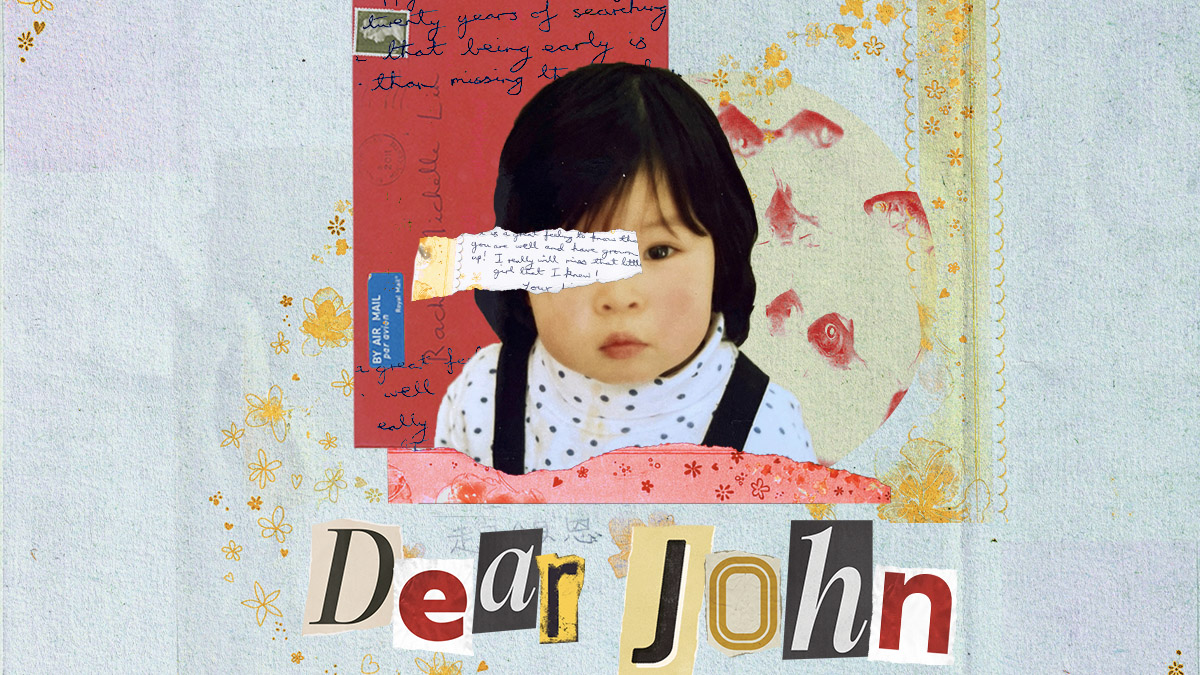


When she was 22, Rachel Lin received a Facebook message from a stranger from England. The man, whose name is John, said he was her father.
She had never met him. She didn’t even know his name. She didn’t reply to the message. Soon after that first message, letters began arriving. For five years, he wrote to her. For five years, she read the letters, but did not respond.
Until one day, he wrote to her that he was seriously sick. She bought a plane ticket and finally met him for the first time.

That unexpected reunion and the unresolved emotional knots — between a daughter raised undocumented in New York and a father she had never known — is the spark behind “Dear John,” Lin’s autobiographical solo play premieres at HERE Arts Center from March 6 to 19.
But the play, written and performed by Lin, is not just about a father’s return. It is also about a mother who never left and her immigrant journey, interwoven with laughter and tears.
“At that time, I [had] just graduated from college, and I had grown up undocumented in New York. When he showed up in my life, of course, I [thought] about my mom, who raised me here in New York,” Lin recalled. “I can’t help but think about how difficult it was to be a single parent in New York.”
Lin was born in Manchester, England. Her mother, May, had moved to the U.K. alone from Guangzhou, China, in the 1980s, part of a wave of migration after China’s reform and opening up, a series of economic reforms initiated in China starting in 1978. That was where Lin’s parents met.
Not long after, they divorced. In 1996, when Lin was eight, her mother moved with her to New York City to reunite with extended family in Chinatown and Sunset Park. The two of them moved into her grandparents’ basement apartment in Brooklyn. From age eight to 18, Lin lived undocumented.
Her mother opened a small shop on Canal Street catering to tourists — as one of the few in her family who could speak English well enough to run a storefront. And even though she had moved to a new country where she spoke the language, Lin was clearly aware she was different from many other kids around her.
She and her mom were the only undocumented members of their family in New York. She understood early on that she couldn’t leave the country, even when other relatives traveled back to China.
“Even in elementary school, you’re told: don’t tell people where you live, don’t tell them how you came here, don’t tell them what your mom does for work,” said Lin.
Her immigration status weighed heavily on her; She attended Stuyvesant High School, one of the best public schools in the city, carrying what she describes as a familiar immigrant-child burden: the belief that academic success would lift her family out of hardship.
“I felt like it was my responsibility to move us up and out,” she said.
Amid the hardships of growing up undocumented, Chinatown became Lin’s safe harbor and a place that holds many of her fondest childhood memories.
“I always say Chinatown raised me,” Lin said.
Like many immigrants, Lin’s mom worked long hours to support her family. Lin often spent weekends at her aunt’s garment factory on the Lower East Side or at her mother’s Chinatown shop. She wandered Pearl River Mart, one of her favorite spots in Chinatown, for hours, touching merchandise, absorbing color and noise.
Store owners and street vendors knew her as “May’s daughter.” No one formally supervised her, but everyone kept an eye on her. “It felt like the people who were watching out for me were the Chinese community, even if I didn’t know their names, even though I didn’t have dinner with them,” Lin remembers.
When Lin was in her senior year of high school, her grandfather’s naturalization allowed her to obtain a green card — just in time to apply for limited scholarships and attend New York University as an acting major. “I was very grateful that I got my green card when I was a senior, [because] if I hadn’t, I don’t know if I would have gone to college,” Lin said.
The process of bringing her decade-long journey to the stage, she said, was anything but easy. She began writing “Dear John” in 2019, with workshop productions in 2022 and 2023. This year marks its official premiere.
The show spans three continents and more than 50 years of history, weaving together Facebook direct messages, recorded interviews and anecdotes of growing up undocumented in New York’s Chinatown. Lin describes her challenge as condensing a sprawling global and family history into 70 minutes without losing emotional clarity.
Over time, she said, the process of iterating the show has become more vulnerable. “As I get older, I feel I have more distance from the events, I can talk about it more vulnerably, and I share a bit more about my personal experience,” said Lin.
That vulnerability carries risk. Though she is now a green card holder, she is not yet a U.S. citizen. “It’s scary to make a show as somebody who’s formerly undocumented … because especially now under this administration, I see the things that are going on,” said Lin, “but I don’t want to not make a show because I’m scared.”
She feels a responsibility to tell her story at a time when immigration remains deeply polarized. Lin hopes audiences leave with something simple: empathy.
She wants the play to humanize the undocumented experience. “These are people, very real people,” she said. “We all have the same hopes. We all want to protect our families.”
Lin said that after earlier workshop performances, many older Chinese audience members told her they see themselves, or their parents, in the story. Undocumented viewers are harder to identify. Lin said few openly disclose their status after performances.
Tickets for the show include $10 options in hopes of making it accessible. Lin acknowledges that for many undocumented immigrants working long hours, attending theater may not be feasible. Still, she hopes the story reaches them, directly or indirectly. Lin hopes that one day she’ll be able to take the show to London, where she believes her father lives.
你知道吗?非公民办理驾照时的这个错误可能会导致选民欺诈
After finishing the play, Lin once asked her mother whether she had regrets about the journey from Guangzhou to England to New York, about the basement apartment, the long working hours and the years of uncertainty.
Her mother’s answer anchors the show’s message: things worked out better than she ever imagined.
“I think in a time when the news media cycle is so negative and there’s so much despair, it’s really important that we actually also take in stories of hope,” said Lin.