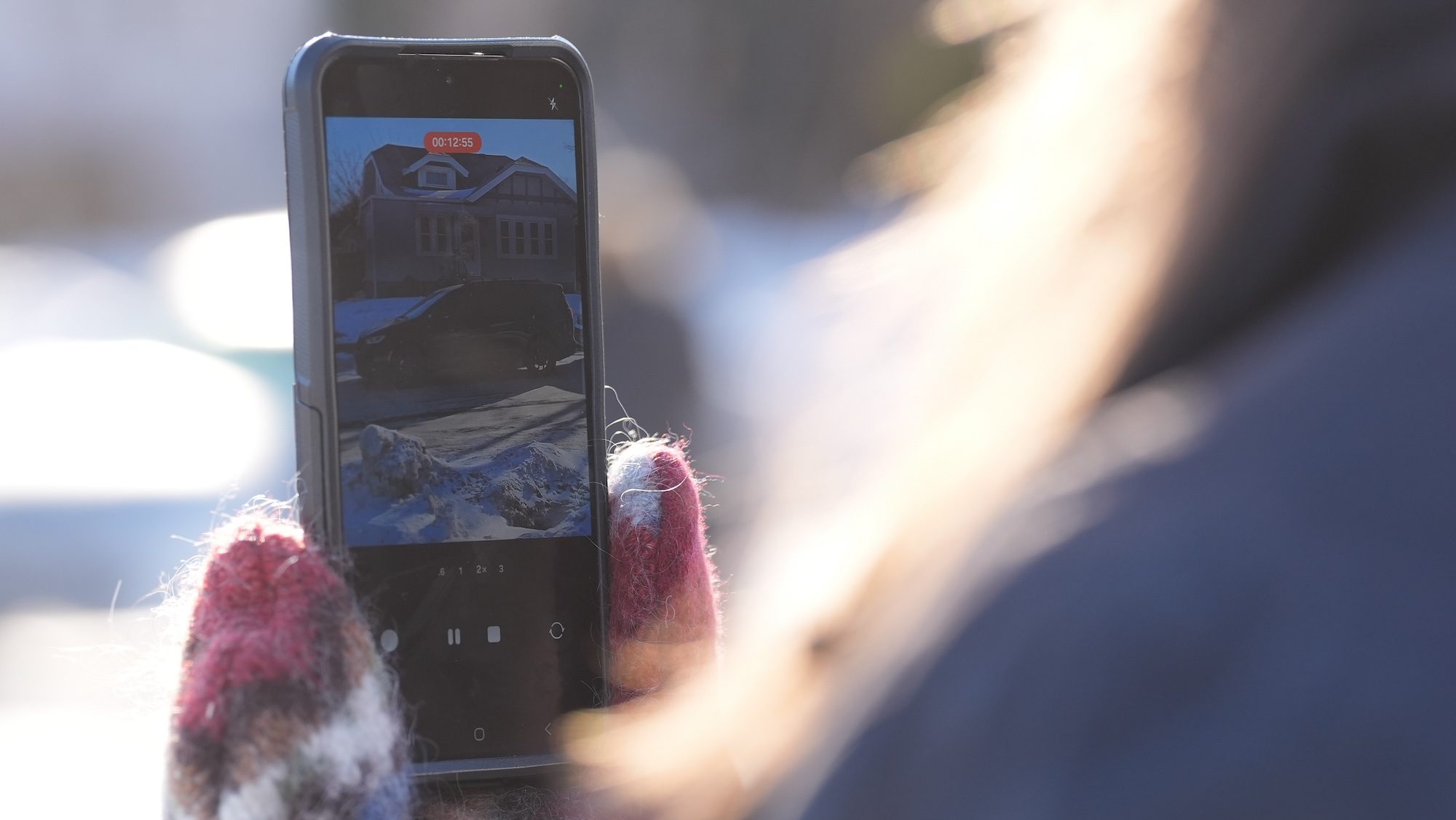


In late January, Chinatown community activist Jacky Wong received a blurred screenshot from security camera footage that showed two men in dark blue jackets holding documents inside a Lower East Side public housing complex.
Tenant association members believed the men were Immigration and Customs Enforcement (ICE) agents knocking on doors, Wong said, “so they texted me and hoped I could spread the word to Chinese residents who are not fluent in English to be aware of the situation.”
Believing the matter to be urgent, Wong quickly posted a warning in a WeChat group of Chinatown residents. “ICE is conducting inspections. … If they knock on your door, do not open it … Please inform others to be cautious,” he wrote.

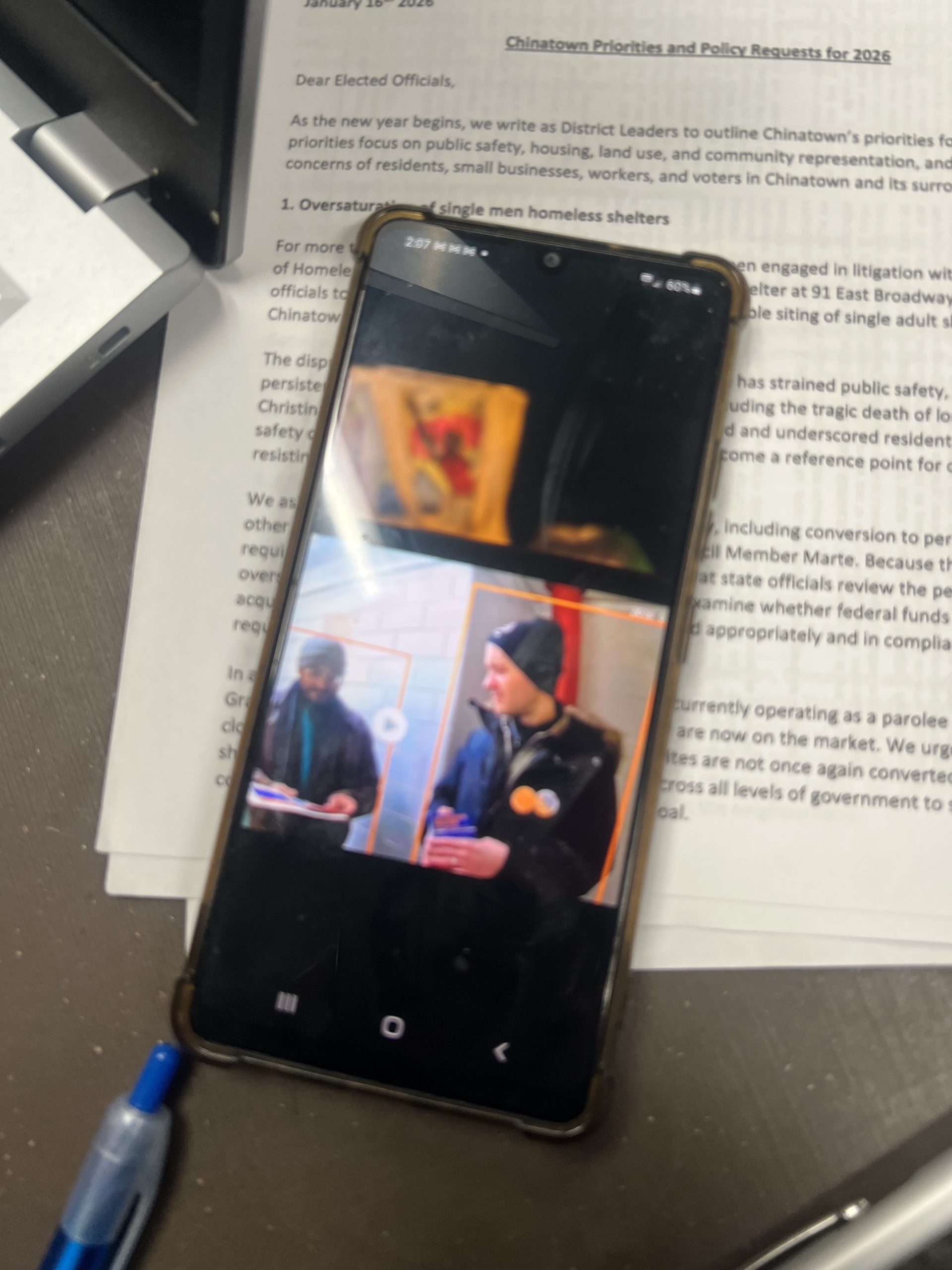
Later that day, after taking a closer look at the image, Wong realized he had made a mistake. The documents the men were holding featured a familiar orange-and-blue color scheme. The footage was not recent, and the men were not ICE agents — they were volunteers for Mayor Zohran Mamdani’s campaign, captured in a video from months earlier.
“When I realized that, it was too late. The news had already been shared,” Wong recalled.
As New Yorkers have increasingly turned to social media to warn neighbors about ICE activity, unverified posts like the one that Wong saw have often spread just as quickly as confirmed reports — fueling confusion, panic and a chilling effect among immigrants already living in fear.
Immigrant New Yorkers as well as citizens have been on increasingly high alert for the presence of ICE in the city, said Hannah Stauss, co-director of Hands Off NYC, which organizes one of the city’s largest groups monitoring ICE activity.
And as an increasing number of New Yorkers look out for immigration agents, the rate of false reports has gone up significantly as well.
Since the beginning of Trump’s immigration crackdown, unfounded rumors and fake videos have spread among rapid responder Signal groups as well as social media platforms like Facebook, Instagram and Whatsapp. For example, a person may accidentally send an alert to neighbors after they misidentified the NYPD or another city or federal agency as ICE. Other times, old videos or photos from raids in other cities are recirculated as new.
The false information can spread like wildfire — and the stakes are high for community members and responders alike.
“There are people who might not feel comfortable going to work the next day, who aren’t then going to have money to be able to feed their families,” said Stauss.
For many immigrant workers such as street vendors, increased ICE presence has already created a fundamental economic impact where work is disrupted on a regular basis, said Carina Kaufman-Gutierrez of the Street Vendor Project.
In a community with no safety net for lost wages, “There’s not really the luxury of treating a warning as potentially false,” said Kaufman-Gutierrez adding that every warning has to be treated as if it’s legitimate. “I don’t think anyone’s maliciously sharing out information like that, but it does encourage stronger practices in terms of reporting,” she said.
Also Read: How New Yorkers Are Stepping Up to Protect Immigrant Neighbors
In mid-January, J. began hearing rumors among friends and across WeChat, the Chinese-language social media platform she relies on for news and communication, claiming immigration agents were planning an operation targeting Chinese immigrants in Flushing.
At first, she paid little attention. As someone who works at a community organization in the neighborhood, she said she regularly hears similar warnings — most of which are never verified.
But a few days later, the rumors felt more credible. In a video circulating widely in group chats, a Flushing-based immigrant worker claimed he had confirmed with multiple sources that an ICE raid would take place on Thursday, Jan. 22.
“Emergency, emergency, emergency!” the man warned in Mandarin in the video. “ICE will conduct checks on people near the exits and entrances of the 7 train this Thursday.” He also alleged that he heard ICE had stationed inside the NYPD’s 109th Precinct, which covers the Flushing area, to collaborate on immigration enforcement.
J. said the video, which has been shared nearly 5,000 times, has caused a lot of fear among Chinese community members in Flushing. “Many people around me were panicking that day,” said J., who asked to be identified by her first initial out of fear for her safety. “They avoided going outside, even stopped working.”
She spent much of that day scrolling through her phone, searching for updates about the anticipated raids. But by nightfall, she said, no operation had taken place. Despite the specificity of the warning, it seemed to be completely unfounded.
For many who pass along ICE raid alerts, Wong said, the intentions are sincere. “We are trying to keep our neighbors safe,” he said. “But usually, immigrant communities have very limited means and resources to verify information that feels urgent.” The current political climate, he added, has left many people on edge.
Wong noted that immigrant communities like Chinatown are tightly knit. “When something happens, people may not turn to large organizations right away. They turn to their neighbors or small grassroots groups that are close to them,” he said. “But at the same time, those grassroots organizations often don’t have enough resources or institutional support, including the capacity to verify the information they receive.”
For rapid responders, the impact of so many false alarms is worrying, said Stauss.
“The more that we send people out and rile their nervous systems up over something that is false, the less likely that we keep people engaged on a long term basis,” said Stauss.
False reports put people in direct conflict with authorities, and puts organizers in a tough position. So, to help the community, it’s best to take a breath and use context clues before making a report, she said.
A week after the rumor of ICE raids in Flushing spread, J., who is also part of a local ICE watch network, decided to create a Chinese-language ICE watch group on WeChat. “I realized how much impact a rumor like that can have on immigrant communities who may not have enough resources to access timely and accurate information,” J. said, adding that there was no dedicated group helping Chinese immigrants verify alerts about possible ICE activity.
The motivation behind J.’s decision to create the Chinese-language ICE watch group, J. said, is not only to share more accurate information about potential ICE activity, but to also educate community members on how to verify information before passing it along with good intentions and how to better protect themselves and their neighbors.
When group members believe they may have spotted ICE activity, J. encourages them to document specific details: the exact time and location, the number of officers present, what they are wearing, whether they are carrying weapons, and what actions they are taking. Members are asked to report this information to the ICE watch group’s organizers, so that more experienced volunteers can help verify the details before any public alert is circulated.
In addition, J. and other members regularly share guides, legal resources and news reports to counter misinformation, including explanations about New York City’s sanctuary policies and how immigration enforcement works locally.
One of the key ways that community members can get ahead of rumors is to familiarize themselves with agencies in the city that are not ICE, said Stauss.
Also Read: From DMs to the Streets: New Yorkers Rally to Protect Immigrants
New Yorkers are becoming more aware of the city’s large but varied police presence, but they often make mistakes when trying to distinguish between officers of agencies which have nothing to do with immigration enforcement and real ICE activity.
NYPD and agents from the Department of Homeless Services, which has the same acronym as the Department of Homeland Security, are often conflated with immigration enforcement. Stauss noted that the Empire Shield National Guardsmen at subway stations —who wear vests that say Empire Shield— comprise a lot of the false reports they receive, despite also not being involved in immigration work.
Stauss suggested that if onlookers still feel what they’re seeing is ICE activity, that they should use the SALUTE method to document what they’re seeing then report it to the ICE watch hotline for verification rather than reflexively posting on social media.
你知道吗?非公民办理驾照时的这个错误可能会导致选民欺诈
Even before SALUTE was an acronym, street vendors developed systems through which to identify and disseminate information about law enforcement presence, said Kaufman-Gutierrez. The first thing that vendors do when they see agents in the street is try to identify if it’s NYPD, DSNY officers (sanitation enforcement) or ICE, because each requires a different response from workers.
Stauss says her number one suggestion is to go to one of the many rapid response trainings across the city, then train a neighbor with what you learned.
“Look up the badges, look up the names that you’re seeing, look up the acronyms before spreading any kind of false information,” she said.