

After 28 days, New York’s largest and longest nurses’ strike may be coming to an end.
On Monday, following a late night of negotiations, 10,500 striking nurses at Montefiore Medical Center and Mount Sinai Health System reached tentative agreements with the hospitals. Negotiations with NewYork-Presbyterian are ongoing.
The nurses union, the New York State Nurses Association (NYSNA), and the Montefiore and Mount Sinai hospitals agreed to terms that the union says satisfy their key demands. Among them are enforceable safe staffing standards, health care protections, protections against workplace violence, and a salary increase of more than 12% over a three-year contract. Nurses are expected to vote on whether to ratify the contracts and return to work this week.

“For four weeks, nearly 15,000 NYSNA members held the line in the cold and in the snow for safe patient care,” said Nancy Hagans, NYSNA’s President, in a statement. “Now, nurses at Montefiore and Mount Sinai systems are heading back to the bedside with our heads held high after winning fair tentative contracts that maintain enforceable safe staffing ratios, improve protections from workplace violence, and maintain health benefits with no additional out-of-pocket costs for frontline nurses.”
Before reaching Monday’s agreement, the hospitals were refusing to budge on some of the union’s key demands, including lower staffing ratios and protections against workplace violence that include enhanced security. The hospitals did not immediately respond to requests for comment on the agreements.
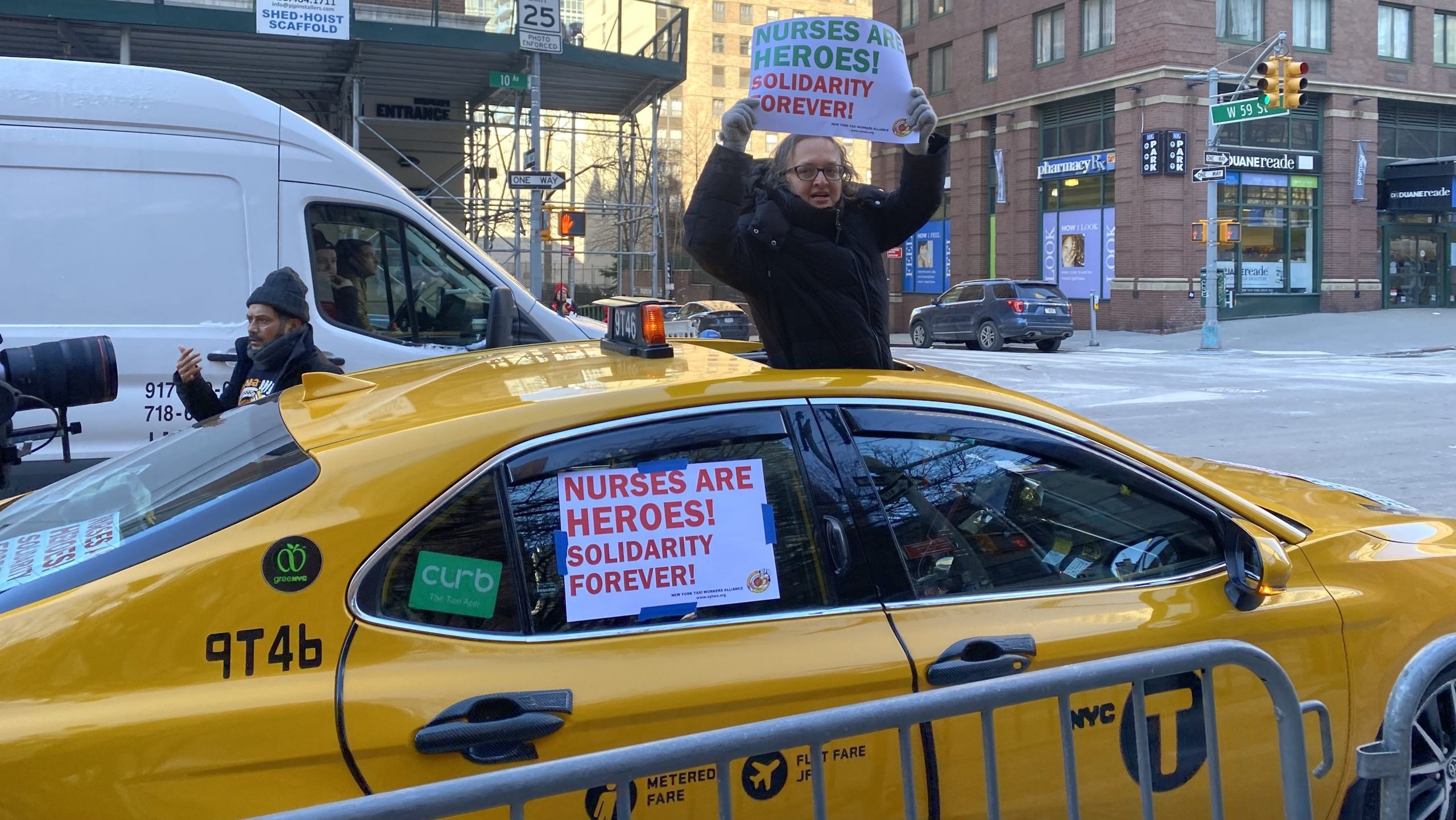
News of the tentative agreement comes as nurses were struggling to cope with the practicalities of a prolonged labor dispute. Since the strike began on Jan. 12, nearly 15,000 nurses have braved arctic temperatures to walk on daily picket lines. Yet, with days snowballing into weeks, many nurses suffered from the financial strain of the strike and grew increasingly frustrated with the slow pace of negotiations. Frustrated, they set their sights on Governor Kathy Hochul.
Last Monday, without their union’s authorization, hundreds of nurses marched from Grand Central Terminal to Hochul’s Midtown office, demanding that she do more to intervene on their behalf and pressure the hospitals.
This demand came as Hochul was being accused of weakening the strike by repeatedly extending an executive order that authorizes hospitals to hire out-of-state replacement nurses.
Hochul’s office did not respond to Documented’s request for comment.
With many nurses in dire financial straits, NYSNA established a relief fund to support nurses in need of monetary assistance due to the strike.
As the strike waged on, immigrant nurses like Astrid Judy, a 44-year-old Haitian registered nurse at Mount Sinai, struggled to put food on their table, as the hospitals paid temporary replacement nurses as much as $9,000 per week to cross the picket line. As of one week ago, the hospitals had spent a combined total of $100 million for replacement staffing.
Judy says that she has had to find a way to stretch her family’s budget so she can keep her three kids fed while she is out on strike.
“I cook at home, and I don’t order out because we try to make meals that can stay for a long time,” she told Documented. “When I cook now, I think that we have to make sure we have enough for the next day because we don’t know when we’re going back to work.”
Her kids are normally in extracurricular activities after school, but Judy has been forced to make some cutbacks, like taking her son out of his karate class, to ensure she can keep up with the bills.
“I don’t want to disturb the kids from their regular life,” she said. “But I had to make some hard decisions, to make sure I pay the mortgage, because we don’t want to get into any trouble. You know, if you miss one or two payments, you’re already in trouble.”
Despite the financial strain the strike put on her family, Judy says the sacrifice was worth it.
“I love my job,” she said. “They don’t want to give us the basics when we give them everything that we have. We give them our heart, our energy, our sweat.”
For Cynthia Campbell, a 60-year-old Canadian nurse at Mount Sinai Morningside, the strike pushed her to the brink of financial ruin. In 2023, she was diagnosed with cancer and was unable to work for nearly a year as she underwent treatment. With only $1,700 left in her bank account, she was unsure how much longer she could continue to support herself if the strike continued. And because she has a work visa sponsored by Mount Sinai, she was unable to take supplemental work to help make ends meet in the meantime
“Due to the particularities of my visa, I cannot go and apply for another job without leaving the country, and I highly suspect that it would be difficult for me to obtain another visa,” she told Documented as she fought back tears last Friday. “I can tell you that I get anxious just at the idea of leaving the country because I do know that I won’t be let back in if I leave.”
To get by, Campbell says she had to rely on the generosity of friends and family.
“I’m asking friends to borrow money, but nobody wants to borrow money at 60 years old.”
NYSNA Executive Director Pat Kane stated that celebrated stalwart nurses like Judy and Campbell endured economic hardship while keeping the bigger picture in mind.
“I’m so proud of the resilience and strength of NYSNA nurses,” Kane said in a statement. “They have shown that when we fight, we win. Nurses sacrificed their own pay and healthcare while on strike to defend patient care for all of New York. We helped galvanize a movement for worker and healthcare justice that reached beyond New York City.”
As the nurses, who on average make $93,320 per year, struggled to make ends meet in New York City, the hospital executives continued to take home millions — a point hammered on by Sen. Bernie Sanders at a recent rally supporting the nurses.
NewYork-Presbyterian CEO Steven J. Corwin made a salary of $26.3 million in 2024. Montefiore’s CEO, Philip Ozuah, brought in $16.7 million in 2024. As for Mount Sinai’s CEO, Brendan Carr, he earned a salary of $5.4 million in 2024. The hospitals did not respond to questions regarding their CEO’s compensation.
As non-profit hospitals, Montefiore, Mount Sinai, and NewYork-Presbyterian all receive generous state tax breaks. In exchange for tax breaks, nonprofit hospitals are expected to give back to their communities in the form of financial assistance, subsidized services, and investments in services that promote public health.
Between 2020 and 2022, nonprofit hospitals received $2.4 billion in tax benefits from New York State, according to the non-partisan think tank Lown Institute. However, a 2025 report from the Lown Institute found that from 2020-2022, 42% of private nonprofit hospitals in the state received more in tax breaks than the amount they spent on community investment, a difference of $518 million each year.
In New York State, NewYork-Presbyterian Hospital — whose nurses are still on the picket line — had the largest difference between tax breaks and community investment at $59 million.
Also Read: Mamdani and Sanders Rally With Striking Nurses as Negotiations Stall
Despite these imbalances, non-profit hospitals continue to hold strong political influence in the state. A New York Focus investigation found that between 2015 and 2023, the Greater New York Hospital Association spent more on lobbying than any other organization in the state.
Montefiore, Mount Sinai, and NewYork-Presbyterian are among the wealthiest hospitals in the country in terms of revenue. In 2024, Montefiore reported $5.9 billion in revenue. Mount Sinai and NewYork-Presbyterian each earned $4.6 billion and $10.7 billion in revenue, respectively, in 2024.
With billions in revenue, the union believes its demands for safer working conditions are modest in comparison.
Although the strike appears to be coming to an end, nearly 4,200 nurses continue to walk the picket line at NewYork-Presbyterian, where the union says the key sticking point in negotiations is safe staffing. But an agreement seems to be on the horizon.

你知道吗?非公民办理驾照时的这个错误可能会导致选民欺诈
“We continue to bargain in good faith and make progress,” Angela Karafazli, Senior Director of Media and Public Relations for NewYork-Presbyterian, told Documented in a statement. “We delivered a comprehensive proposal through the mediators this week that covers both economic and non-economic terms, including safe staffing and workplace safety.”
For nurses like Judy, the strike was not about themselves, but a fight for a better healthcare system overall.
“Nurses are the heart of healthcare; we should not be forced to be on the picket line, just to have the minimum staffing for us to function,” she said. “When we do good, it’s not only good for us, as nurses and the patients, but it’s also good for the hospitals.”