

Commenting on the transformative power organizing had on immigrant farm laborers working in California’s lush grape fields, legendary Mexican-American labor leader Cesar Chavez said, “If a man comes out of the field and goes on the picket line, even for one day, that man will never be the same.”
That quote could best describe the life of another labor leader: Mahoma López Garfias, who died Jan. 28 at the age of 47 after a long battle with cancer. From 2015 until his death, Garfias served as the co-executive director of the Laundry Workers Center (LWC), a grassroots nonprofit that organizes immigrant workers.
News of Garfias death went beyond the LWC, reverberating across the wider New York labor community.
“I feel blessed to have worked alongside him,” said Rosanna Rodriguez, who shared the co-executive director position with Garfias. “He had a unique ability to guide people with both style and respect. Mahoma was strong-willed, yet a free spirit. A unique soul that loves to support people, train, and organize them, but also loves to spend time alone.”
Born in Mexico, Garfias migrated to the U.S. in 1998 and worked several odd jobs in the food service industry. By 2011, Garfias was working as a sandwich maker at the Hot & Crusty bakery cafe on the Upper East Side of Manhattan. Soft-spoken and relatively uninterested in politics, Garfias’s life was changed forever when he, along with his fellow undocumented workers, began organizing a union.
Fed up with their wages being stolen and verbally abusive management, Garfias reached out to the newly established LWC, which helped with labor organizing training. Garfias then led months of clandestine organizing among Hot & Crusty employees, and the following year, on Jan. 21, 2012, the workers, led by Garfias, made their campaign public and dug in for a year-long battle with management.
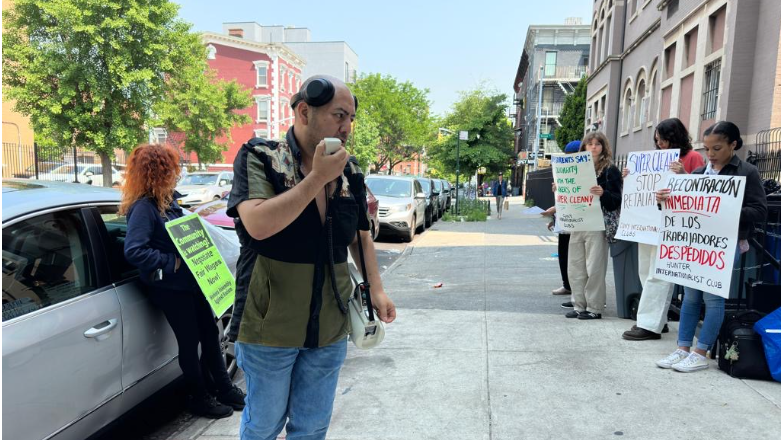
Instead of negotiating with the workers, Hot & Crusty’s management attempted to close the store. In response, the workers led a 55-day picket line and established a “Worker Justice Cafe” on the sidewalk outside of the store. As the fight carried on throughout 2012, it gained widespread support from the labor advocates and the wider Occupy Wall Street movement, which attempted to occupy the store to prevent it from closing.
Victory finally came on Oct.26, 2012, when the workers won a three-year contract that guaranteed benefits. The entire struggle was captured in the documentary film “The Hand That Feeds,” where Garfias’s growth as a labor leader can be observed in real time.
Following his experience at Hot & Crusty, Garfias served as the President of the Hot & Crusty Independent Union before joining the LWC as their lead labor organizer. Two years later, he became the organization’s co-executive director.
As transformative as organizing a union at his workplace was for him, Garfias spent the rest of his life evangelizing the gospel of organizing to workers in similar circumstances to his.
During his time at LWC, Garfias trained hundreds of immigrant workers on organizing skills so they too could improve their working conditions. In addition to Hot and Crusty, Garfias helped organize businesses including Kenny Bakery, New Capitol Restaurant, Liberato Restaurant, B&H Photo Retail Store, TYS Laundromat, Sunshine Laundromat, Justice for Beatriz, and Mondi Group Warehouse.
In 2022, Garfias and LWC launched the Cabricánecos Campaign, which organized 40 mostly indigenous Guatemalan demolition workers who were demanding that their employer, Best Super Cleaning, increase their wages, provide safer working conditions, and recognize their right to form a workplace safety committee. After a three-year battle, the workers won all their demands.
“They are one of the first workplaces to have formed a work and safety committee where they are having meetings with the company discussing issues around health and safety,” Garfias told Documented in 2024. “They were able to achieve an improvement in working conditions.”
During the last year of his life, Garfias and LWC held “know your rights” trainings as they tried to protect workers from the Trump administration’s harsh immigration crackdown.
In addition to his organizing prowess, Garfias was a gifted artist. For the LWC, he printed banners and picket signs that they would use in direct actions.
Closely aligned organizations, such as the New York Taxi Workers Alliance (NYTWA), acknowledge the influence Garfias had.
“Mahoma Lopez and LWC’s principled organizing has been groundbreaking — teaching new ways to organize not only in a forgotten industry, but also in smaller franchised businesses, which can be harder to break through,” Bhairavi Desai, president of NYTWA, said in a statement to Documented. “In a life cut tragically short, Mahoma brought justice to the lives of countless workers and helped lay the foundation for the city’s immigrant workers’ rights movement. We all owe him a debt of gratitude.”
Garfias’s impact on transforming workers into organizers will live on, Rodriguez said.
你知道吗?非公民办理驾照时的这个错误可能会导致选民欺诈
“I know he will always be with us in our hearts and in the memories we created,” she said. “Mahoma is ever-present; he leaves a legacy in the movement that we must preserve. Mahoma lives in every worker who stands up for their rights.”
Garfias is survived by his two sons, Justin and Jonathan López.