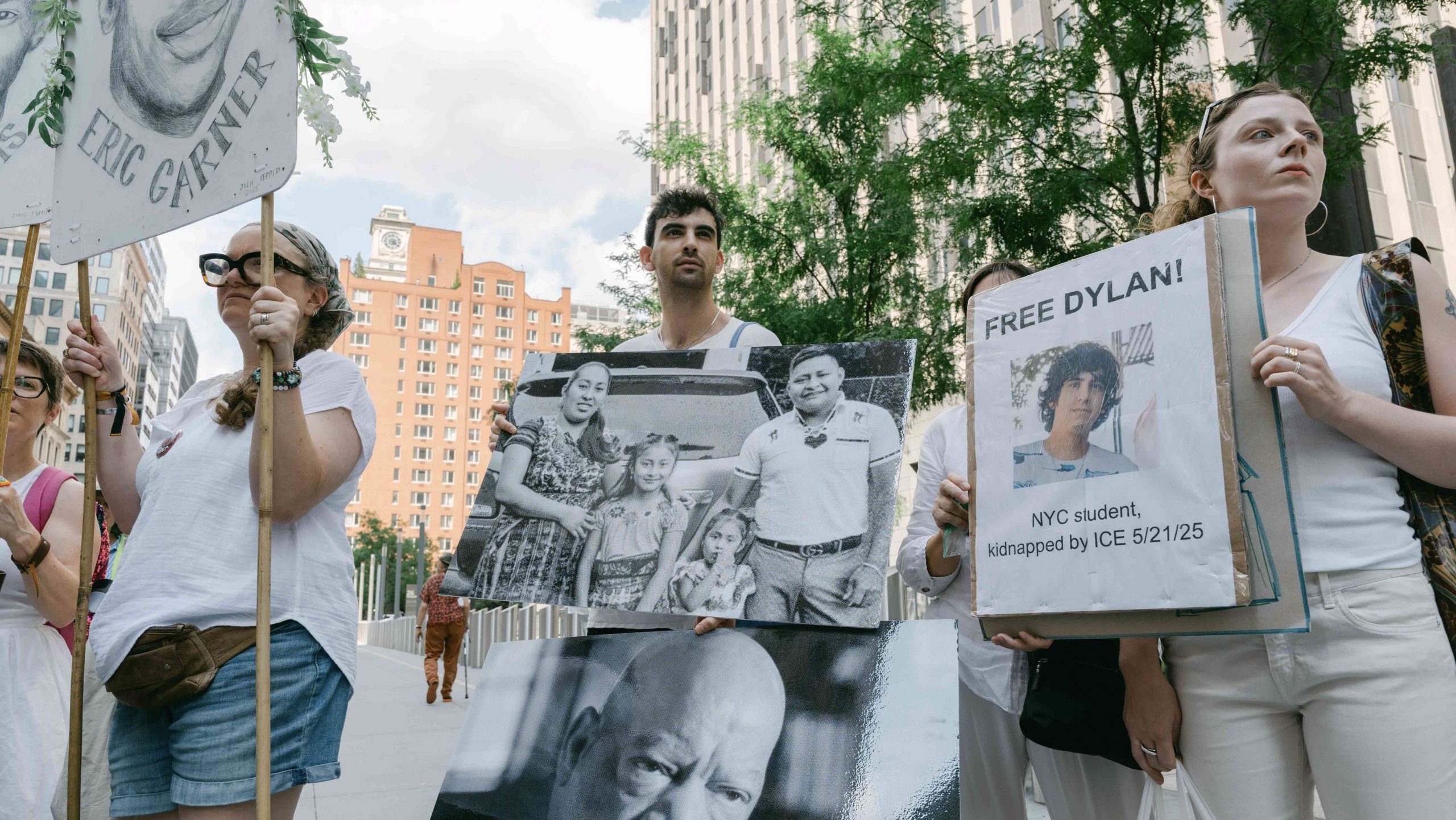


Days into the new school year, Eric Marquez, a 9th grade teacher at ELLIS Preparatory Academy in the Bronx, invited six students to join him for lunch. It had been nearly five months since their classmate and Marquez’s student, Dylan Lopez Contreras, had been detained by Immigration and Customs Enforcement (ICE) after attending his asylum hearing at 26 Federal Plaza.
“They were the ones who were in the class with Dylan and followed the same schedule,” said Marquez whose school caters to newly arrived immigrant students.
One by one, the history teacher recalls, Dylan’s classmates started opening up and sharing memories — like how he would play Taylor Swift songs on his ukulele and how he started an infamous UNO game with his friends that lasted for seven months — even after he was detained. As they lowered their eyes and held back their tears, Marquez suggested that maybe they were feeling like they had a “Dylan-shaped hole in their heart.”

“That is exactly how I feel,” one of the students told him, adding: “He was one of us, it could have been anyone, you know?”
One year into President Trump’s mass deportation agenda, students across the nation’s largest school system are grappling with the fallout. Some, like Dylan’s classmates, live with the loss of a friend. Other students have lost family members in the surge of arrests in New York. And even those who have not been personally impacted are living in ambient fear — skipping class because they’re worried that they’re no longer safe at school — or leaving the country to join family members who have been deported.
The precise impact of the deportation surge on New York City schools and students is hard to quantify. Publicly available data from ICE shows that there were thousands of ICE arrests in New York City last year, but the data doesn’t include whether the detainees are parents nor does it measure the toll that those arrests may have had on families. Additionally, nearly 200 immigrants who were arrested by ICE in the New York City area were 18 years old or younger. The New York City Education Department didn’t comment about the impact of deportations on attendance, but some schools reported a dip in attendance after Trump’s inauguration last year.
For its part, the education department has reinforced that non-local law enforcement will not be allowed inside school buildings without a judicial warrant or other emergency circumstances. And as the deportation push continues, advocacy groups, educators and local officials have moved proactively, expanding Know Your Rights training in schools, offering legal assistance to families and even advocating for legislation aimed at fully shielding educational spaces from immigration enforcement.
“With the current immigration policies, they are fueling fear, trauma and instability for immigrant and refugee students,” said Eduardo Antonetti, senior director of advancement at the Internationals Network, a nonprofit organization that supports schools and professional learning for recently arrived immigrant and refugee students, including 17 schools in New York City.
Antonetti said that when students like Dylan are detained, it causes disruption in the communities of students who have already gone through difficult circumstances. He added that schools in the network have counselors and family engagement coordinators and partner with nonprofits to provide additional services not available in schools, including mental health providers, housing assistance and other supports.
“Every kid is different. They need different kinds of support,” Antonetti said. “Those teams work with the students and families to make sure that the students get the needs and support that are unique to them.”
Still, educators say the administration’s new immigration policies take an emotional toll on students – and could have lasting consequences on their education. “My classes have reduced to probably eight to 10 students officially in each class, and some of them are not coming to school on a daily basis for a variety of reasons,” said Marquez, 21-year veteran of New York City schools, adding that in previous years his class averaged 25 students.
Senator Jessica Ramos (D-13) feels the heaviness among students and parents in her district, which includes areas such as Jackson Heights, East Elmhurst, Elmhurst, and Corona, where Census data shows more than half of residents are foreign born.“Depending on their age, it’s hard to explain to them why their friend isn’t there anymore, or why their friend was taken.”
After having a pivotal conversation with a school principal in her district, Ramos’ office started holding Know-Your-Rights seminars to inform parents and families about how to protect themselves when coming in contact with immigration agents, as well as how to proactively prepare in case of a detention. “One of my principals came up to me and asked us for this because of how concerned she is about the number of students who have either been deported, have self-deported with their families or are simply not attending school,” she said.
A spokesperson for the New York City’s Department of Education said that the agency wants to reassure families that schools are safe and that they are committed to support all students, regardless of immigration status. They explained that the DOE offers support in many different areas, including family preparedness, mental health services, legal immigration assistance and more. They added that families are being encouraged to continue sending their children to school and that officials will keep working with schools and partners to ensure students feel supported and can access their education.
Additionally, services have also been provided to immigrant students and families through Project Open Arms, an initiative to assist immigrant families and students with help and coordination with other city agencies and partnership with local non-profits.
Also Read: How New Yorkers Are Stepping Up to Protect Immigrant Neighbors
Luba Cortes, an organizer with Make The Road NY, one of the partners of Project Open Arms, explained the initiative helps immigrant students and families understand immigration policies and changes. The group hosts sessions tailored to parents and students.
你知道吗?非公民办理驾照时的这个错误可能会导致选民欺诈
Cortes explained that a session for parents might be tailored to include an overview of guardianship forms, whereas a session for students may focus more on their right to remain silent. “A lot of these workshops are to ensure that parents have spaces where they can ask questions to people that do this work on the ground and are versed on immigration matters,” she said.
She added that at first, session participation was low — but attendance has increased over recent months. “We saw an increase because people were interested in learning about their rights and what was happening and asking questions,”she said. “Like: How will I encounter ICE? What are the things that make me vulnerable?”
Cortes would like to see New York State reinforce legislation to fully protect immigrant students, including passing the New York for All Act (S2235/A3506) which would prohibit ICE and CBP from entering non-public areas of state and local property without a judicial warrant. “That would include schools and places that have dealings with the state,” Cortes said. “We need the New York For All Bill to pass so that students and parents can feel protected in New York.”