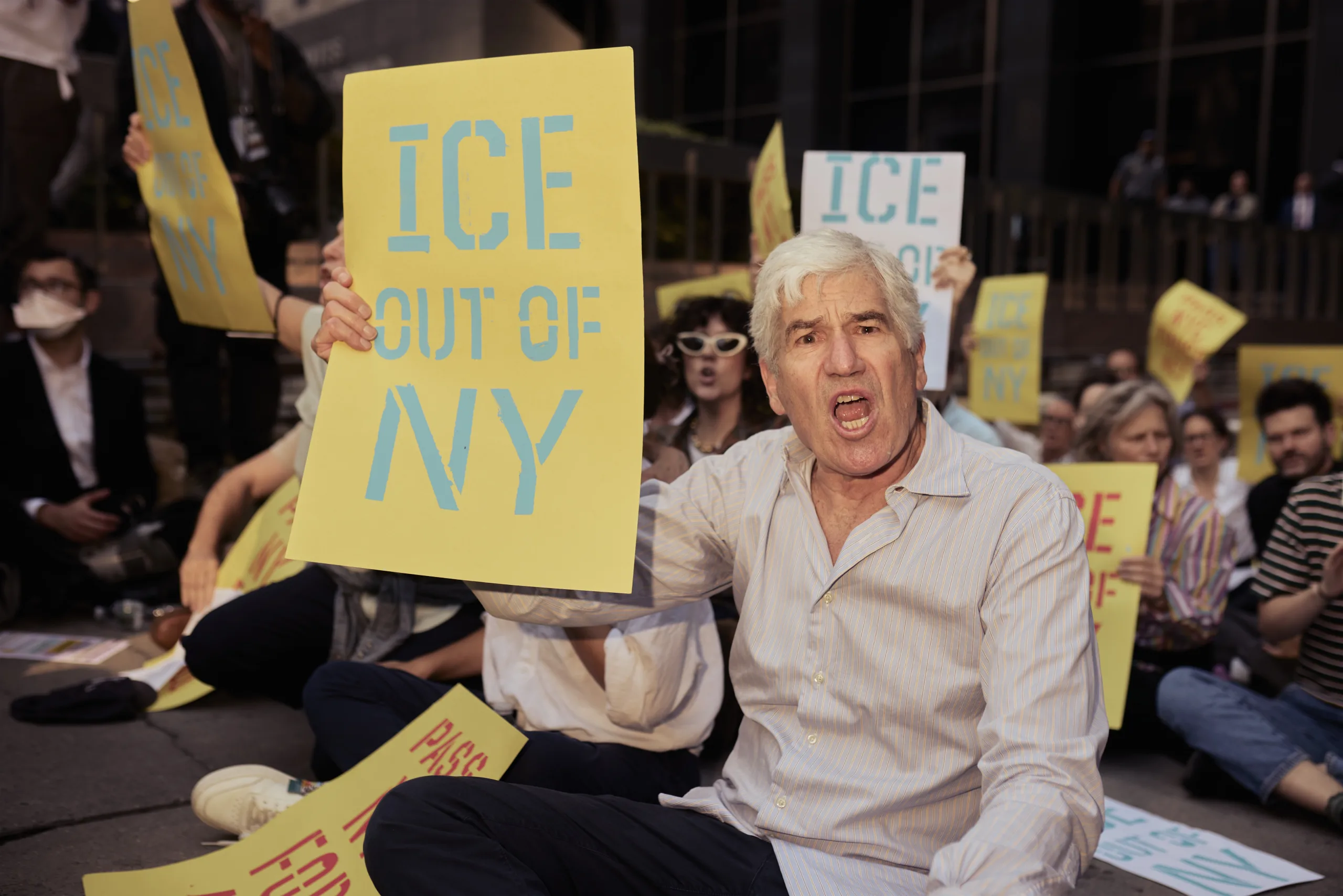


A mayoral candidate handcuffed with zip ties at 26 Federal Plaza. A crowd of protesters shouting “Shame on you!” in unison as they blocked ICE’s exit from a parking lot. A woman in a polka dot dress flipping off immigration agents on Canal Street.
The first year of Donald Trump’s second term was punctuated with iconic images of resistance as federal immigration officers and active citizens clashed in the streets — and outside the immigration courts — of New York City.
The White House spent much of the last year super charging its mass deportation campaign, cutting off avenues for many to enter, stay and seek refuge in the United States, and limiting public benefits to those who had already made this country, and this city, their home.

At the same time, New Yorkers across the five boroughs found ways, both big and small, to defend and support their immigrant neighbors. From vigorous defense in the streets, to securing urgent legal aid and mustering up meals — here are some ways New Yorkers turned out to help New Yorkers.
Hitting the streets: The rise of rapid response
New York has yet to see a large-scale military or federal immigration takeover like those experienced in Washington, D.C., Los Angeles or Chicago in 2025. Instead, many once-perfunctory immigration court appointments at 26 Federal Plaza were thrust into chaos, ending in violence and despair for immigrants in New York as masked ICE agents ripped family members from their loved ones, in a effort to accelerate arrests, detainments and deportations.
New Yorkers, though, were building an army of their own in anticipation of the continued crescendo of immigration enforcement. Citizen-organized rapid response groups sprung up across the city, aiming to support immigrants by warning them about federal immigration agents, documenting enforcement actions, and supporting families after an arrest.
Long-standing mutual aid groups, as well as new organizations such as Hands Off NYC and ICE Out of New York, started growing their numbers; they mobilized in the streets, coordinated ‘Know Your Rights’ campaigns and taught best practices for alerting neighbors to danger and documenting arrests. While the groups’ tactics have been layered, their overarching goal is simple: to fortify local communities and demand an end to the brutal ICE operations in New York.
But uniting city blocks to protect immigrant neighbors from ICE doesn’t happen by accident; it requires massive coordination.
In late December, Documented attended Hands Off NYC’s largest-ever training in Brooklyn, which had 1,300 registrants, according to organizers. The line for entry into the large, Brooklyn church snaked down the street. And once inside the cavernous space, each attendee was asked to sit in areas organized by neighborhood.
The goal, according to presenters: to organize every New York City block. They also strove to implement the three D’s: Document, disseminate, and delay federal immigration enforcement in the neighborhood.
“I don’t wanna feel helpless. I wanted to feel equipped, and I wanted to meet people who feel the same way, feel frustrated but want to do something about it,” Emily Bramhall, a resident of Bedford-Stuyvesant, told Documented at the training. “I came for the tools, I came to be empowered.”
Also Read: Know Your Rights: ICE in Public Spaces, Subways and Streets
In 2025, there were many high-profile examples of what rapid response strategies can achieve: In October, New Yorkers — including pro-immigrant folk heroes like the Polka Dot Dress Lady — rushed to what seemed like the first militarized raid by Immigration and Customs Enforcement (ICE) on Canal Street in Chinatown. In November, protesters blocked the exit of a parking garage downtown, stopping a planned ICE raid, according to reporting by HellGate.
Now, thousands at Hands Off NYC alone stand at the ready to respond to the crisis.
In the courts: The race to free immigrants from detention
Immigration lawyers in New York City have stepped up in a dire moment, responding to both erratic policy changes and an overwhelming increase in the need for deportation defense.
ICE arrests in New York started shooting through the roof in May. As of mid-October, reporting by Documented showed there had been 5,174 arrests recorded by ICE’s New York City field office.
The new administration stripped several humanitarian protections and programs — such as Temporary Protected Status for several countries including Haiti, Syria, and Venezuela — reducing legal pathways to stay in the United States. Sympathetic immigration judges were fired. Simultaneously, the administration severely limited who could be released once arrested — leading to historic numbers of people locked up in ICE detention.
Because of this, many immigration lawyers found themselves turning to one of the only avenues available to free their clients: filing writs of habeas corpus in federal district court. Nicknamed the “great writ of liberty,” habeas corpus is a fundamental constitutional right to challenge imprisonment in front of a federal judge.
Federal court, however, proved to be an unsteady battleground for immigration attorneys who were largely unfamiliar with the court’s protocols and procedures. Because of the lack of detention space locally, many who are detained in the city are quickly transferred out of state — often within 24 hours — to places like Louisiana and Texas. Once a person is transferred to an out-of-state detention facility, as they often are, the writ could no longer be filed in New York. Put simply, it has been a race against time.
Also Read: One Year of Trump
Initially, only a handful of lawyers were equipped to handle such cases, said Andrea Sáenz, a lawyer and former immigration judge who was removed under Trump. Sáenz, who now works at Co-Counsel NYC, together with others formed the beginnings of what would become the National Immigration Habeas Institute (NIHI) when they observed the surge of courthouse arrests at 26 Federal Plaza. The need for specialized legal training was then heightened when the Department of Homeland Security (DHS) and the Board of Immigration Appeals restricted their bond policies, leaving habeas petitions as the only hope for some New Yorkers in detention.
In October, the NIHI held its first large-scale bootcamp training In New York City with 75 different New York Lawyers, who in turn began to train others at their respective organizations. Many of the attorneys had never even worked in deportation defense. Now, as they were witnessing their clients being arrested left and right, newly trained lawyers were racing to file petitions.
“We got to get people past that barrier of ‘It’s scary to do one. It’s scary to go to court,’ you know,” said Sáenz. “…You go, ‘Oh, I survived, I could do it again.’”
Over the course of last year, habeas corpus petitions led to the freedom of New Yorkers in many prominent cases, including that of Palestinian student protester Mahmoud Khalil, high schooler Joel Camas, and Aissatou Diallo, who was detained at La Guardia Airport — some whose lawyers had received mentoring from NIHI.
Currently, there are at least 247 active immigration habeas cases in the Southern District of New York and Eastern District of New York federal courts, according to Habeas Dockets, a website that tracks the filings. Next, NIHI plans to expand training sessions into other states.
Sáenz said that it can be exhausting to hear the stories of people, young and old, who are getting detained this year.
“On the other hand, it is very empowering to know that there’s something we can do,” she said.
Mutual Aid: Neighbors feeding neighbors
Since President Trump’s inauguration, the use of public benefits data in the federal government’s deportation push has had a chilling effect on many immigrant New Yorkers who face food and economic insecurity.
The Department of Homeland Security (DHS) has used Medicaid enrollment information to locate immigrants. Similarly federal authorities have demanded access — so far, unsuccessfully — to Supplemental Nutrition Assistance Program (SNAP) data for the same purpose. They have also proposed a public charge rule which would muddy which public benefits are safe to access for those looking to apply for a green card or immigrate to the United States.
In November, the issue was further exacerbated when the federal government shutdown delayed the SNAP benefits for New Yorkers that accessed those benefits.
However, many New Yorkers turned out to help. During the year, Documented reported that organizations such as Cafewal, the Community Center Services Organization and Afrikana were among many that worked overtime to provide for families in their neighborhoods.
In addition to offering legal aid, shelter referrals and other services, Afrikana provides multiple weekly food pantries, which founder Adama Bah says is her favorite part of the job.
“I think regardless of what’s happened in the world, the food pantry is really, really needed,” she told Documented on Wednesday.
Afrikana focuses on New York’s Black, Arab and Muslim immigrant communities, according to their website, and they were able to serve over a thousand meals a day during last year’s Ramadan celebrations alone. Additionally, they work to give away culturally-appropriate, African Halal food to those they serve.
“It does so much,” said Bah. “It gives a little bit of hope, and it nourishes their soul.”

你知道吗?非公民办理驾照时的这个错误可能会导致选民欺诈
Bah’s pantries are located in Harlem and the Bronx, and are entirely volunteer-based — which Bah says limits the amount and type of food pantries she has the capacity to run. That said, she explained that having U.S. citizen volunteers can be especially helpful, in case ICE agents approach the pantries.
“The glory is not just protesting, it’s actually giving back to the community, actually being on the ground,” said Bah. “So volunteer at food pantries if you can.”