Q&A: NYC Deputy Mayor Julie Su on Affordability, Childcare and Listening to Immigrant Voices
Documented asked immigrant community members what issues and questions they'd like to raise with New York City's first-ever Deputy Mayor for Economic Justice. Here's what they said — and here's how she answered.
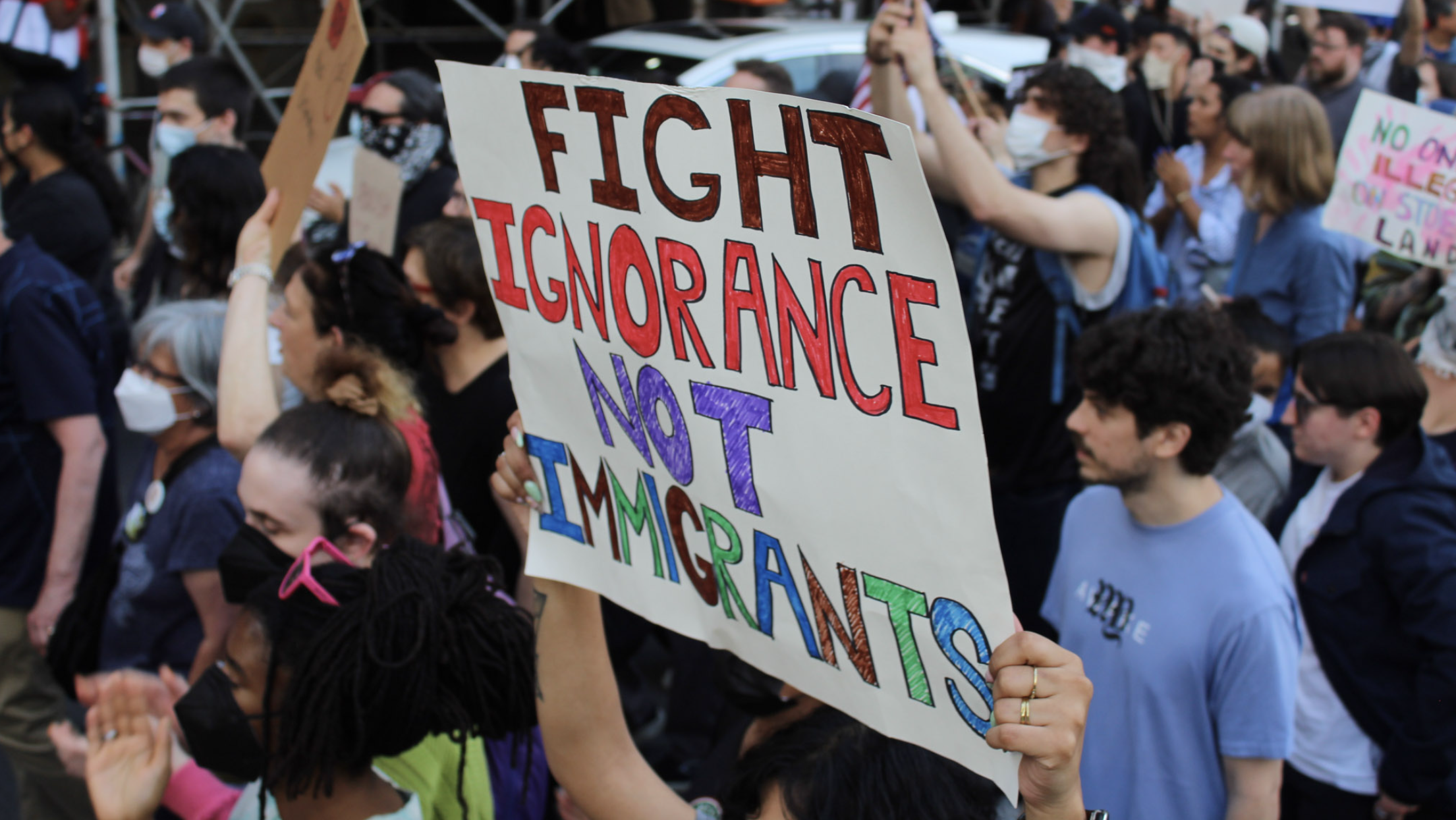
A protester holds up a sign that reads 'Fight ignorance not immigrants'. Photo: Rana Roudi for Documented.
New York City’s first-ever Deputy Mayor for Economic Justice oversees a vast portfolio: protecting the city’s workers and consumers and tackling inequality.
Before being officially sworn in as mayor, Zohran Mamdani had already chosen Julie Su to fill this role, a pro-labor public servant who’d be crucial to achieving his progressive agenda. Su, who formerly held positions as the secretary of labor under President Joe Biden and in the state of California, will supervise a wide array of city agencies, from the Office of Immigrant Affairs (MOIA) to the Taxi and Limousine Commission (TLC) to the Department of Cultural Affairs (DCLA) – and she’ll even oversee Mamdani’s “World Cup Czar”.
As a newsroom that reports for and with immigrant communities, Documented asked community members from the Spanish-speaking, Chinese, and Caribbean communities what issues and questions they would like to raise with the new deputy mayor. Their input helped shape the following interview.
Immigration News, Curated
Sign up to get our curation of news, insights on
big stories, job announcements, and events happening in immigration.
You're Subscribed!
Please check your email for further
instructions.
Su responded to our questions in English, Spanish, and Mandarin. For length and clarity, this interview has been edited and is presented below in a Q&A format:
April Xu: Thank you for speaking with us. So first, I just want to ask, you have been on the job for one week. Can you describe what it’s been like in one word?
Julie Su: Thrilling. It’s been thrilling.
Xu: Many Chinatown residents feel the city has not adequately listened to local voices when making policy and development decisions. They point to issues such as building a jail in Chinatown instead of much-needed affordable housing, the lack of effective enforcement against counterfeit bag vendors on Canal Street, and replacing the long-requested traditional Chinatown archway with a gateway from the $56 million Chinatown revitalization plan. As you work to build a more equitable economy for New York City, how will you ensure that the voices of the Chinese community are heard and meaningfully considered?
Su: Our mayor himself is an immigrant. During his campaign and in these first two weeks since taking office, he has firmly believed that every New Yorker should be able to live and work here with stability. Whether you work in a restaurant, drive a taxi, or run a small business, you shouldn’t feel that New York is unlivable because it’s too expensive.
We have a lot of work to do. New York is facing many challenges — like the high cost of living you mentioned — and many people feel the government hasn’t truly been listening to them or understanding their problems and circumstances.
There are two parts to this. First, as the mayor builds his team, he is looking for the best people in New York and across the country — people who have actually done this work, who have used government to improve residents’ quality of life — to help him. He found me because I’ve worked for many years in California and in the federal government, doing a lot of work that involved listening to the needs of each community and helping them.
Second, what we want to do should affect every community. The Chinese community, like others, hopes for more affordability in housing, transportation, and other areas, and we want to help. But each community also has long-standing, unresolved issues of its own. I will listen, spend time going out to communicate with people, learn more, and tell everyone that we are just getting started. There is a lot to do, but we will work in an inclusive way — everyone matters, and the city government represents them.
Xu: Small business owners in Flushing and in Brooklyn’s Chinese communities welcome the new executive order that creates an inventory and identifies ways to cut the fees and fines that small businesses pay in New York City. But many are also concerned about how existing regulations are enforced. Some say they received tickets without warning, while others were unaware of certain rules because information did not reach immigrant business owners in their language. What is your office’s plan to improve education and outreach so violations can be prevented before they happen?
Su: I actually went to the Small Business Summit at Barclays Center today, and I addressed this very question. If you want to run a legal and successful business, you should want the government to help you. We will increase services — for example, small business owners will have someone they can call, or they can turn to Small Business Services for assistance.
Today the mayor said he wants to look at 6,000 regulations, fees, and fines. Some of them are of course necessary, but some really need careful review — do they actually help, do they truly serve a purpose? If we have the authority to say that something is truly unnecessary, we will eliminate it. If it requires working with the City Council, we will also seek their help.
Finally, some laws were legitimately needed at the time — for example, minimum wage protections for workers. We also need to help businesses. If you make a small mistake and immediately face hundreds of dollars in fines, that’s a big burden. What really matters is focusing on major issues and doing things properly, with someone there to help you through the process.
Xu: Are there plans to provide language versions so that immigrant small business owners in different communities can understand policies in languages they are comfortable with?
Su: Yes. Small Business Services already has some of this, but I think one issue is that for people running businesses, it’s often not just a language problem — it’s also a time problem. Time is money. Business owners start early and work late. My parents used to run small businesses too — they worked in a laundromat and then ran a restaurant — so time was extremely important.
We need to find ways to more smoothly and easily deliver the resources that can help them, especially to those with language barriers. This is one of our priorities, and we will definitely communicate through multiple languages.
“Anything we can do, we will continue to do — whether it’s helping small businesses, helping immigrants, or addressing labor issues. We never ask about immigration status; that’s not important. Everyone should have rights. For New York City, we want to tell everyone that we don’t just welcome immigrants — we protect immigrants.”
—Julie Su, NYC Deputy Mayor for Economic Justice
Xu: Street vendors are an important part of the city’s economy, but some small business owners feel they are at a disadvantage because vendors often have lower operating costs and can sell similar products. How will your office balance the needs of street vendors and brick-and-mortar businesses to maintain a healthy and fair local economy?
Su: President Trump has created many problems in society. Immigrants and small businesses are facing challenges — not just in New York, but in many places. Things are very chaotic, and many immigrant communities feel under attack. Mandani has made it very clear that New York City has always been a city of immigrants and is very welcoming to immigrants.
Anything we can do, we will continue to do — whether it’s helping small businesses, helping immigrants, or addressing labor issues. We never ask about immigration status; that’s not important. Everyone should have rights. For New York City, we want to tell everyone that we don’t just welcome immigrants — we protect immigrants. All of our services are also open to immigrants.
Eileen Grench: Our Spanish-speaking audience has told us that there is a high demand for information on how to enroll their children in Pre-K and 3K. What is the strategy for reaching these Spanish-speaking communities? Have you collaborated with organizations or schools in the communities to spread these announcements.
Su: This issue of childcare is very, very important to Mayor Mamdani. It’s one of the strongest promises in his whole campaign. And now that we’re in City Hall, it’s something very important for him. Because of this, his priority was to work with the governor to demand more than a billion dollars for childcare for children two years old and under, but now we’re announcing all over that today until Feb. 27, everyone who lives in New York can enroll their children in Pre-K and 3-K.
We’re doing everything we can — and thank you all for helping us tell everyone that this is the time to do it. And you can visit the website myschools.nyc. We also have a phone number, 718-935-2009. And we also have thirteen Family Welcome Centers in the city. And all those ways you can go sign up between now and Feb. 27. The website and phone number can answer in Spanish.
Grench: We have reported many times on how immigrant communities are impacted by wage theft. In January of this year, the new minimum wage came into effect. How would you hold companies accountable for ensuring they pay workers the minimum wage in New York?
Su: We have the agency that enforces the laws, the pay laws, the time laws. It’s a new era. It’s a new era of enforcement. Those who follow the law, those people should receive all the support of the city. We want to help them to comply with the laws. But for those who use illegal practices on their workers, they’re going to understand that that’s not acceptable.
We’re going to mandate that all jobs pay. … All workers must receive their full pay for all hours and all days that they work. And we’re also sending a clear message that for those employers who’ve decided that it’s cheaper to break the law and the chances of getting caught are slim, and the consequences if they get caught are minimal, then it is a new era for this city too. Those employers who choose to break the law day in and day out are not going to get away with it.
“It is a new era for this city too. Those employers who choose to break the law day in and day out are not going to get away with it.”
—Julie Su, NYC Deputy Mayor for Economic Justice
Grench: Many Caribbean immigrants work in low-wage or informal sectors, like home healthcare, construction, and food service. In your first week, what did you hear from workers that shaped your immediate priorities? And what is the most immediate action they will see from your administration?
Su: Too many workers still work too hard and can’t get ahead. There are many reasons for that — it’s a combination of things that just cost too much, and it’s what the mayor said, it’s childcare. It’s rent. It’s transportation, but also that workers can’t do enough to get by.
And our agenda is both to bring down the cost of things, but also to bring up the standards for working people, and that includes enforcing laws when they are broken. I’ve heard from many workers just in the time that I’ve been here, that they can’t always know that when they start the day at work that they’re going to get the full pay that they should have been paid by the end of that day. And that’s not okay.
That’s a matter of affordability, but it’s also a matter of basic dignity. And for me, the definition of economic justice has to be that everyone in the city gets to experience real dignity in all its forms.
Eileen Grench writes about immigration enforcement for Documented. Previously, she covered the impact of the criminal justice and immigration systems on communities in New York City, Houston, and beyond. Eileen also worked as an investigative reporting fellow at the Global Migration Project, where she reported for outlets such as The New Yorker, The Intercept, The Nation and Documented. She was a 2021 Livingston Award finalist for her coverage of inequities in child welfare, and won the Newswomen’s Club of New York Front Page Award in Local Investigative Reporting. Eileen graduated from Columbia University School of Journalism and is also an Olympic fencer representing Panamá.
Support Trusted Journalism Made With and For Immigrants
Documented is the only New York City newsroom centering the voices of immigrant communities. Each week, we bring immigrants critical multilingual reporting on local and national news impacting their lives.
Our community doesn’t just shape our reporting – it sustains it.