

Cities like Los Angeles and Chicago, which have found themselves at the front lines of the battle against the Trump administration’s mass-deportation initiative, have honed community response tactics that are quickly gaining traction in New York.
The common whistle has been at the center of this grassroots defense. Usually found on hikers’ bags, around the wrists of crossing guards or in the excited hands of children, whistles are becoming popular in urban communities across the country, hanging around the necks of street vendors, latched onto neighbors’ keychains, or distributed by community organizers like Rodrigo Camarena of Sunset Park.
Camarena’s “day job” is building free tools that support immigrant life in New York. Outside of work, he can be found traversing South Brooklyn, responding directly to crises and distributing tools to keep communities safe and whole, such as know-your-rights cards and whistles.

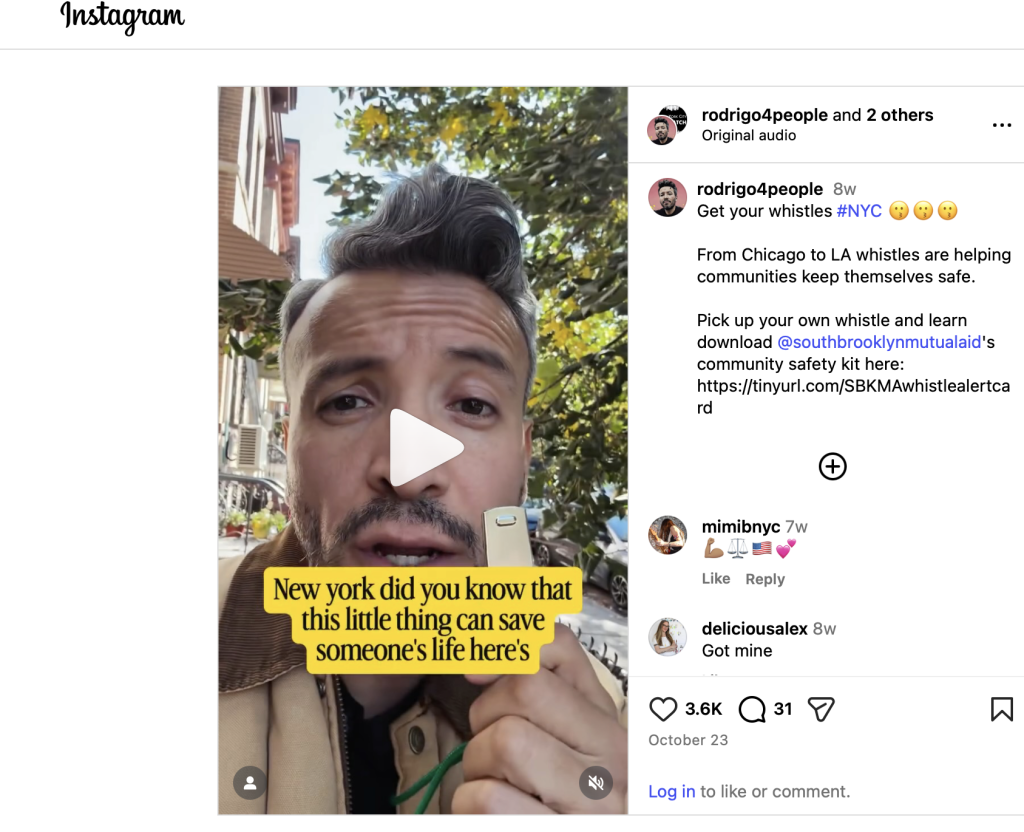
Those carrying the whistles follow a simple code: three short bursts to indicate the presence of ICE and three long blows for an active detainment. Utilizing whistles in this way is the latest iteration of what Camarena calls a “tried-and-true” method of resistance. Novel on the national scale, the act of literally ‘blowing the whistle’ has been instrumental in numerous movements both abroad and domestically.
A profound example comes from Thailand, just one decade ago. Accused of being a puppet for her billionaire brother, Thailand’s prime minister Yingluck Shinawatra faced massive protests led by the country’s Democratic Party in 2014. The protests, 200,000 strong at their height, consisted of “whistle-blowing mobs” making incredible amounts of noise to garner the attention of Thailand’s ruling class. The demonstrations eventually resulted in the ousting of Shinawatra.
In 2016, protesters across Chad, upset with president Idriss Derby’s attempt to extend his 26-year tenure in power, leveraged what they called the “citizen’s whistle.” The whistle provided a particular advantage given the government’s harsh punishments for dissent. Rather than taking to the streets, disgruntled citizens remained home and blew whistles to disrupt daily life without exposing their identity.
Back in the western hemisphere, “cacerolazo” protests — or noise making protests — of the early 70s defined much of South America’s disdain towards the neoliberal model. While typically characterized by the banging of pots and pans, the “cacerolazos” used all kinds of noise makers, including whistles, to coordinate movements, show solidarity, and disrupt normal daily functioning.
Here in the U.S., a 2003 string of worksite protests by unionized American workers at a fiber-optic cable manufacturing plant used whistles as a work-around to “no-strike” clauses. Frustrated with the stalling of contract negotiations, workers blew their whistles loudly whenever anti-union managers were present as a way to shame them, hinder their productivity, and display solidarity.
While the motives and contexts of these movements are complex, they all offer variations on using whistles as a tool of resistance.

你知道吗?非公民办理驾照时的这个错误可能会导致选民欺诈
“Evidence shows that when people are alerted on the street, they come out and look. They realize it’s an emergency,” Camarena explains. “[Whistles are] not just to alert vulnerable people, but to alert allies and people with privilege to come out and get involved. It’s really a call to action, to record, and a call out to everyone in the community.”
In this way, he elaborates, the whistles play a crucial role in delivering accountability. “We’ve seen cases and litigation brought about against the government and individuals…The record of these actions are valuable and in many cases can bring about consequences to people who are abusing their authority and abusing due process.”
Decentralized, anonymous, completely legal, and impossible to ignore — the whistle has long been the civil disobedient’s best friend. As Camarena puts it, “The threat might be different, more exaggerated, and violent, but it’s nothing new. We’re using all the strategies at our disposal and iterating. Communities are fortunately good at this grassroots creativity.”