

I don’t mean to start the year on a preemptively exhausted note, but I should warn you that I don’t see the pace of immigration news slowing down anytime soon. Events set in motion over the last year (or last several years, or decades, even) are continuing to roll along, and we can expect new developments from the Trump administration as well as the governments, institutions, and communities trying to resist it.
The list of things I’m keeping an eye on for 2026 is, accordingly, pretty long. And it’s awfully hard to have any confidence predicting what will end up being most important. (I kind of feel like I’m writing a column about Pots I’m Watching in 2026, and we all know watched pots never boil). So please don’t think of this as a list of worries, so much as a roadmap for some things that might happen over the next 12 months.
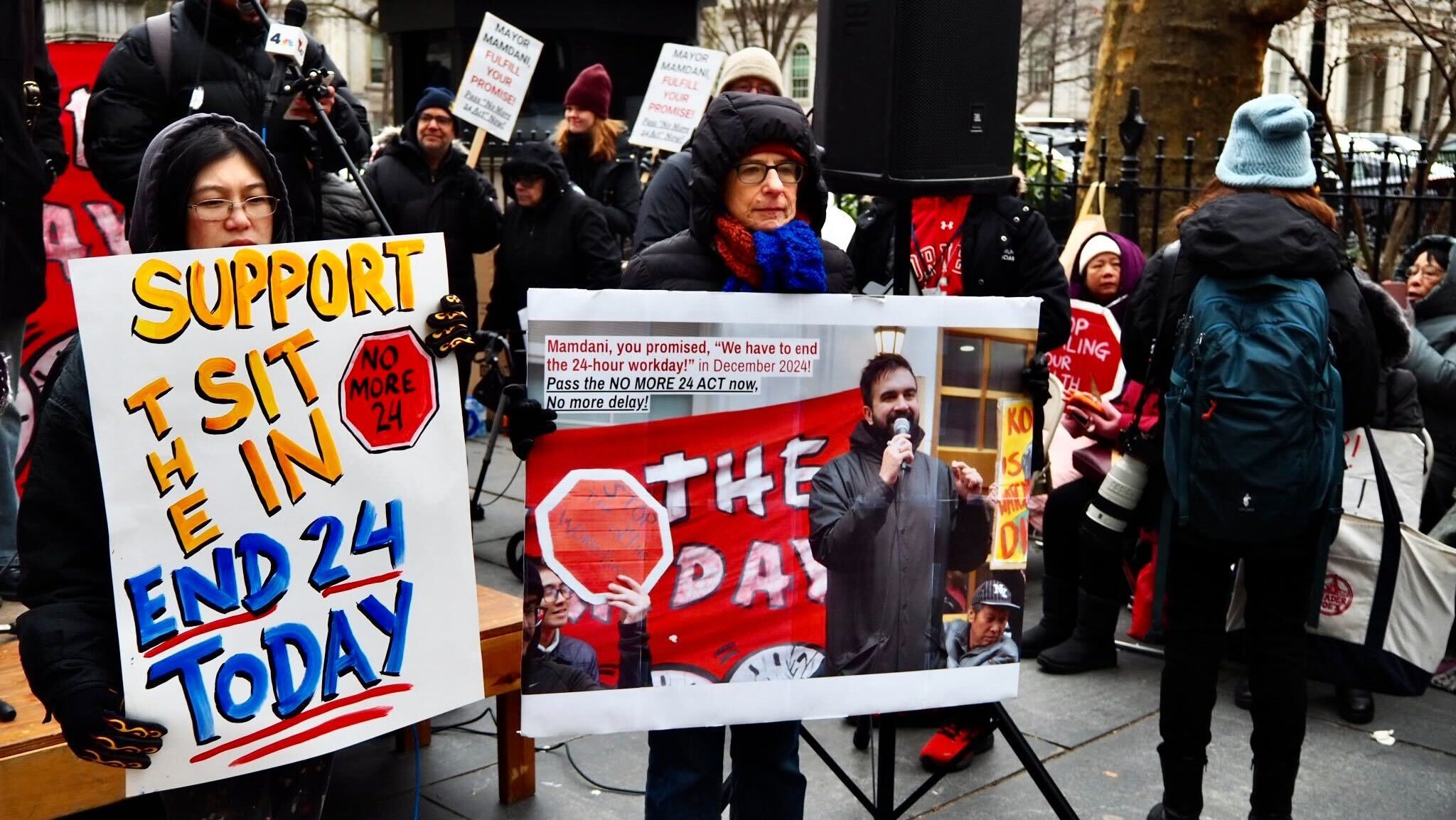
In New York: How does the Zohran showdown really play out?
Zohran Mamdani’s first action as New York City mayor was to reverse all executive actions signed by his predecessor, Mayor Eric Adams, after the date of Adams’ federal indictment on bribery charges. The message sent wasn’t just that the city needed to turn the page on the Adams era, but that New York had been compromised by Adams’ efforts to play nice with the Trump administration — most notably on immigration — in order to get them to drop his prosecution.

But that doesn’t mean that the first weeks of the Mamdani mayoralty will be marked with TV-ready standoffs between New Yorkers and the feds. For one thing, the intensive, city-by-city targeting that federal immigration agencies were engaged in through fall 2025 might not be the focus going forward. For another, the relationship between ICE and local police forces is likely to be an even more important story in 2026. Some police figures (and unions) could cozy up to ICE as a way to show opposition to their city’s political leadership, while other leaders continue to get upset that ICE’s signing bonuses and attack ads are depopulating and demoralizing their police forces. Look for the NYPD-City Hall relationship to be a big factor in what happens on immigration in New York City. After all, ICE still can only do so much without local support.
In the courts: How much damage does Trump’s agenda face from fed up federal judges?
One of the most surprising developments of 2025, as I noted the other week, was the willingness of federal district judges to issue rulings against the Trump administration, including ordering them not to deport — or even to release — individual detained immigrants. There are a few dynamics feeding the judges’ frustration: federal judges’ ongoing beef with the immigration court system, which they often find to be arbitrary and opaque; their reduced willingness to give the “presumption of regularity” to executive-branch officials, given how often those officials have been caught in half-truths or outright lies in court; and a growing tension between the Supreme Court, which keeps issuing unexplained “shadow docket” rulings reversing lower-court judges, and the judges who have to somehow interpret those rulings as precedent.
Does the Supreme Court find some way to halt the trend of federal habeas grants, thus making it easier for the Trump administration to deport people quickly? Do they keep allowing the administration to move forward with “de-legalizing” groups of people while lower courts decide if those actions are truly legal? Conversely, do other forms of federal court action — such as mandamus orders instructing the government to take action on stalled immigration applications — become more popular in 2026 as some federal judges lose what remaining faith they have in the executive branch to uphold the law without being specifically instructed?
In the economy: Does business continue to suffer in silence?
The most common prediction I heard for 2025 that utterly failed to pan out was that, faced with a mass-deportation regime, business owners who relied on immigrant labor would take a strong stand for their self-interest and force the administration to back down. This didn’t happen (the one time it looked like business had prevailed upon Trump to lay off worksite raids in certain sectors, the decision was reversed within days). An estimated 18.6% of the labor force in 2023 in the United States was foreign born, and according to the Economic Policy Institute, “were it not for immigration, the total prime-age U.S. labor force would have stagnated: Over 95% of the cumulative growth of the labor force in the past three decades is due to immigration.”
It’s possible to imagine a world in which this administration has picked enough high-profile fights with businesses (and universities) that anyone who relies on immigrants as a labor or consumer base has gotten intimidated out of speaking up. But it’s also possible that there is a point at which the economic pain becomes too much to bear in silence, and business owners start telling the administration (and the public) that things have gone too far. Will we reach that point? If so, will it be this year? Perhaps it will happen over the course of the midterm election campaign, when business interests might decide that they want to push for a Congress more sympathetic to their interests in 2027 and beyond.
In the media: Do we know anything anymore?
I had a lot of chats with reporters last year about the basic question of what to do when you have no idea if what the government has told you is accurate or not — or has even been checked. There remains a strong norm in conventional media that you ask the government for comment, and if spokespeople tell you something relevant to the story, you include what they say. But what if the comment is snide or dehumanizing? Or, worse, what if it contains allegations you suspect are wrong, and are unable to verify? How do you articulate that in your article in a way that both editors and the public will understand and accept?

你知道吗?非公民办理驾照时的这个错误可能会导致选民欺诈
I suspect that in 2026 we might see this skepticism and frustration inflecting coverage of top-line deportation numbers. Occasionally in 2025, DHS press releases would throw out hugely inflated numbers of removals, or of immigrants who had left the U.S. But the government continued to put out some data that seemed more reliable and consistent with prior administrations’ methods, so you could check the government against its own work. Any erosion of data reliability in 2026 — or an insistence from the White House that reporters take inflated numbers as seriously as they took the “Gulf of America” — could make it that much harder to gain a basic understanding of what this administration has actually done, and what it merely wants us to think it has done.
And finally, three big what-ifs that I couldn’t even begin to predict the consequences of, other than to say that they would be big:
- What if ICE simply decides to destroy the Detainee Locator, preventing lawyers and loved ones from finding out where detainees are being held?
- What if some of the flurry of third-country removal agreements the Trump administration signed in its first year actually end up being implemented at large scale, with thousands of people being sent to another country instead of a planeload or two every six months?
- What happens if (when?) border apprehensions go back up?
These are simply the known unknowns; who knows what stories that aren’t even on my radar will end up defining 2026 in immigration policy. But no matter what happens, the Documented team and I will be here to guide you through it.