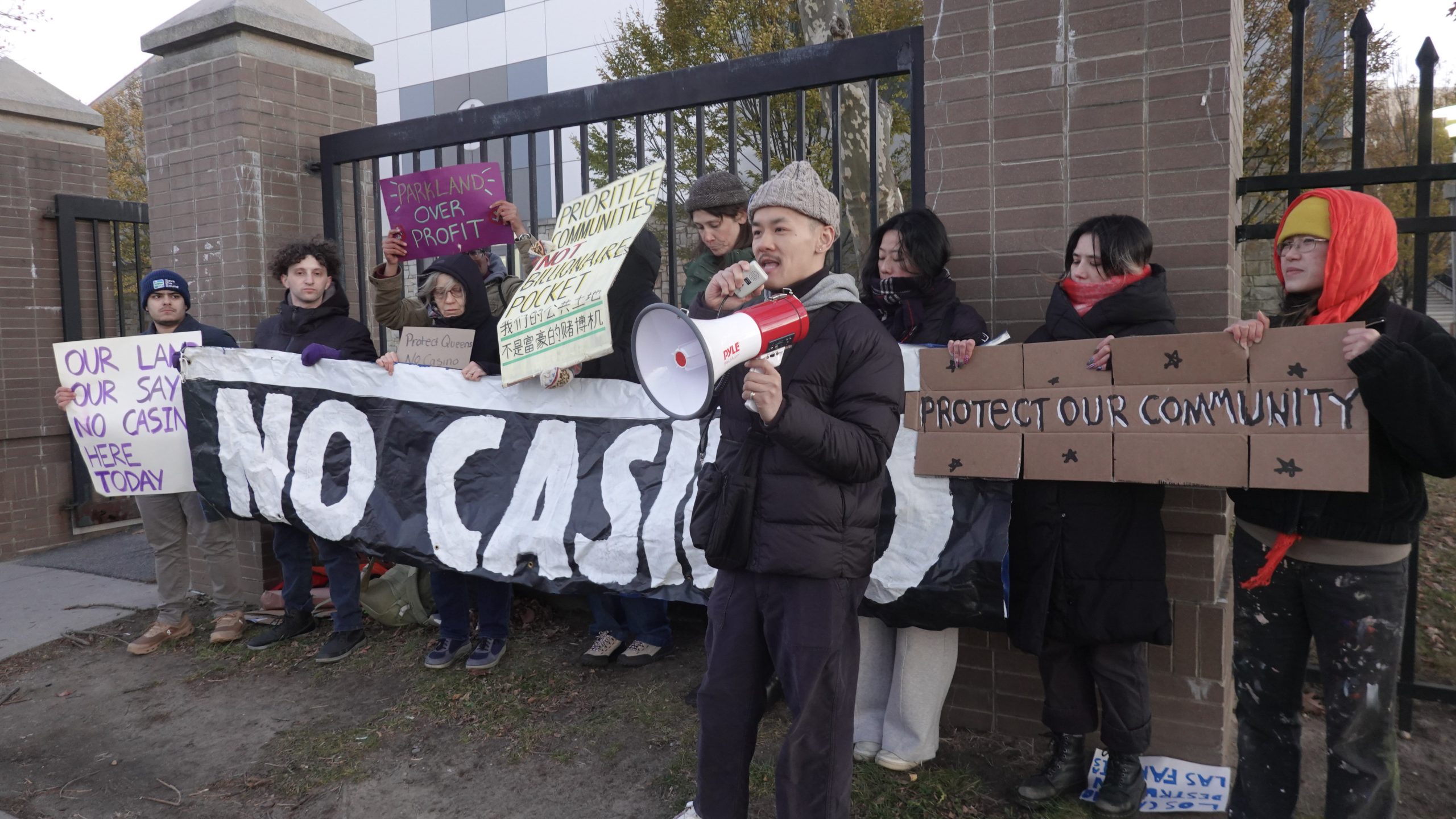


The air was chilly, but the crowd was fired up.
Outside the gates of St. John’s University on Monday, where the Gaming Facility Location Board was meeting about prospective NYC casinos, Jack Hu stood with a dozen community organizers from Queens and Bronx. Together they unfurled a roughly 10-foot banner that read, “WE DEMAND NO CASINO!!!”
The banner bore hundreds of signatures collected from participants at an anti-casino rally held in Flushing the day before — a testament to the growing vocal bloc of Asian community members in Queens who oppose the three casino proposals under financial review by the GFLB.

The three competing casino proposals in New York City — Bally’s in the northeast Bronx, Metropolitan Park near Citi Field in Flushing, and the expansion of the current Resorts World New York City in Ozone Park — each cleared a major hurdle in September after securing approval from their local Community Advisory Committees (CAC).
All three bids are now in the final approval stage for receiving up to three downstate casino licenses, which the GFLB is expected to award by December. As the decision deadline approaches, opposition from directly affected communities, particularly in Queens, has intensified.
“This is a predatory casino placed right next to an Asian community to extract wealth from us,” said Hu, a 35-year-old Flushing resident. Hu joined the anti-casino movement about three months ago after seeing a flyer from the Flushing Workers Center promoting a town hall on the proposal.
Like many opponents, Hu worries the project would do more harm than good. “The community struggles with [gambling]. You hear about a lot of illegal gambling parlors that happen in homes,” he said. “It’s a really big problem. It’s not helping the Asian community, and this is going to make it even worse.”
Sandy L., a volunteer with the Flushing Workers Center, pointed to a 2022 New York Times report noting that some casino operators who were scouting locations in New York City cited “proximity to large Chinese populations” as a top consideration. The article also noted researches, while limited, shows Asian Americans face a higher risk of gambling disorder than the general population. In 2023, a NYU Furman Center report showed that more than 54% of residents were Asian in Flushing/Whitestone, where the Metropolitan Park is going to be built.
“Because of the tendencies, because there’s the stereotype of locations near high Asian immigrant populations are highly favored by the casino industry, and that’s why we see buses in Chinatown to the casinos,” said L., adding that casino advertising is “everywhere in Flushing.” She recalled seeing the ads on subway turnstiles, trash cans, and inside shopping malls. “Now we have another private developer trying to take away public parkland to build a casino basically in our backyard. This is extremely predatory.” L. only shared her last name’s initial due to privacy concerns.
For Hu, the proposal brought back memories of his father’s long-standing gambling addiction. His father, a Chinese construction worker, routinely drove the family for hours to casinos in Atlantic City or Connecticut, to spend the entire day gambling before returning home the next morning.
“As long as I’ve been alive, my father has struggled with gambling,” Hu said. “I had to hide money from my father. I had to yell at my father. We had arguments over his gambling. […] And this is the type of life these people [casino operators] want for families in Flushing.”
Local residents also questioned whether the economic benefits promised by casino operators would materialize. The $8 billion proposal near Citi Field, backed by New York Mets owner Steve Cohen, would turn a 50-acre parking lot into a sports and entertainment complex known as Metropolitan Park. Developers say the project would create 23,000 union jobs and include 25 acres of public park space, according to its website. But a recent report found that, rather than delivering an economic boost, casinos often “reshuffle” existing jobs by pulling workers from nearby businesses, and that many of the jobs touted are temporary construction roles tied to the casino’s buildout.
At the rally on Monday, participants also criticized what they described as a lack of community awareness and meaningful involvement in the approval process. L., who attended two public hearings on the Flushing casino proposal, said both sessions were held during weekday work hours, making it difficult for 9-to-5 workers to participate. She also alleged that speaker lists were rearranged to “manipulate the process.”
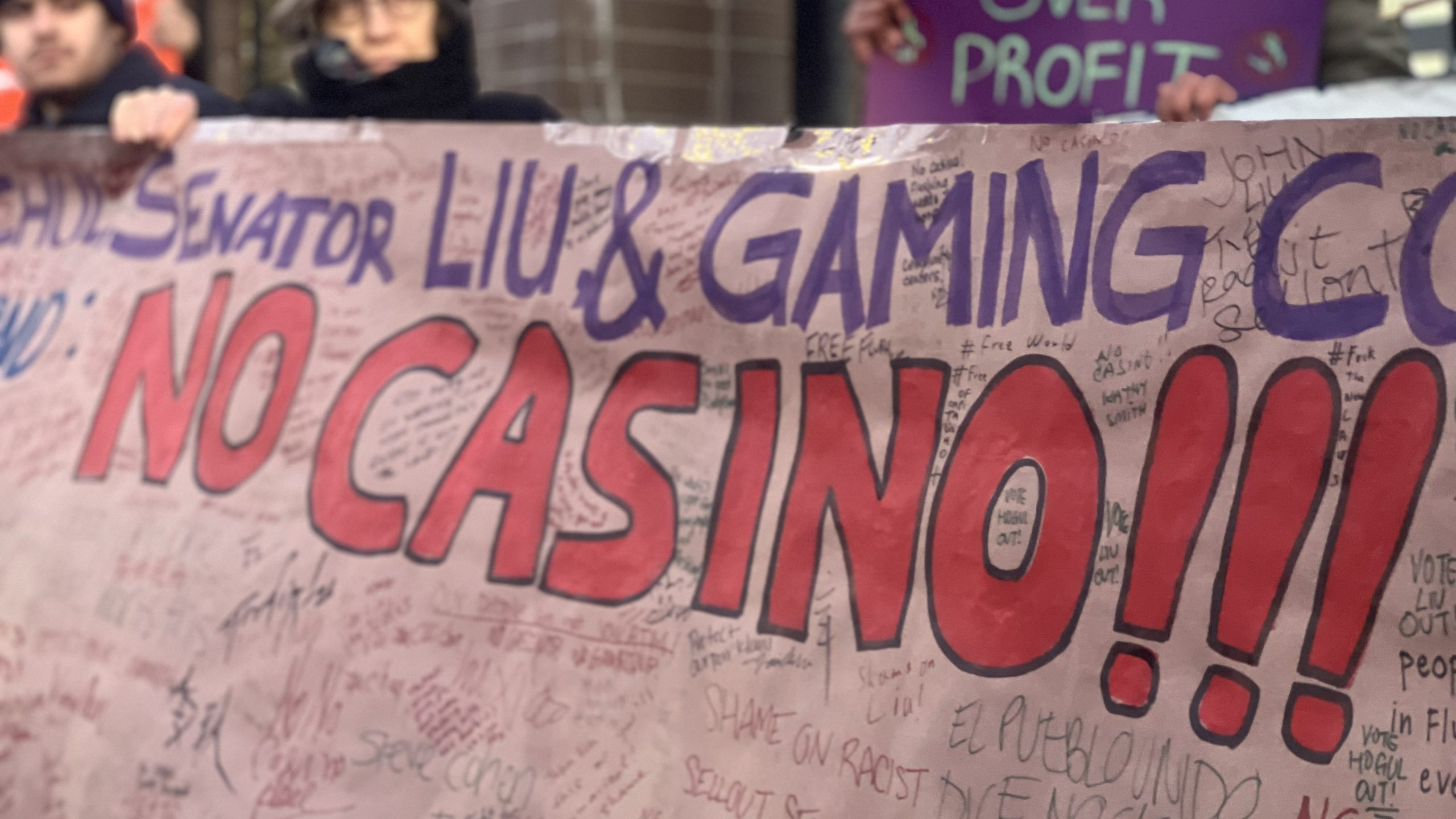
Kara Fan, a Flushing Workers Center volunteer who lives in Elmhurst, expressed disappointment in State Senator John Liu, whose district includes parts of the area that would be affected by the Flushing casino. Liu published an op-ed opposing gambling in 2024 but introduced a bill earlier this year alienating the parkland, which transfers a park’s use from public recreation to private use, a necessary step needed for Metropolitan Park to move forward with its proposal. Many opponents have said Liu’s move is a shift driven by financial interests over community concerns.
However, Liu told Documented he has not changed his stance on gambling.
“I’ve never stated a position on this proposal [Metropolitan Park], but I have clearly articulated my concerns about gambling and gambling addiction,” he said, referencing the op-ed. “If I had the power to do so, gambling would be illegal in New York. And there would be no casinos.”
He added that the three casino proposals stem from voters’ 2013 approval of a statewide gambling expansion, allowing up to seven commercial casinos, including three in the New York City area. Liu said the expansion of casinos in NYC is already set by state law and will move forward in neighborhoods near his constituents. “I don’t like gambling, but the reality is that three casinos are coming to New York City,” said Liu. “Given that reality, I submitted that bill so that the Mets owner can submit that proposal. And in the process, I got as much as possible in benefits for the community.”
The MinKwon Center for Community Action on Wednesday released the results of a localized survey of 371 Flushing voters, conducted as part of the 2025 Asian American Exit Poll. It found that the vast majority of Asian American residents in the area were excluded from the official public feedback process for the Metropolitan Park casino proposal.
The survey, which asked whether respondents were able to voice their opinions through the CAC process, revealed a significant gap in community engagement, with 83.5% of Flushing Asian American participants saying they were either unaware of or unable to participate in the proposed casino’s CAC process, which was supposed to hear the voice of the people and represent their interests.
Another 2024 joint exit poll conducted by MinKwon and AALDEF showed 68.6% of Flushing Asian American voters oppose the casino, citing “gambling addiction,” “public safety,” and “congestion” as their top factors.
Also Read: Study Finds Queens Casino Bid Could Displace Over 50,000 Renters
“This poll confirms what we experienced on the ground: the Community Advisory Committee process was a failure by design,” said Yu Soung Mun, president of the MinKwon Center for Community Action, in a press release shared with Documented. “These numbers are not an accident. They are the direct result of a flawed and undemocratic process that was actively hostile to public participation. A process that 83% of local voters were excluded from cannot be masked as ‘demonstrated community support.’ It is a sham, and this poll is the proof.”
MinKwon and other community members urged the NYS Gaming Commission to suspend the licensing process until a formal investigation of the Metropolitan Park CAC process is completed and public complaints are fully reviewed. They want both the GFLB and the Gaming Commission to reject the Metropolitan Park proposal because of widespread community opposition and concerns over its social, economic, and environmental impacts.
In a statement shared with Documented, the New York State Gaming Commission noted that the casino siting process has already provided “substantial opportunity” for public input.
Lee Park, deputy executive director at NYS Gaming Commission, said the CACs, an independent body appointed by the elected officials representing the location of each proposed project, were obligated to conduct meetings in accordance with New York State’s Open Meetings Law and each was required to conduct no less than two public hearings.
“Each public hearing conducted was properly noticed in accordance with the law, evidenced by the hundreds of individuals who participated at 16 public hearings,” said Park, adding that GFLB’s website also provided details on how the public could provide input, whether by participating in a hearing or providing written comments. Park also pointed out that the city has undertaken a City Environmental Quality Review, which enabled input on social, economic, and environmental impact regarding the casino proposals.
你知道吗?非公民办理驾照时的这个错误可能会导致选民欺诈
As of publication, Metropolitan Park had not responded to inquiries regarding community members’ concerns about the lack of public input.
Rebecca Pryor, executive director of Guardians of Flushing Bay, the group leading opposition to casinos in New York City’s public parks, also highlighted environmental and social risks linked to building a casino in Flushing Bay, including more traffic, air pollution, and water pollution.
She warned that the Flushing casino threatens to displace tens of thousands of residents and would take away public parkland from Flushing Meadows Corona Park. That area, she said, is already underfunded and understaffed, despite being larger than Central Park. “We are calling on the city and the state to invest in our public parkland,” she said, “not give it away to a billionaire for a 78-acre Vegas-style casino project.”