

Bronx high schooler Joel Camas was freed today from immigration custody on bond after nearly a month in the hands of federal immigration authorities.
In October, Camas became the latest high schooler to be detained by Immigration and Customs Enforcement (ICE) in New York City. His case, which became highly publicized in part due to his Special Immigrant Juvenile Status (SIJS), made headlines and even garnered the attention of the mayor and city comptroller. After today’s ruling by Judge Cathy Seibel, he was allowed to leave a federal youth shelter and return to his uncle’s care in the Bronx.
Now he will await the court’s decision on whether to stop his deportation.

Camas told Documented that he was looking forward to returning home and telling his family about everything he’s been through in the last month.
“When the judge was hearing the case I felt a little nervous,” Camas said in Spanish. “I didn’t know what was going to happen, and when my lawyer said that she was going to let me go free, I felt better, relieved.”
Camas’ case is one of the latest in a string of ICE arrests of youth in New York City, a trend that has concerned advocates and city officials who speak out against the broadening dragnet of deportations by federal immigration authorities. In August, Mamadou Diallo, 20, of Brooklyn, was also arrested at immigration court.
As the judge began her final statement of the day, Camas and his lawyer from The Door looked at each other with cautious optimism after roughly an hour of oral arguments in the White Plains courtroom.
“Plaintiff has shown immediate release is necessary,” Judge Cathy Seibel told onlookers.
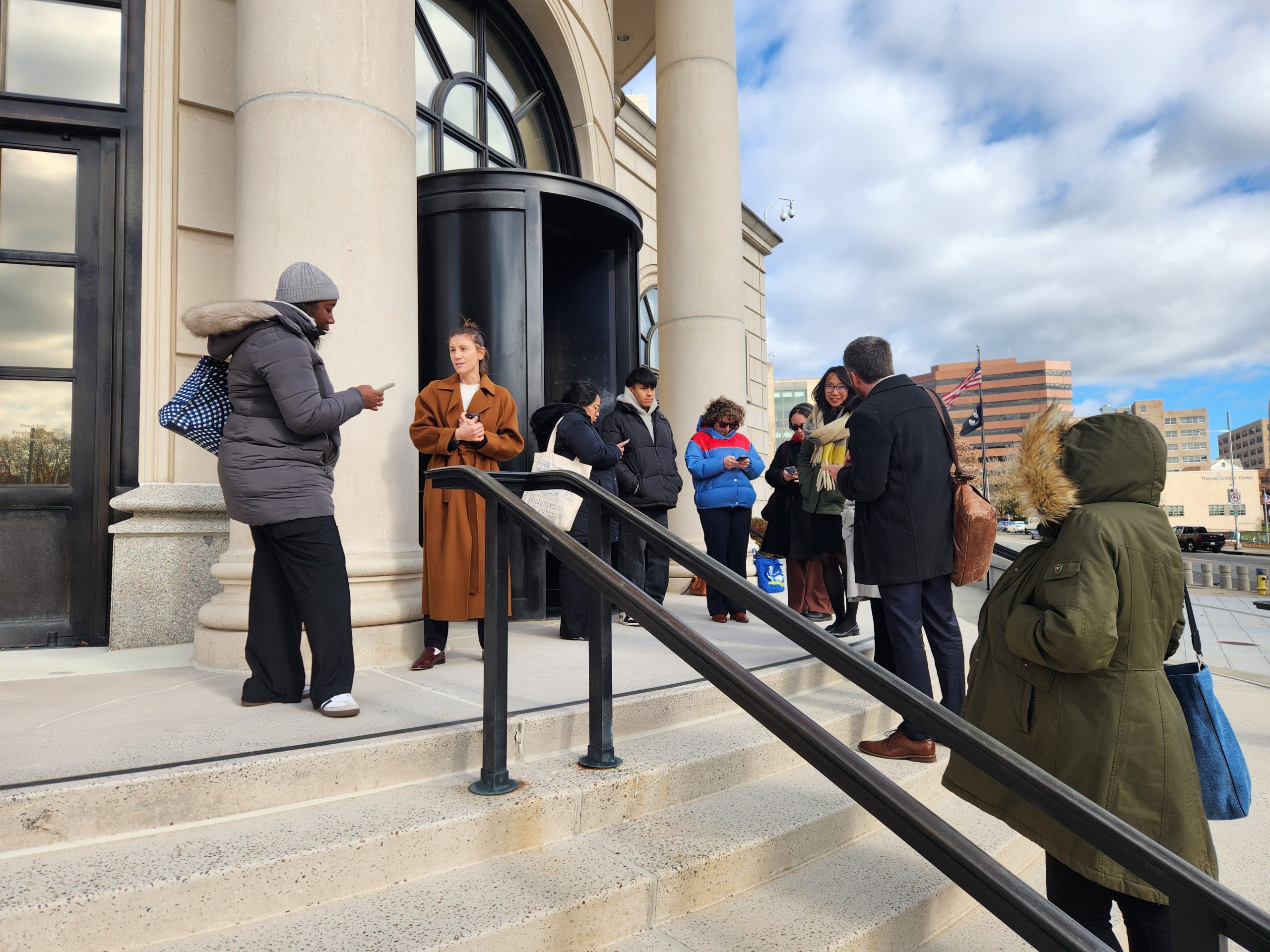
The 16-year-old couldn’t stop from smiling. He rose from his bench, walked out through the court’s wooden doors and was greeted by an elated legal team and group of supporters, including educators from Gotham Collaborative High School.
Once outside the courthouse, he stepped freely into the brisk November air and called his mother in Ecuador. Leaning over to quietly speak to her, he pulled his hood up over his head to help guard against the wind.
“I felt really good to tell her the news, and she felt a little more relieved,” he said.
In October, Camas was arrested at a routine check-in with ICE and sent to a youth shelter run by the Office of Refugee Resettlement. Four weeks earlier, his mother, Elvia Chafla, had self-deported to Ecuador in a herculean effort to protect him after the two fled Ecuador due to gang violence in 2022, according to court documents.
The case, first reported by the New York Times, caused a citywide uproar, earning the boy supporters at the highest levels of government.
“He can’t have a normal life here,” Chafla told Documented from her mother’s home in Ecuador.
Chafla said that while she was happy to hear of his release, she was still worried about his future.
“Now I don’t know what will happen to my son,” she said in Spanish.
In April, Camas had received Special Immigrant Juvenile (SIJS) status, a designation that federal immigration authorities confer upon immigrant youth who have been found by a state court to have been neglected, abandoned or abused by their guardians in their home country.
SIJS was created by Congress to provide legal protections to vulnerable immigrant children and requires that the juvenile court also finds it is not in their best interest to return to their home country.
The youth are given the opportunity to adjust their status and become permanent residents but have to wait — often for years — for official visas to become available.
Under the Biden administration, youth with the status were protected from deportation as they waited for the opportunity to apply for a green card. But in April, the Trump administration stripped those protections, leaving young people like Camas vulnerable to deportation as they waited in line to apply.
Also Read: What is Special Immigrant Juvenile Status (SIJS)?
As soon as Camas was detained, lawyers with The Door, the New York Civil Liberties Union and American Civil Liberties Union filed a writ of habeas corpus, requesting his release from custody and claiming the arrest violated his “statutory and constitutional rights.”
“[Camas] respectfully asks this Court to hold that his continued detention is unlawful and order his immediate release from custody,” read the original suit.
At Monday’s hearing, lawyers sparred over whether Joel could in fact be deported, or whether he had the right to rejoin his family and school.
“The government made [SIJS] to protect vulnerable children like Joel… it has to mean something,” said NYCLU attorney Elizabeth Gyori. She also noted that as Camas awaits his opportunity to apply for a green card, he would need deferred action in order to apply for a work permit. The determination would be an additional protection against deportation.
However, government lawyer Rachel Kroll disagreed, waving her hands as she argued before the judge.
“There’s nothing in the statute that protects you from removal,” she said.
While the judge pushed back on both sides, Seibel questioned the government with particular intensity.
“Why would Congress pass a law that says you need a legal pathway…but any time we feel like it for no particular reason we can pull you out of the line and strip you of that status?” Judge Seibel asked the government on Monday.
Quoting the Vietnam War protest song “War” by the band Edwin Starr, Seibel later said: “ ‘What is it good for? Absolutely nothing.’ ”
Seibel did not make a decision on the suit, but noted that, among other things, Camas’ SIJS status, his absence from school and the threat of psychological harm from being in federal custody was enough to reach the extraordinary circumstances needed to release someone from immigration custody on bond.
“I do find it extraordinary, the combination of factors here,” she said.
The decision on Monday came to the happy surprise of Camas’ lawyers, who noted that it was a high bar to be released on bail by a federal judge.
“We’re really excited that he’s going to be able to rejoin his community, to go back to school tomorrow, and to continue pursuing his dreams here in the U.S.,” said Gyori. “We’re all very, very thrilled,” she said, adding: “The rest of his claims are still pending.”
Judge Seibel also mulled the possibility of waiting for a decision on Camas’ case until a different case in the Eastern District of New York is concluded. The case, A.C.R. v. Noem, will decide if Trump’s removal of protections for kids like Camas violated federal law.
For now, Camas was able to leave the White Plains courthouse with his uncle and guardian, and return to normal life.

你知道吗?非公民办理驾照时的这个错误可能会导致选民欺诈
To Camas that means returning to his role as defender in his weekend soccer games in the Bronx, and getting back to his studies. He’s grateful, he said, for his lawyers and the community members that support him.
While he was in the shelter, he said he received letters and messages that helped him stay strong.
Camas also had a message to others like him: “Never give up,” he said. “Anything is possible with faith.”