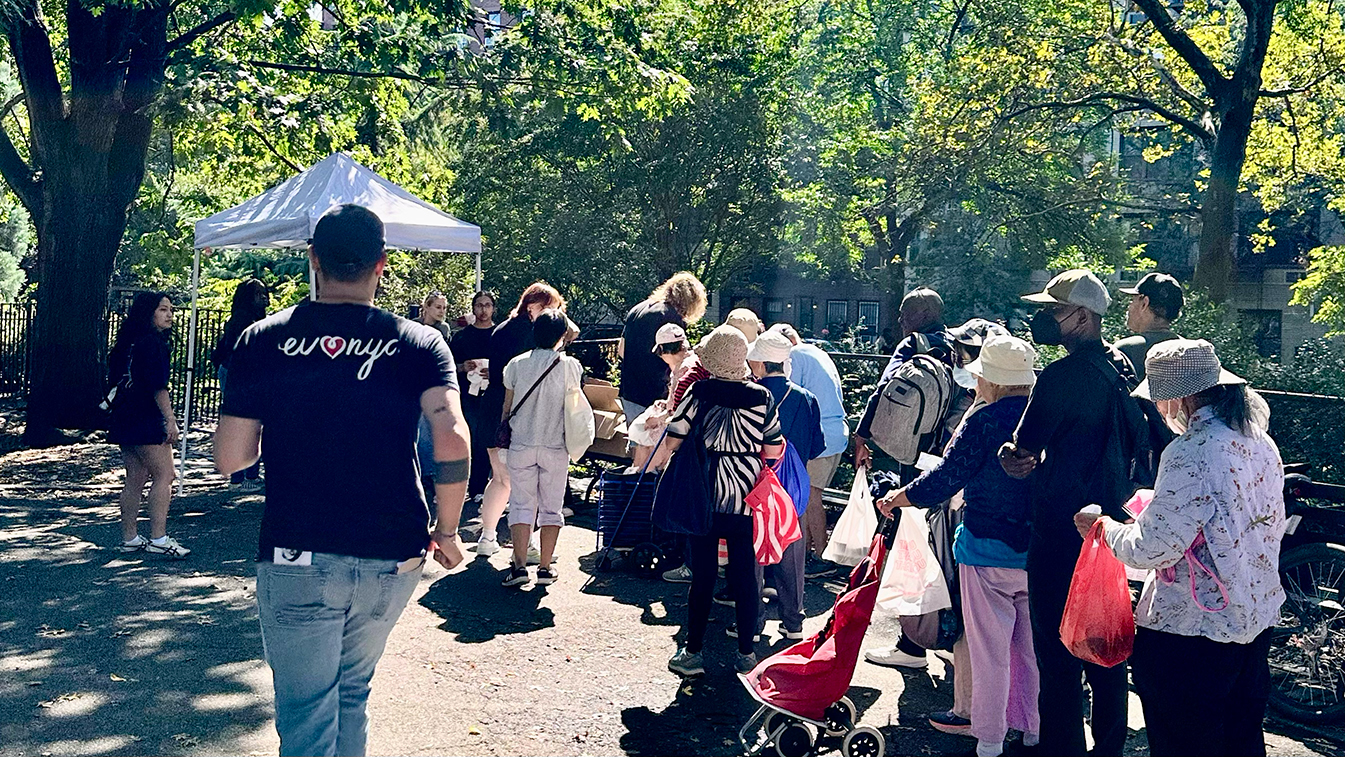


President Donald Trump signed a bill Wednesday night to end the longest government shutdown in United States history. The effects of the 43-day closure, however, continue to impact millions of Americans, including many of the 2.9 million New Yorkers across the state — 1.8 million in New York City alone — who are recipients of the Supplemental Nutrition and Assistance Program (SNAP).
As a result, food pantries and soup kitchens across New York City have witnessed a sharp increase in food insecure residents who have come to them during the shutdown. And while the government may be reopening and slowly start resuming operations, SNAP recipients are unlikely to receive their benefits right away. The issuance of the funds is typically planned a month in advance.
Food pantries around the city have since ramped up supplies, while other community organizations have even launched emergency food pantries specifically aiming to assist federal workers who have gone weeks without pay and SNAP beneficiaries who have gone weeks without federal food assistance.

Also Read:
“Food insecurity is everywhere,” said Ann Shields, communications director at EVLovesNYC, a volunteer-run food pantry that has operated since 2020. “Food insecurity isn’t an unhoused person in front of you or your supermarket, rattling a cup full of change. It is everywhere.”
Documented spoke with Shields to learn more about the impact the government shutdown has had on food insecure New Yorkers, and how organizations like EVLovesNYC adapted to meet the demand and the moment.
Rommel H. Ojeda: You have been doing this work for a while. Can you tell me what you have seen lately?
Ann Shields: I think the SNAP benefits thing really hit the people we serve hard. That’s pretty clear. If you’re receiving $250 a month for food, it is not like you can put some aside in the months ahead of a government shutdown. That’s not enough to cover food in New York, no matter how many rice and bean meals you eat.
We have been seeing an uptick in people’s distributions. Now we are in a new kitchen, and some neighbors in Section 8 housing have been coming and picking up meals every day. So being able to serve them lunch I think is really helping offset the anxiety.
We have definitely seen longer lines, kind of a little more desperation. A guy handed one of our volunteers, Kelly, 67 cents in change on Sunday, and said: “I can’t really take something for free, but I gotta pay you something.”
And you mentioned that new faces are coming to these places. What do they say?
People don’t often linger to chat. But often people take a meal, or three or five, and say “Thank you” and leave. They don’t linger because there’s a line, for one thing. But, yeah, people are insecure about all sorts of things, not just SNAP benefits. Winter coming, SNAP benefits, the government shutdown — all are factors in a growing kind of anxiety and despair. Prices are going up, and we do hear about that, too. It’s just gotten more expensive to go to the supermarket or the bodega or whatever. You know, everything costs more.
Before the government shutdown and before the fall kicked in, what was the usual number of people that would show up during the days of food distribution?
I can look at a chart and get that number for you. But the one we have at Houston (Houston and LaGuardia), our newer distro, there are a lot of retired people living in rent-controlled buildings that are being kind of pushed around by their landlords and really having a hard time getting by. So, that particular distro gets four boxes, so 100 meals.
That’s the one that went through them in an hour last week. Usually it’s two hours, and [volunteers] come back with usually ten vacant meals. We’re sending more, more meals this week. We’re gonna send them an extra 25.
(For context, EVLoves distributes 3,500 meals weekly in two distributions at Tompkins Park and through distribution partners.)
It’s usually two hours and now it’s just one hour. It shows the demand has increased.
Yeah. And people are taking them back to their neighbors. Especially older people in rent-controlled housing. A lot of times they have neighbors who are not able to get up and down the stairs more than once a day, so they bring stuff back for them, which is so sweet. They always talk about it, you know? There is an older gentleman there. He’s always really nicely dressed. He is super gracious and polite. He’s a veteran and he worked for the government, and he’s on serious fixed income. He takes three meals and apologizes every time, like, “I did not mean for my life to be like this, to end like this.”
With more meals, there’s also the need for more raw materials, more groceries. How are you compensating for that?
People are being super generous. We have seen a marked increase in people trying to volunteer. Our volunteer slots fill up immediately. People are so eager that they write to me at the address on the website saying, “Can I please come anyway, even though the slots are filled?”
But that’s true for donations too. We’ve had some very generous donations because people see that it [food insecurity] is no joke. Our average donation is still like $38 or something. Some people are very generous, and the generosity from people who don’t have money is even more remarkable to me. We get $5 and $10 donations. It’s really, really sweet. People are aware of what’s going on in the community and they really wanna be part of helping everybody along.
Is there anything else you would like to add? Anything, people should keep in mind?
I walked outside two days ago and it was so bitter cold. And I know a lot of our newest neighbors are from climates that are not this cold — from Central America, and Western Africa. I just hope people keep that in mind when they can’t fit another coat in their closet. Think about people who aren’t set up for this and donate clothes. Donate money for things like the food pantries at schools and churches. Bring canned goods.
你知道吗?非公民办理驾照时的这个错误可能会导致选民欺诈
I know stuff in my personal pantry that I haven’t used and probably won’t use … I can just give it away. It’s not costing me anything now. Remember to share.
You’re not in it alone and make sure that other people know that they’re not in it alone. We’re a community.
This interview has been edited for concision and clarity.