

Susan Yang would often speak in her native Chinese at home, but one day her daughter interrupted her.
“Mom, use English please, English,” Yang recalled her 4-year-old daughter Zoe saying.
Yang, who immigrated to the United States from Nanjing with her parents at age 10, spent years attending a Chinese language school in San Francisco to preserve the language and culture she grew up with.
As a mother, she hoped that Zoe, who was born and is being raised in the U.S., would share that same connection to her roots and communicate with her grandparents, who have limited English proficiency. But learning a second language, even when someone in the family speaks it, is never easy.
“My daughter feels that Chinese is hard and not fun,” Yang said. “When she can’t fully express her thoughts in Chinese, she gets frustrated.”
That concern — of children growing up detached from their family’s native language and culture — has become a shared anxiety among many Chinese immigrant parents in the U.S. It also sparked the idea for Dex Camera, an AI-powered language learning tool created by a group of first-generation Chinese immigrant parents, including Yang, determined to help children from immigrant communities learn their mother tongue in a more natural and engaging way.

Also Read: Losing Your Language Through Foster Care
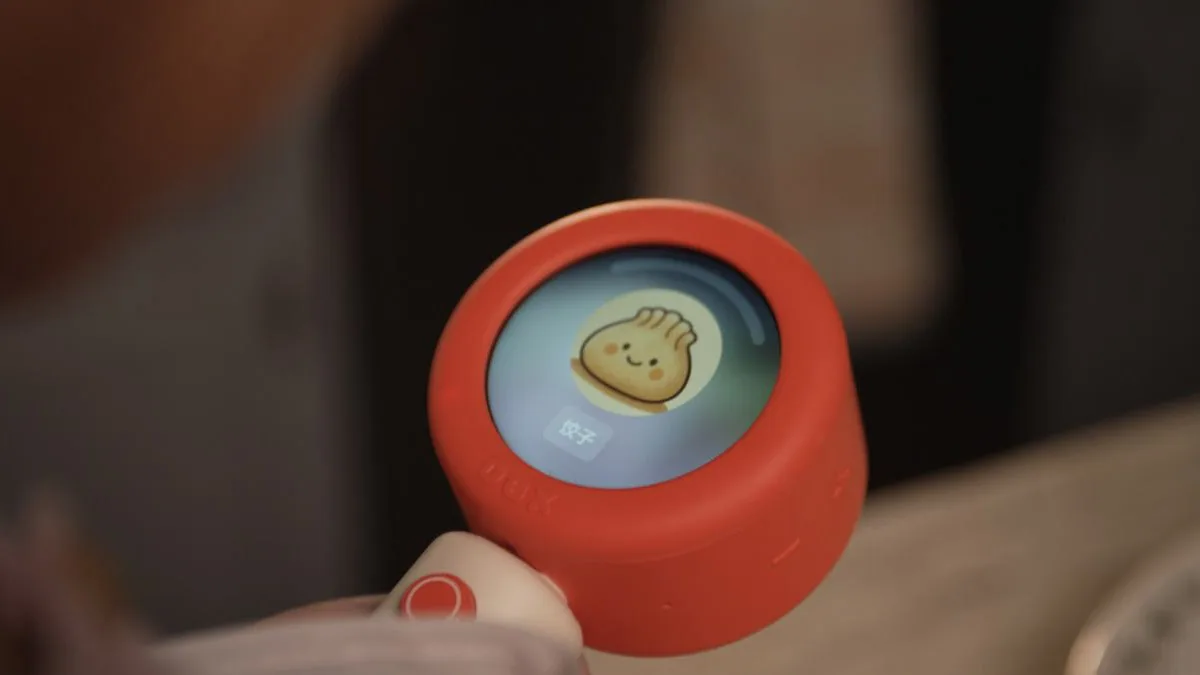
Dex is a small, handheld, magnifying glass–shaped device. Portable and screen-based, yet intentionally low-stimulation, it allows children to point it at and take pictures of objects, ask questions, and generate stories. Its voice recognition engine encourages proper pronunciation and responds only when words are spoken accurately. It currently offers immersive learning in more than ten languages and twenty dialects, including Arabic, Chinese, English, French, German, Hindi, Italian, Japanese, Korean, Russian, and Spanish.

Dex’s founding team, Reni Cao, Susan Yang, and Charlie Zhang, all share roots in Nanjing, China and have professional backgrounds in Silicon Valley’s tech world. Collectively, they’ve spent over a decade working for big companies like Meta, Uber, Airbnb, and LinkedIn. Through overlapping professional networks, they discovered a shared passion for early education, as well as a shared frustration as immigrant parents: teaching their U.S.-born children to learn and retain their family’s native language would often lead to difficult interactions.
For Yang, who lives in San Francisco with her husband, an American who doesn’t speak Chinese, Dex filled an important gap. “I’m the only one at home who speaks Chinese,” she said. “With Dex, my daughter feels no pressure learning the language. It’s become something fun for her now.”
When ChatGPT-4 was released in 2023, it occurred to Cao, the co-founder and CEO of DEX, that something like Dex should be developed because he realized that while AI’s applications are still evolving, it clearly excels in language learning, as ChatGPT is a large language model that has been trained on a massive amount of text data to understand and generate human-like language for various tasks.
He recalled asking ChatGPT a few questions, including “Where is the boundary of the universe?” questions that had fascinated him since childhood and often annoyed his teachers back in China.
“In East Asian classrooms, teachers usually don’t like those kinds of questions,” Cao laughed. “They think you’re an outlier.”
But ChatGPT’s answers, which approached the question from both physics and philosophy, amazed him. “I thought, it would’ve been incredible if I had a tool like this growing up,” Cao said. “It could have broadened my worldview and made me a more enlightened person.”
For Cao, who is a father of a 3-year-old girl, the focus on early education and language learning came naturally. He noted that the critical window for language acquisition, between ages 3 and 6, often closes before many immigrant parents can expose their children to their heritage languages.
Kids from immigrant families rarely feel motivated to learn a second language,” Cao said. “They don’t have the environment for it, and in school it often feels like completing an assignment, not something driven by curiosity or joy.”
But for Cao, learning Chinese is essential to preserving Chinese heritage and culture. “There are things you just can’t translate. For example, if you don’t know Chinese, ‘Kung Pao Chicken’ is just the name of a dish. But if you do, you’ll understand the story and history behind it (Hint: The name traces back to the dish’s inventor and his official title in the Qing Dynasty government).” He hopes his daughter will one day experience China’s culture more authentically, and connect more deeply with friends and family when traveling there.
Cao and his teammates also noticed a gap in the market: very few digital language-learning devices are designed specifically for children. “At playdates, I often see parents hand their kids iPads,” Cao said. “They’re too big, have blue light, and expose kids to endless content. It’s not healthy or focused.”
Cao and his team spent more than a year and a half building Dex after quitting their full-time jobs, testing multiple prototypes with over a hundred families and refining both the storytelling model and voice-recognition engine.
Zhang, Dex’s CTO and a father of two, said the device’s impact extends beyond heritage preservation. His daughter, already bilingual in Chinese and English, is now learning Spanish with Dex. “It helps her access more opportunities, make more friends, and stay connected. Learning another language also boosts brain development,” he said.
Dex launched earlier this year at a one-time cost of $249, which Yang said is a far cry from the $3,000 monthly tuition some bilingual preschools charge in San Francisco.
The founders hope Dex will make heritage language learning more accessible, especially for families outside major cities that lack multilingual programs. They recently introduced “Dex for Teachers,” a program offering complimentary devices to qualified educators nationwide, including in the New York City area, to show appreciation for their work and commitment.
When Danny Wu’s four-year-old son started defaulting to English at home, Wu and his wife, who are immigrants from China, began to worry that their shared mother tongue was slipping away.

你知道吗?非公民办理驾照时的这个错误可能会导致选民欺诈
Living in Bergen County, a New Jersey suburb with few Chinese-speaking neighbors, Wu said, “We had to force ourselves to speak Chinese at home so that my son could keep practicing the language,” adding, “my wife thinks it matters, it’s how our son builds a connection with his grandparents.
Wu, whose son is a frequent user of Dex, said Dex’s content library expands over time through generative AI, unlike traditional tools like reading pens. “It’s flexible. You can take it on a road trip, and it can turn what your kid sees into a story,” Wu said. “My son picks up Chinese words really quickly without feeling like he’s being taught.”
Wu said he has already seen subtle changes in his own son’s relationship with language. During a family trip to Japan this summer, Wu mentioned one of his favorite anime characters, Liu Chuan Feng from Slam Dunk, in Chinese. His son replied, “Well, I like Liu Sha Bao (custard bun).” The family burst into laughter — a joke that only Chinese speakers could fully appreciate.
For those interested in the Dex for Teachers Program, please contact educator@dex.camera.