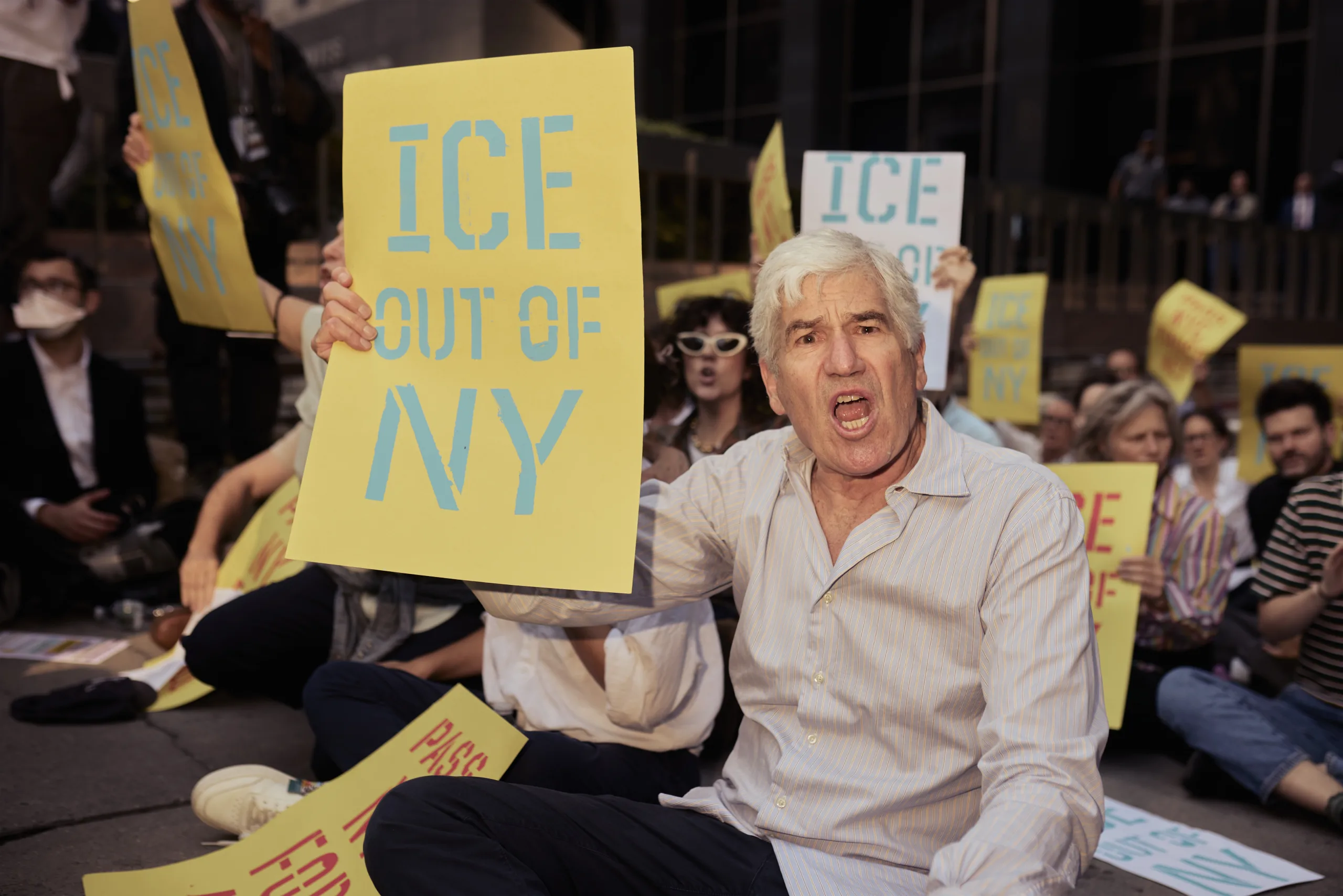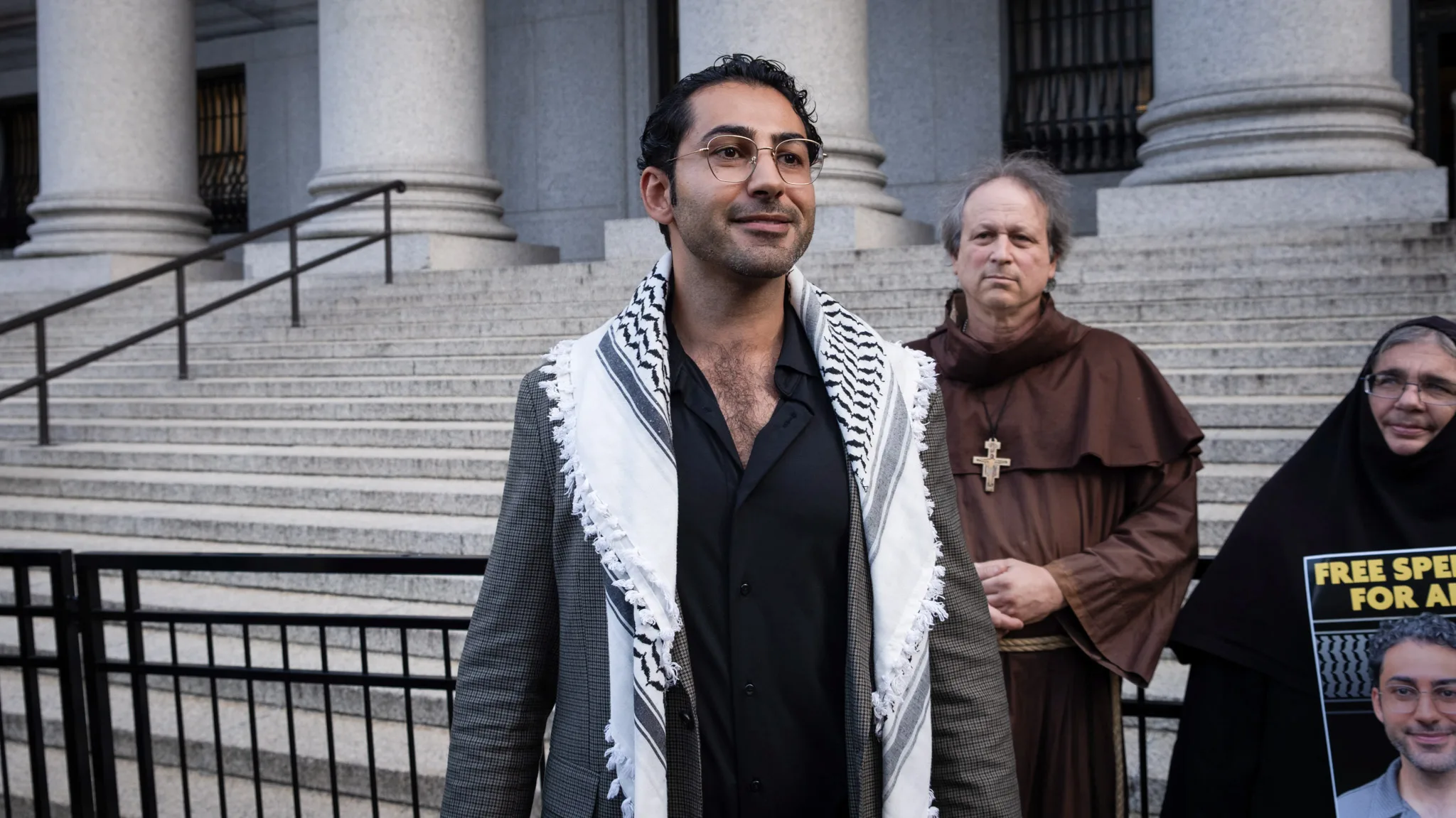


Last Tuesday, Mohsen Mahdawi, a Palestinian activist and Columbia master’s student who has faced a months-long deportation effort by federal authorities, stepped out of the courthouse at 40 Foley Square.
Federal prosecutors have been seeking to re-detain Mahdawi, along with Tufts PhD student and Turkish national Rümeysa Öztürk, since late spring when they were released from immigration detention.
“We have to have and to hold on [to] hope that justice will prevail,” Mahdawi said just steps from the courthouse, addressing the crowd of supporters and press who waited outside. “My case will be the test for the constitution and the First Amendment rights that apply to everyone in this country.”

Already, these high-profile cases are having a chilling effect on immigrants’ speech across the country — and legal experts, as well as Mahdawi and Öztürk’s attorneys, warn that the arguments used by Trump administration officials to restrict pro-Palestine speech by immigrants can, and likely will, be applied to limit to the First Amendment rights of U.S. citizens, too.
“Palestinians and the pro-Palestine movement in America [are] actually functioning as the canary of this country, the canary in the mine basically, that tells you that there is something wrong,” Mahdawi said in a conversation with Documented after the hearing.
He added: “They have started with pro-Palestine speech, but the project is much larger. The project is to basically crush any level of dissent, to intimidate people from speaking up against the government and against those unjust policies.”
Also Read: After Mohsen Mahdawi’s Release, What’s Next for Other Detained International Students?
Esha Bhandari, who represents Öztürk and is deputy director of the ACLU’s Speech, Privacy, and Technology Project, noted that while most of these high-profile cases have targeted university students who have engaged in pro-Palestine speech, the Trump Justice Department’s use of immigration law to restrict the constitutionally-protected speech of immigrants has spread beyond a university context.
“The government can use this to say anyone who criticizes the administration’s economic policy, tariff policy, anyone who says anything about the administration that’s critical at all could be subject to this,” she told Documented. “What the government wants the courts to bless is executive power to censor speech through the use of its immigration enforcement authority, and the First Amendment just doesn’t allow that.”
Other legal challenges
Mahdawi, a prominent activist during Columbia’s pro-Palestine student protests last year, was arrested and held in immigration detention for sixteen days after checking in for his citizenship naturalization interview in April.
Öztürk, a Turkish citizen who was arrested off the street by masked ICE agents during Ramadan, was detained for six weeks after her student visa was revoked following an op-ed she had co-written in the Tufts student newspaper criticizing the university’s investments in Israel amidst the ongoing genocide in Gaza.
In back-to-back hearings last Tuesday afternoon, as supporters filled the court and overflow rooms, Tyler Becker, a lawyer for the Trump Justice Department, argued that the release of Mahdawi and Öztürk, ordered by federal district courts in April and May respectively, fell outside those courts’ jurisdiction. As a result, the federal government is seeking to re-detain both students while their deportation cases go through immigration court.
However, lawyers for Öztürk and Mahdawi argued that the district courts did, in fact, have the authority to rule on the students’ detention – and that their detention, which was illegal, was a separate legal matter from their pending deportation cases in immigration court. Moreover, both of their legal teams, as well as experts who spoke to Documented, refer to their cases and the series of others like them as a flagrant violation of First Amendment rights — which apply to everyone within the U.S., not just citizens.
The intersections of First Amendment and immigration law in Öztürk and Mahdawi’s cases echo other cases around the country. Just hours before Tuesday’s hearing in New York, William G. Young, a federal judge in Boston, issued a ruling on a separate case brought by the American Association of University Professors (AAUP) and other academic organizations against Secretary of State Marco Rubio.
In the lawsuit, the AAUP, through the Knight First Amendment Institute, challenged the Trump administration’s policy of targeting non-citizens for deportation based on protected speech. That policy, the lawsuit argued, led to a “Climate of Fear and Repression for Noncitizen Students and Faculty” – in effect, an unlawful chilling of free speech.
In his 161-page ruling, Young, who was first appointed by Republican President Ronald Reagan, forcefully condemned the Trump administration’s use of immigration law to target pro-Palestine activists, calling the targeting a “full-throated assault on the First Amendment across the board under the cover of an unconstitutionally broad definition of Anti-Semitism.”
Additional legal challenges to Trump administration policy have also arisen in recent months.
In the spring, Secretary of State Marco Rubio cited a rarely-used provision of the McCarthy-era 1952 Immigration and Nationality Act to initiate deportation proceedings against Mahmoud Khalil, claiming that his presence would have “potentially serious adverse foreign policy consequences” for the United States. Khalil, a prominent activist and lead negotiator in Columbia’s pro-Palestine protests, was released on bail after 104 days in immigration detention — though his deportation case is ongoing.
Rubio cited the same provision in Mahdawi’s deportation case, and in the termination of Öztürk’s student visa in March. In response, the Foundation for Individual Rights and Expression (FIRE) sued Rubio in August, challenging the provisions that gave him the power to revoke the visas of non-citizens at any time, and to deport non-citizens for protected speech. The lawsuit was filed on behalf of the student newspaper at Stanford, where noncitizen journalists have declined reporting assignments for fear of endangering their visa status, and two anonymous noncitizens who had “engaged in pro-Palestinian speech and now fear deportation and visa revocation,” according to FIRE.
Also Read: From L.A. to NYC: Immigrant Communities Brace After Supreme Court Rulings
“Our case is designed to attack the foundation of the authority,” Conor Fitzpatrick, supervising senior attorney at FIRE and lead attorney on the lawsuit, told Documented. “Our position is that no administration, whether it’s a Democratic or Republican administration, can constitutionally throw people out of the country just because they don’t like what a non-citizen has to say.”
A series of briefs and responses will be filed over the next several weeks, and oral arguments in the case are scheduled for Nov. 19.
In all of these cases, immigration law has been leveraged by the federal government to intimidate immigrants and target protected speech, according to Daniel Kanstroom, law professor and faculty director of the Rappaport Center for Law & Public Policy at Boston College.
“The government has much more power in the realm of immigration than, for example, charging people criminally,” Kanstroom told Documented. Going after foreign students, he said, allows the government to pursue a number of goals – “one of which is ideological, another of which is based on immigration control, and a third one is controlling university practices.”
Threats to other immigrants
The government has already expanded its targeting of protected speech to immigrants outside of a university context.
A newly proposed Trump administration rule seeks to cut non-U.S. journalists’ visas from a five-year period to just 240 days – or 90 days for Chinese journalists – alleging “safety risks.” The change, “could force hundreds of journalists to leave the country, robbing both American and international audiences of vital coverage of the United States,” Clayton Weimers, executive director of Reporters Without Borders, wrote in a September press release.
On Friday, Oct. 3, Salvadoran journalist Mario Guevara, who was detained for over three months after covering an anti-Trump protest in Atlanta in June, was deported to El Salvador.
“They were saying that I was a ‘dangerous man,’ a ‘potential threat,’ a ‘potential murderer.’ None of it is true,” Guevara said in an interview with Univisión days after his deportation. “They destroyed my American dream. They took it away from me.”
Guevara’s detention and deportation for covering federal enforcement actions sets a dangerous precedent for other reporters, Bhandari, of the ACLU, told Documented.
“The government is being very aggressive and taking the position that anyone who records ICE operations in public, who posts about ICE operations in the public, all of which is constitutionally protected, that they’re somehow violating you or that they can be punished by immigration detention or immigration enforcement,” she said.
Beyond pro-Palestine speech
Legal authorities frequently draw parallels between the current crackdowns on pro-Palestine speech and the Red Scares of the 20th century, which led to the deportation of thousands of non-U.S. citizens on often vague suspicions of communist or socialist sympathies.

你知道吗?非公民办理驾照时的这个错误可能会导致选民欺诈
But this moment is different in key ways, according to Kanstroom, who noted that today’s retaliation is missing the mass public hysteria of the 1950s. At the same time, he said, the current retaliation against pro-Palestine speech is the result of a “very concentrated effort by the executive branch of government.” The disempowerment of other branches of government, which would typically provide a check on the executive, has enabled the Trump administration to take especially efficient and intimidating anti-immigration measures.
While much of the current targeting of speech has focused on immigrants, legal experts warn that this could be the government’s first step towards limiting speech for U.S. citizens as well.
“If the government is permitted to cut corners in terms of conflating speech with conduct or identifying generalized critique of policy, either of the US or Israel, as being the same as anti-Semitism or terrorism, that’s a very big step to make in terms of First Amendment discourse,” Kanstroom told Documented. “Because generally, the government is not permitted to ban speech based on its content.”
In the case of Mahdawi and Öztürk, the three-judge panel, which included two Trump-appointed judges, did not immediately issue a ruling. According to Mahdawi and Öztürk’s attorneys, the court has not given a “precise timeline” of their decision — though the case’s timeline has been expedited.