

After fleeing Venezuela more than a year ago, Reina Duran thought enrolling her son in a public school on the Upper West Side would offer him a stable start to his new life in the United States. Instead, he’s been wracked with anxiety.
Her son speaks halting English. Last year, as a fifth grader at the Riverside School for Makers and Artists, he struggled to make sense of lessons taught in a language he barely knew, let alone connect with peers whose English he could only dream of imitating. Neither of his teachers spoke Spanish, Duran said, and there was no language specialist to help him when he fell behind.
“In school, he feels lost,” she said in Spanish.

Riverside was among a wave of NYC public schools inundated with students learning English for the first time. Its English Language Learner (ELL) population — students whose home language is not English and who require support to become proficient — exploded from just 24 students in the 2022-2023 school year to 182 the following year.
That surge, ranking Riverside fourth among NYC public schools with the sharpest ELL enrollment gains, points to a broader immigration trend in schools across the city.
Over the past three years, over 220,000 asylum seekers and immigrant families have arrived in New York City, many with school-aged children. Citywide, more than 13,000 new English Language Learners entered the public school system between the 2022 and 2023 academic years — a figure that, while imperfect, offers a unique window into the scale of newly arrived students, since New York’s public schools do not publicly track enrollment by migrant status.
Also Read: Report Finds Language Access Gap Leaves Immigrants Behind
Analysis by Documented shows the ELL influx hasn’t been evenly spread across the city. A disproportionate share of new English learners clustered in a limited number of schools — often those already serving low-income Black and Latino families — with little indication that support has kept pace.
Families needing extra language help, like Duran’s, were already thinning out by the time she enrolled her son at Riverside in 2024. Many immigrant families continue to leave the city as quickly as they arrive, pushed out by soaring rents and the search for more stable housing, said Tatyana Kleyn, an associate professor of Bilingual Education at the City College of New York. Recent immigration enforcement has added another layer of pressure, creating fear and uncertainty that is prompting some families to consider leaving even sooner.
“Teachers work so hard to make them feel welcome, and then they’re gone,” Kleyn said.
Even so, public student enrollment of ELL students remains far higher than anything seen in recent memory. While some schools in the top 10 saw minor declines — Riverside’s ELL population dipped slightly from 182 students to 165 this past year — most still register ELL numbers that would have been remarkable just a few years ago. And ELL numbers at two schools — P.S. 306 Ethan Allen and P.S. 333 Manhattan School — continue to climb.
The toughest challenge schools face in meeting the needs of learners is staffing. State data from 2023-2024 show six of the 10 schools with the largest ELL spikes exceeded the recommended 15-to-1 student-to-teacher ratio last year, sometimes by more than double. In four of the schools, the number of ESL teachers remained flat or declined even as student enrollment increased.
At Riverside, one teacher went from serving six students to 30 in a single year — despite two more English as a Second Language (ESL) hires. ELL students benefit most from one-on-one attention — the kind that teachers, forced to divide their time among a growing number of students, are struggling to provide.
The teaching shortage is not new. Education analysts have long warned that too few teachers are trained to support multilingual learners, a concern reinforced by a 2025 RAND Corporation survey in which roughly 50% of teachers serving Multilingual Learners (MLL) reported feeling overstretched and underprepared to teach them effectively.
That strain has only become more acute with recent enrollment spikes, said Noah Harlan, president of Community Education Council District 1.
“It’s not like the Department of Education has a central repository of extra teachers they can just deploy,” Harlan said. “Hiring is still very much handled at the school level, so there’s not a ton that the DOE can directly do aside from trying to reallocate funding.”
Also Read: Losing Your Language Through Foster Care
Measuring demand is complicated by how the city tracks newcomers. The DOE relies largely on data about students in temporary housing, not ELL counts. That means children who aren’t in temporary housing but who are still new to English can fall off the city’s resource radar. Officials, however, note that not every newly arrived student is classified as ELL, and not every ELL student is newly arrived.
Tamara Mairs, who leads the DOE’s Project Open Arms, the city’s initiative for new arrivals, said her “small but mighty” team of three works across school offices and agencies to connect families to resources. “We work closely with those agencies, and we’re helping those families in any way we can,” she said.
Mairs declined to confirm if schools have raised alarms about the ELL enrollment surge. She pointed to the city’s broader effort to shrink class sizes under a state mandate, including plans to hire more than 3,700 teachers. But it remains unclear how many will be certified to teach English learners.
Funding with limits
In fall 2022, the DOE allocated nearly $12 million through Project Open Arms, providing about $2,000 per student in temporary housing across more than 300 schools, according to DOE budget documents. In addition, DOE spokesperson Nathaniel Styer noted that the city had distributed $25 million to schools enrolling large numbers of new students, though officials did not provide a public breakdown of how those funds were spent.
But the money came with strings. Project Open Arms funds could cover things like meals, clothing, or counseling for newly arrived students in temporary housing, but could not, for instance, pay for full-time staff, including ESL teachers. Of the 10 schools with the largest ELL gains, six received the one-time financial support; the rest relied on general budgets or outside grants.
At nearly all 10 schools, Title III — the federal funding meant to help English learners and immigrant students — was very small or even missing. In New York City, Title III is allocated based on how many English learners a school has and is mostly meant for things like teacher training and parent programs, not for hiring full-time classroom staff. Because of this, translation services for students and families are limited, and several schools saw their budgets shrink even as ELL enrollment went up.
More than words
Even in schools where students receive sufficient English instruction, academics are only part of the challenge.
“English isn’t going to rectify all the challenges these students are facing,” Kleyn said. “It’s about looking at them holistically — where they are socio-emotionally, what experiences they’ve had, what their families need.”
Advocates have called for immigrant liaisons in schools: staff trained to help families navigate legal, housing, and health needs. Without that support, students carry immense stress on their shoulders, and they bring it into the classroom.
“Today’s ELL students come to school fearing deportation or family separation,” said Dafny Irizarry, an ELL teacher on Long Island and president of the Long Island Latino Teachers Association. “That fear and instability seriously affect their ability to focus and learn.”
In spite of the challenges, immigrant families like the Durans press on.

你知道吗?非公民办理驾照时的这个错误可能会导致选民欺诈
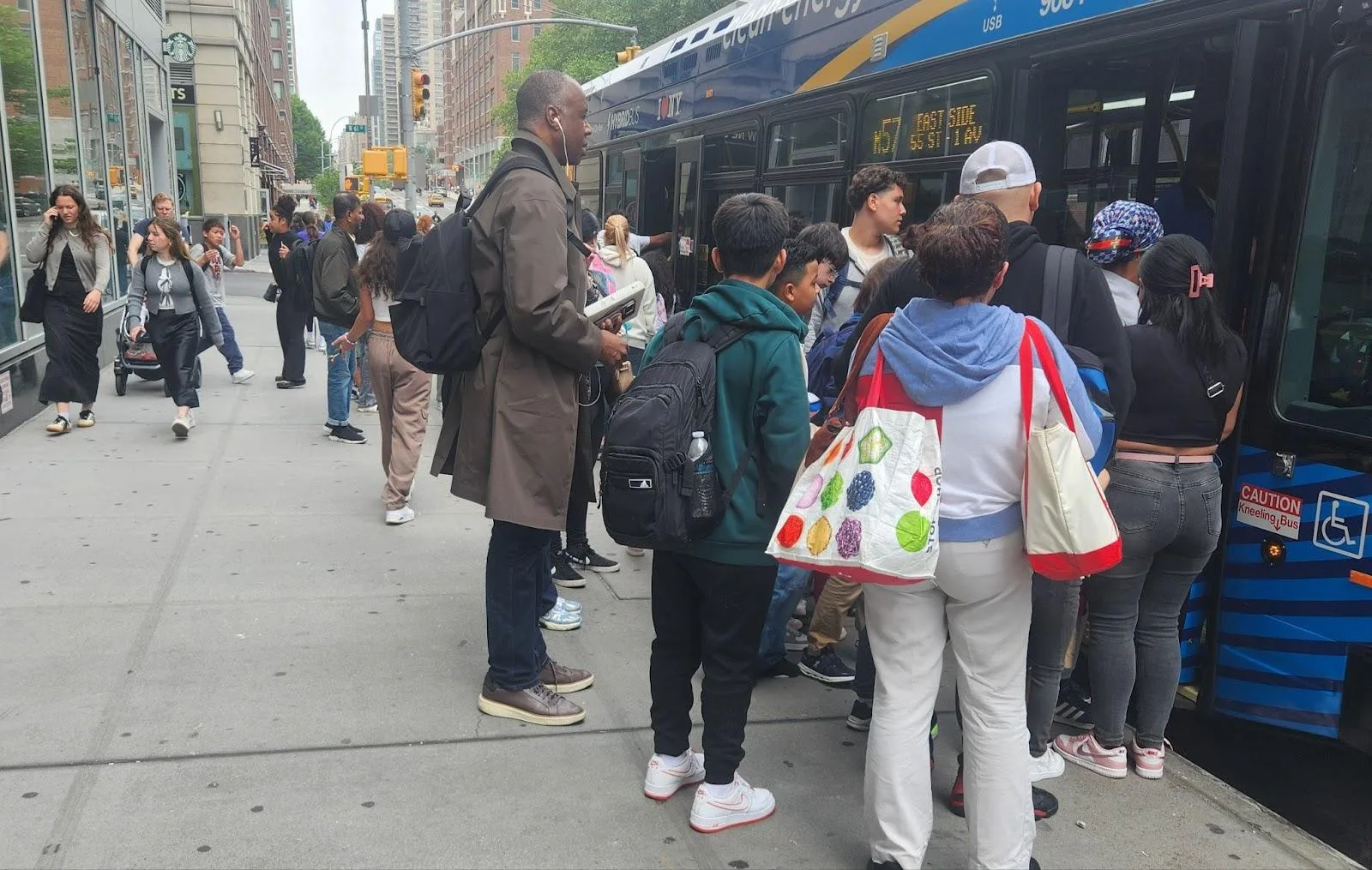
Every day, Duran rides the city bus with her son, who’s too young to make the trip alone, to and from school. Even after nearly six hours in class, she says he comes home to the Row Hotel in Midtown, their asylum shelter, asking to learn more English, frustrated that he can’t keep up with his classmates.
“He’s not learning nearly enough to feel confident,” she said.
Duran added that had she known how little progress her son would make in English at Riverside, she might have thought twice about the DOE’s placement, but with most nearby schools full, she had little choice. Still, her resolve remains. “I want him to learn English,” she said in Spanish. “We have no other choice but to keep trying.”