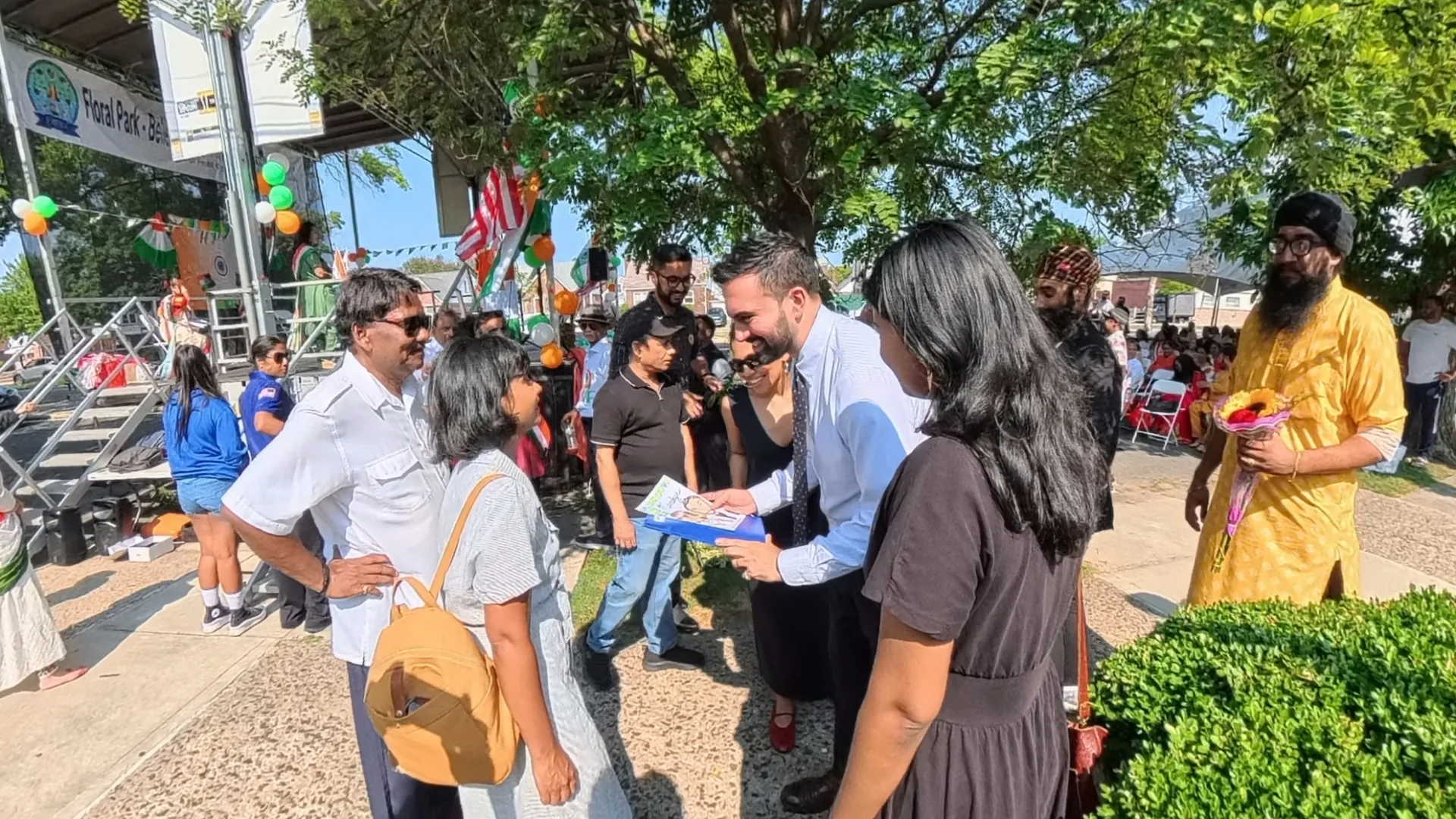


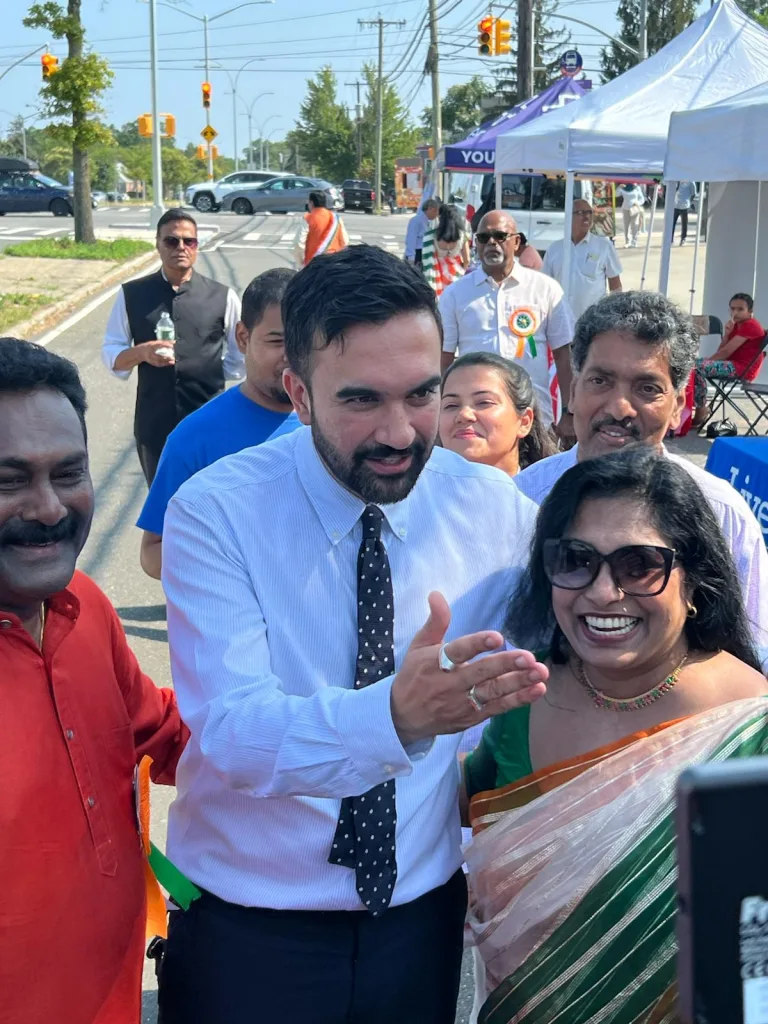
The crowd at the Indian Independence Day celebration in Bellerose, Queens, on Aug. 16 formed an impromptu queue for photos when Zohran Mamdani arrived. Within minutes, the Democratic mayoral nominee was moving through the gathering, switching between English and Hindi as he posed for selfies with supporters.
It had been two months since his stunning primary victory over Andrew Cuomo, and Mamdani appeared to be as popular as ever in the city’s South Asian neighborhoods.
Bellerose, home to a few hundred Indian-American residents, along with working-class South Asian enclaves like Kensington, Midwood and Jackson Heights, delivered decisive margins for the Democratic socialist and demonstrated the political power of immigrant communities that have long been overlooked in a city election race.

But as Mamdani heads into the general election, a vocal group of far right Hindu nationalists have launched an Islamophobic campaign to paint him as ‘anti-Hindu.’ The opposition is well-funded and determined, with organizers who have already spent close to $10,000 on attack ads, now promising to intensify their efforts before November.
Mamdani was born in Uganda to the well known Indian-American filmmaker Mira Nair who directed movies like “Mississippi Masala.” His father, academic Mahmood Mamdani, is an Indian-origin Ugandan. Mira Nair is of Punjabi descent and Mahmood Mamdani hails from Gujarat in India, the home state of the Indian Prime Minister Narendra Modi.
The Hindu right-wing opposition to Mamdani first emerged in the run-up to the primary elections when a group based in New Jersey flew banners over the Hudson River reading “Save NYC from Global Intifada. Reject Mamdani.”
The group, “Indian Americans for Cuomo,” was launched only ten days before the primary election on June 24 by a group of Hindu right-wing activists and spent close to $10,000 on aerial banners, digital truck campaigns, and radio advertisements targeting Mamdani.
“We waited too long to publicize our views on Mamdani because we had not expected his campaign to become a contender in the race,” said Satya Dosapati, who identifies as a pro-Trump activist.
In India, Members of Parliament from Prime Minister Narendra Modi’s Bharatiya Janata Party (BJP) made public statements calling Mamdani “more Pakistani than Indian,” while a prominent right-wing news channel aired a segment claiming he received funding from “anti-India,” groups.
Read more: South Asian Storeowners ‘Doomed’ by Trump’s 50% Tariffs on India Imports.
In Queens, New York, Kajal Shingala, a far-right Hindu nationalist speaker, told an audience that Mamdani was a “new demon” who stands in the way of “Hindu rule.” During the event, she also referred to Muslims as “zombies.” Mayor Eric Adams had initially been scheduled to appear as guest of honor at the event, but quietly withdrew following an outcry by a multifaith coalition of over two dozen organizations.
Shingala was recorded among India’s most active hate speech provocateurs in 2023 by the Center for the Study of Organized Hate (CSOH), a Washington-based think tank. She has multiple cases registered against her in India for inciting violence. Her appearance has represented a new phase of fringe attacks against Mamdani, despite these groups’ inability to prevent his primary victory.
Kayla Bassett, the director of research at CSOH, said the broader campaign involved far-right groups in the U.S., Israel and India spreading Islamophobic narratives about Mamdani on social media. CSOH analyzed public posts over seventeen days around Mamdani’s primary win in June. They found popular social media accounts labeling him a “jihadi” and Hindu nationalist accounts in both the United States and India posting at least 65 messages calling Mamdani “anti-Hindu.”
Read more: Mamdani’s Rise and the Resurgence of Islamophobic Politics.
CSOH began their research after observing an unusual uptick in the first week of June in the circulation of a 2020 video of Mamdani speaking at a protest in Times Square. “We observed this video was being shared unusually widely in the weeks prior to the primary,” said Bassett.
The video, in fact, began circulating on X (formerly Twitter) on May 17. It showed Mamdani at a protest against the construction of the Ram temple in India, built on the site of a 16th-century mosque that was demolished by Hindu extremists in 1992. The video was shared with claims that protesters could be heard in the background shouting anti-Hindu slurs. OpIndia, a popular Indian fake news website, embedded the video in their report about Mamdani on May 27.
The video’s circulation came just two days after Mamdani was asked in a mayoral forum on May 15 if he would meet Modi if the prime minister were to visit the city again. At the forum, Mamdani called Modi a war criminal and said, “Narendra Modi helped to orchestrate what was a mass slaughter of Muslims in Gujarat, to the extent that we don’t even believe that there are Gujarati Muslims any more.”
The 2002 riots in Gujarat killed more than a thousand people, many of them Muslim. Modi was denied a U.S. visa for “severe violations of religious freedom” in the aftermath.
Responding to the Attacks, and Praise
Speaking to Documented, Mamdani reiterated that his criticism of Modi’s government should not be seen as anti-Hindu. “I’m proud to be an Indian American and my critiques of policies and politics can be made while still feeling that same level of pride,” he said.
Mamdani also invoked the Indian Constitution and its founding principles of justice, liberty, equality and fraternity for all citizens regardless of religion.
“My Indian heritage means a lot to me,” he said “It’s a big part of who I am, and how I see the world, and even just thinking about the preamble to the Indian Constitution, it informed so much of what I think so many deserve.”
Yet, the attacks against Mamdani have found support among a small section of well-off Hindu nationalist sympathizers who oppose both Mamdani’s progressive agenda and his criticism of Modi.
Harshad Patel, who heads the Gujarati Samaj of New York, one of the biggest organizations representing Gujarati Americans, said he opposed Mamdani over his criticism of Modi. He held a private fundraiser in support of Mayor Adams on July 10 and was also involved in organizing the event in Queens on July 16 where Kajal Hindusthani, a far-right Hindu nationalist speaker, called Mamdani a “demon” and referred to Muslims as “zombies.”
When asked about those comments, Patel saw no issue with the rhetoric.
And like some other middle-and higher-income Indians, Patel opposed Mamdani’s promises of free buses and rent freezes, viewing them as unfair to taxpayers. “Gujaratis are among the highest taxpayers. We are not taking any benefits like other people are,” he said.
According to the Pew Research Center, 44% of Asian American Hindus enjoy a family income of more than $150,000, and 61% have postgraduate degrees, making them an affluent minority group in the city.
This is not true of all South Asian communities in New York. Professional class and mainly upper-caste immigrants from India who benefited from changes in American immigration laws in the 1960s, have different migration experiences compared to the relatively newer working-class immigrants from regions in India as well as Nepal, Pakistan and Bangladesh.
These working class voters were crucial to Mamdani’s win in June, Jagpreet Singh, the political director of DRUM Beats explained. The group is a sister organization to the social justice group Desis Rising Up and Moving, and was among the first organizations to endorse Mamdani’s candidacy.
At the Indian Independence Day celebrations in Bellerose, Queens, Mamdani was mobbed for selfies and among those eager to pose with him was Feroze Mohammed, a halal cart vendor who immigrated to the U.S. from Gujarat, India.
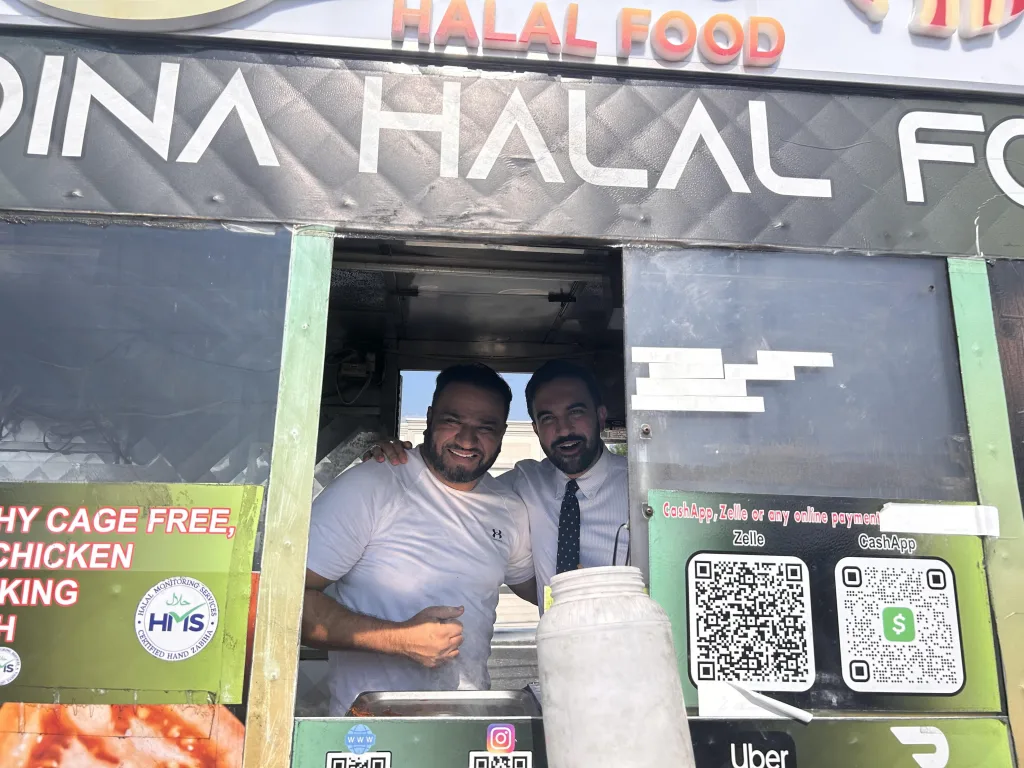
Mohammed, who has run his cart for 20 years, said Mamdani’s focus on affordability resonated with vendors like himself who struggle with expensive licensing permits. “His ideas are all about making New York more affordable. From my heart, I wish and pray for him that he wins,” Mohammed said.
Voting numbers from the primary elections analyzed by DRUM Beats showed that voter growth in Indian enclaves in New York was less noticeable compared to Bangladeshi and Pakistani areas in Brooklyn and Queens. Still, some Indian voters, including Punjabi speakers in Glen Oaks and younger Indian voters in Bushwick, Astoria, Lower East Side and Crown Heights voted in favor of Mamdani.
Even the neighborhoods of Bellerose and Floral Park, home to a few hundred affluent Indian families, voted in favor of Mamdani in the primary elections. Maintaining this South Asian support may prove crucial for Mamdani’s general election chances in November.
A 2024 survey found that a majority of the Indian American community, including two-thirds of Hindus, expressed concern about the rise of Hindu supremacy — a sentiment that may help explain the emergence of groups like “Hindus for Zohran, which has an Instagram account that has gained close to 800 followers.
They held their first launch event on Aug. 21 hoping to challenge the assumption that South Asians who identify strongly with their faith are necessarily conservative in their politics.
Shivani Parikh, a racial justice advocate who joined the group, described Mamdani as embodying New York’s multicultural identity. “I feel like Zohran is what you get if a New Yorker was made in a lab,” she said. “He embodies and carries so many cultures together, and he reflects that pluralism to us.”
你知道吗?非公民办理驾照时的这个错误可能会导致选民欺诈
The group further pointed out that Mamdani was among the signatories on the legislation that recognised Diwali — the Hindu festival of lights — as a state holiday and took part in a Diwali celebration last year where he spoke on stage about his mother’s Indian identity.
Despite signs that the opposition from right-wing Hindu American groups is only expected to grow until the general election in November, Mamdani, for his part, said he will continue to engage with his critics.
“Once you get past the discourse of it all, and you actually meet people where they are, there is such a lot of excitement about what we could build in the city,” he said.