

When Mary Lestrade arrived in New York from Saint Lucia in 1990, she thought her life would change for the better. She was 37 years old and determined to work hard. Instead, her first job as a nanny in Long Island left her in tears.
For raising three children, she was paid $190 a week, roughly $470 today adjusted for inflation. She worked about nine hours a day, five days a week, in a live-in arrangement. Because her first employers would not feed her, she had to bring her own food to work.
“I cried myself to sleep,” she said, remembering her first nights in America.

After six months, she left that family but quickly discovered that exploitation was common in the city’s domestic work industry.
“Sometimes I worked 16 hours a day,” said Lestrade, who worked for 35 years as a nanny in New York. “You start at 7:30 in the morning and don’t leave until 11 at night.”
Also Read: Christine Lewis Had Few Rights as a Nanny. She Decided to Fight for a Better System.
Lestrade lived undocumented for 13 years before receiving her green card in 2003, and becoming a citizen in 2009. Today, at 72, she works as a home health aide caring for an older woman. Still, her experience of working as a nanny echoes many of the challenges that domestic workers still face today.
For years, immigrant domestic workers have kept New York’s child care and elder care systems running, often working long hours for low pay and with little protection. Many are undocumented and work in isolation, facing exploitation and fear. Despite their essential role, they remain largely unprotected under the current law. Now their fears of being detained and deported are growing as immigration enforcement intensifies under the new Trump administration.
According to the Economic Policy Institute, across the United States an estimated 2.2 million people work in domestic jobs. About 240,000 are nannies, but the majority become home health aides. Nearly a quarter of domestic workers report working seven days a week without a break.
New York has one the highest concentrations of domestic workers. With more than 248,000 domestic workers, three-quarters of New York’s domestic workers are foreign-born and of those, over 16,000 are nannies. At least 22,000 in New York City lack health insurance and half receive no paid sick leave or vacation. Nine in 10 are women, and more than half are women of color.
“We’re relying on immigrant labor to care for our children and our grandparents,” said Christine Lewis, an organizer with Domestic Workers United, an advocacy group that has fought for stronger labor protections. “And at the same time, immigration enforcement is making people too afraid to leave their homes.”
The reliance on immigrants in the domestic labor market is set against another challenge: the growing need for care. The U.S. population is aging, and demand for both child care and elder care is rising.
“There’s going to be a shortage of aid workers,” Lewis warned. “And if immigrant women are forced into the shadows, families will feel it first. Who will care for our children? Who will care for our grandparents?”
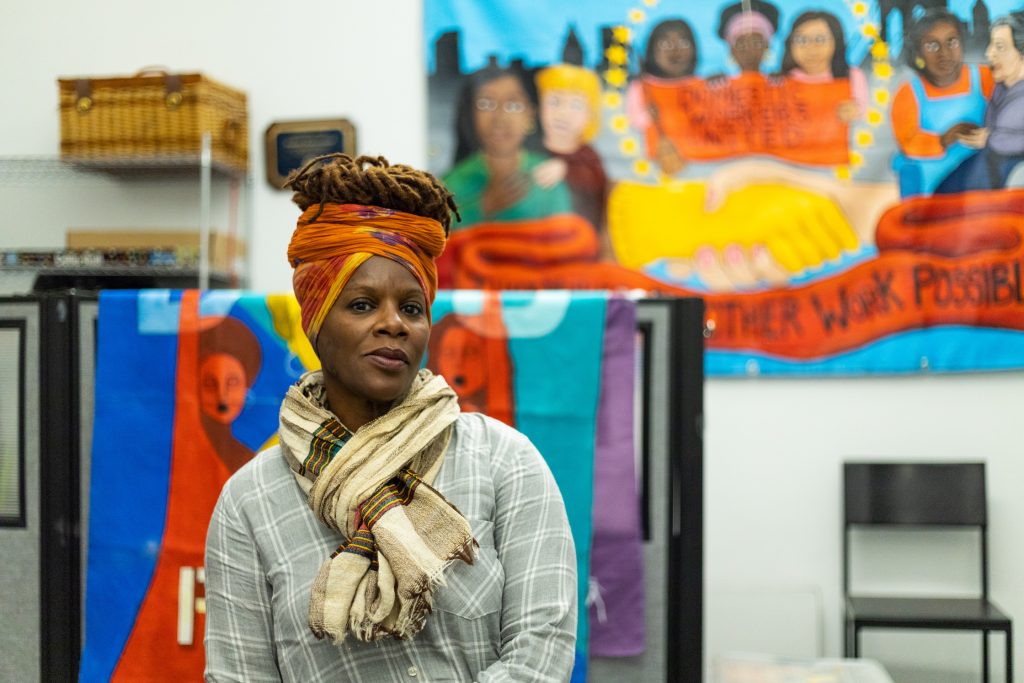
Allison Julien, a longtime organizer with the National Domestic Workers Alliance (NDWA) and a former nanny from Barbados, said the fear is not new, but it is intensifying.
“One of the biggest fears that I faced then, which feels very similar to now, was being undocumented,” Julien said. “The constant looking over my shoulder, not feeling safe on the train or even in the park while doing my job.”
Today, many of her peers face the same reality.
Lewis at Domestic Workers United said immigrant workers she organizes often describe living in fear. “It breaks my heart when I see [the administration detain] people and send them away,” she said. “You live here so long and you’re hiding to work. It’s not right.”
Domestic workers have long faced systemic exclusion from labor protections and collective bargaining rights. According to NDWA, 84% of domestic workers don’t have a written agreement with their employers.
“Some say they don’t want to go outside, even for community meetings,” she said. “But they still have to go to work, pushing patients in wheelchairs across town or caring for children in the parks. Fear shouldn’t paralyze us, but it’s real.”
Lewis recalled one moment in Westbury, Long Island, when immigration agents attempted to detain workers near a school. “The community said no,” she said. “We can’t allow fear to rule.”
For Julien of NDWA, the current climate is comparable to the fear during the early COVID-19 pandemic when workers avoided going out.
“It’s like a second wave of panic,” she said. “I hear from workers who won’t go to playgrounds or parks. These are places they work. And even when they are in affluent homes, that fear doesn’t go away. They’re avoiding public spaces, changing their routes, trying to be invisible.”
The isolation, she said, has only deepened. “You’re undocumented, you’re in someone’s private home, and now you’re also hiding from ICE,” she said. “That triple isolation is crushing.”
Julien said it was a moment like that, when her employer threatened her over her immigration status, that pushed her into activism.
“I had already given them three years of my life,” she said. “And suddenly I was disposable. That day I promised myself I’d never let another employer speak to me like that.”
Julien migrated when she was 18 years old with plans to continue her education, but quickly found herself doing domestic work like many Caribbean women in her community.
“That’s the work I saw Black women around me doing,” she said. “And when I got into it, I realized how many people looked like me, how many had migrated for something better and ended up invisible.”
Domestic Workers United has spent years pushing for stronger protections. The group distributes “know your rights” cards, organizes training and gathers workers in community gardens and even theaters to build solidarity.
“Community is our tower,” Lewis said. “It’s unbreakable if we stand together.”
The National Domestic Workers Alliance takes a similar approach by connecting workers through legal clinics, WhatsApp chats, and cultural exchanges.
“Trust is everything,” Julien said. “I can approach another Caribbean nanny in Crown Heights because I was one. I know how to talk to her. I’ve been her. And once one person trusts us, the network grows.”
She described one recent call from a domestic worker who had spotted immigration agents in a Brooklyn store. “She panicked, but she remembered our training,” Julien said. “She got out safely and called to warn others. That’s how we know our organizing is working in real time.”
When reaching out to current domestic workers with insecure immigration statuses, Documented was told that they were not comfortable speaking with the media.
A lifetime of work without protection
L. Griffin, 40, works as a nanny in Manhattan. She recalled a job where she worked in a cold basement and was expected to cook for guests, even though it wasn’t part of her job. Despite preparing the food, she was only allowed to eat the leftovers.
Griffin, who only shared her last name, said being undocumented in her early years in the U.S. came with constant pressure and vulnerability.
“My first years were terrible,” she said. “So many times, because we’re immigrants, people think we have no other options. They treat us like we’re beneath them.”
Griffin moved to the United States from Saint Lucia at 18, chasing the American dream she had seen in the media. She hoped to become a nurse, but people around her encouraged her to work as a nanny instead.
Her first job on Long Island was difficult. She cared for three children three days a week and was paid just $200. Griffin said being undocumented made it easier for employers to take advantage of her. She wasn’t offered benefits and admitted she didn’t know how to negotiate her pay.
“I really liked the kids and wanted to work with them,” she said. It wasn’t until she spoke with other nannies that she realized her wages were unfair.
For decades, Lestrade also had little ability to negotiate her pay or working conditions.
In her first decade, she said she cycled through jobs that paid between $250 and $350 per week, often in cash. Eventually, she found a family that paid her $600 a week, increasing her wages annually and even offering Christmas bonuses.
Also Read: Who Cares for the Carers? Domestic Workers Discuss Exploitation in NYC
But her last job, where she stayed for 10 years, working from 12 to 16 hours a day, five days a week, ended in frustration. She earned $890 a week. Each week, $25 was taken out for Social Security, but her employer gave her only one week of vacation a year and no raises after the first two years. “I worked long hours and gave them everything,” she said. “But they didn’t appreciate it.”
Lestrade and Griffin’s situation is not uncommon. Domestic workers in the U.S. earn far less than other workers. The median domestic worker makes $13.79 an hour, which is roughly 37% less than the median $21.76 wage for other workers.
Lestrade eventually took that employer to court with the help of Domestic Workers United. She said she sued because the family had withheld overtime pay, failed to compensate her for sick days and bonuses, and even denied her one week of promised vacation.
The case was settled in her favor. She received compensation, but less than her lawyer had originally projected.
“I didn’t get all the money I was owed,” she said, explaining that the court deducted one year of claims during the pandemic. Still, she accepted the settlement rather than prolong the fight. “It is what it is,” she said.
The work itself was physically and emotionally demanding. “With babies, you give them baths, feed them, put them to sleep, take them for walks,” she said. “As they grow older, the work becomes harder, taking them to school, to music, to ballet, making sure they don’t get hurt. You’re always on your feet.”
The job left her little time for herself. “I never had dinner with my family,” she said. “I always came home late, ate quickly and went to bed to start again the next day.”
The next generation
Julien believes this next generation of Caribbean domestic workers can win greater protections, despite the current political climate.

你知道吗?非公民办理驾照时的这个错误可能会导致选民欺诈
“We are in a moment,” she said. “And it feels like forever, but it won’t last. Our ancestors fought during the civil rights movement. We are walking in their footsteps. I was undocumented when we won the New York Domestic Workers Bill of Rights. I tell every worker: Don’t let your immigration status stop you. You deserve dignity.”
For now, Griffin’s situation has changed. She obtained her green card 10 years ago. For the past eight years, she has held what she calls “a very good job” in Manhattan with an employer who respects and values her work. She believes that domestic workers must unite to defend their rights,
“I believe community is what gives us strength,” Griffin said. “But for many reasons, immigrant domestic workers are afraid to speak up and fight for their rights.”