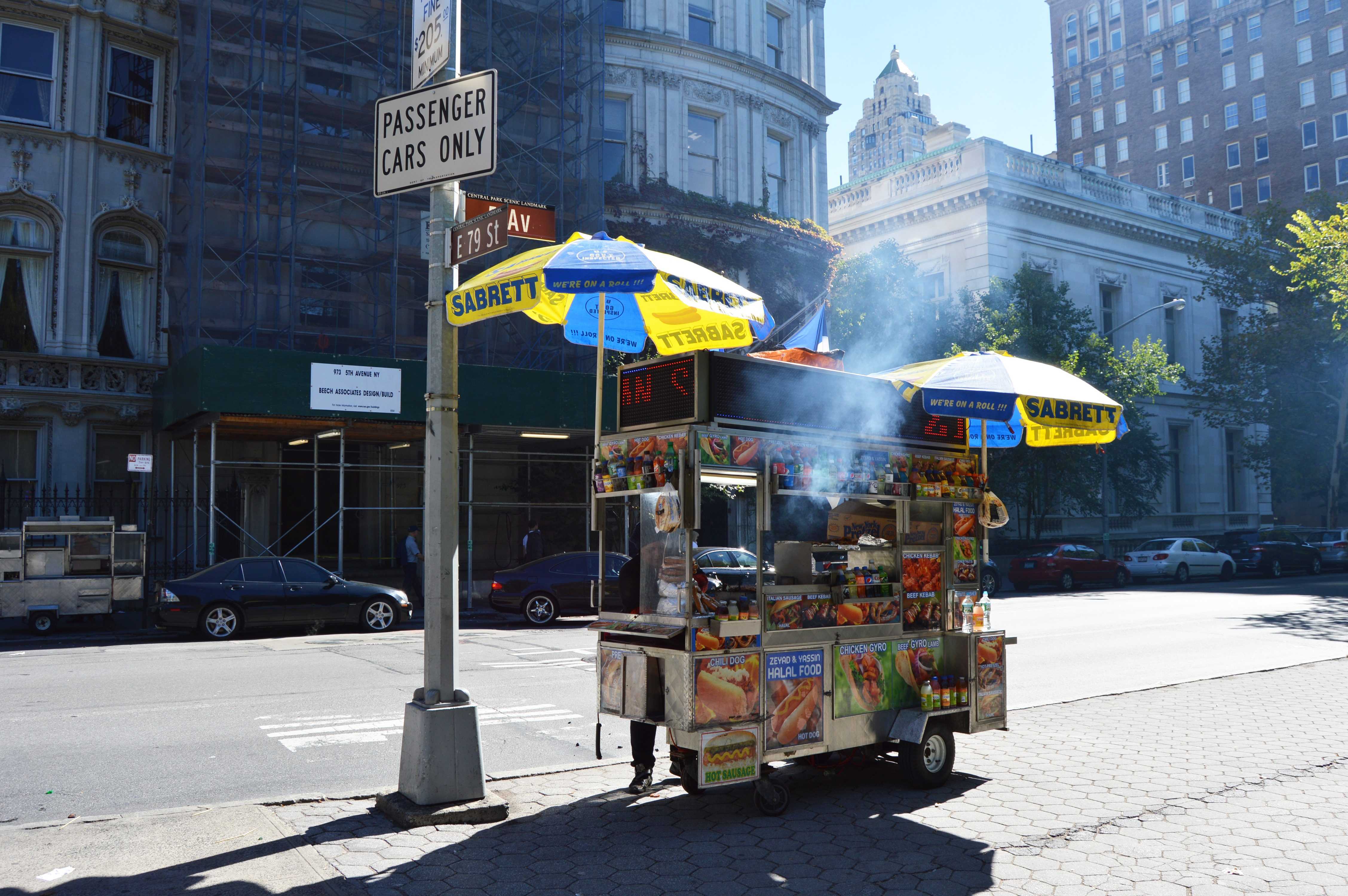


Sonia Pérez was frustrated but not surprised. Weeks earlier, on July 30, Mayor Eric Adams vetoed a bill that would have removed criminal misdemeanors incurred by street vendors for selling food without a cart permit.
“This is not the first time that there has been holdbacks for street vendors,” the 54-year-old street vendor told Documented in Spanish, adding that in her two decades of working in the industry, the fight to improve working conditions for street vendors has always been an uphill battle.
The bill Mayor Adams vetoed, Introduction 47-B, would have eliminated all misdemeanor criminal penalties for general and mobile food vendors, replacing them with civil fines.

In vetoing the measure, Mayor Adams argued that it would strip the city of “an important enforcement tool” to regulate street vending violations under the city’s administrative code. But for street vendors who are not citizens, it would have meant that criminal misdemeanors could be removed from their records — which could be scrutinized in future immigration proceedings.
“As immigrants we have been given that label of being criminals,” Pérez said. “But we are not criminals, we are humans who are trying to make a living.” Advocates and vendors who spoke with Documented also denounced Adams’ veto, saying the continued use of criminal misdemeanor summons jeopardizes the immigration statuses of the street vendor workforce, 96% of which is foreign born.
Pérez has been working as a street vendor, selling Mexican food in Bushwick since 1997. She told Documented that she has been issued misdemeanor tickets in the past for operating her cart without a permit — which is illegal in New York City.
In New York City street vendors are required to have a vending unit permit, which are limited. There is a waitlist of more than 10,000 people, which means it can take decades for someone to obtain a work permit, so many risk receiving tickets to make a living in the interim. For Pérez, after 27 years of waiting, she finally obtained her permit last month.
Also read: An Outdated System Is Preventing Street Vendors From Getting Permits
But now, with increased ICE raids, detentions and other anti-immigrant measures pushed by the federal government, Pérez says that many of her fellow street vendors in Bushwick have abandoned their carts in an attempt to avoid accruing misdemeanors on their records. Advocates also told Documented that fear of receiving a criminal citation has driven some vendors to leave the industry altogether.
As Documented previously reported, having a criminal record can negatively impact individuals who are undergoing immigration proceedings — like those requesting bond, those who have pending asylum cases and those who have consistent check-ins with ICE.
Pérez explained that street vendors who are not able to take care of their tickets will have a criminal misdemeanor show up on their record. “That could also prevent us from getting a legal status — because I could not take care of or pay the ticket in the past. All because I was working as a street vendor,” she said. “My name is already there.”
Susana, 29, who requested that Documented use only her first name, began selling seasonal fruit – bananas, strawberries, tangerines — and vegetables in Corona, Queens, two years ago after she was unable to find a job in construction, something she had done since arriving in New York from Ecuador in 2019. “I used to sell fruit in Ecuador too and I always liked to be independent and have my own business.”
When Susana first started selling her fruit in New York, she said she did not know she needed a license for preparing food and a permit for her cart. A few months in, she was approached by a police officer who gave her a ticket that required her to show up to criminal court. At the same time, she recalls, she was moving to a new apartment and had missed the court date. Today, she rents a food cart permit, but says that the past ticket still hangs over her head.
“It’s very worrisome, especially right now with all the deportations. [My friends] told me to go but I told them ‘I don’t know, what if something happened to me?’ I don’t know, I don’t risk it.”
According to a report by THE CITY, in 2023, the NYPD issued 1,244 criminal summons — which is triple the amount of tickets that were issued in the previous year. The report also showed that street vending-related criminal tickets had increased ever since Adams took office in 2022.
“You don’t see a police officer walking into a restaurant and writing a criminal ticket to the worker or the manager there,” said Mohamed Attia, managing director at the Street Vendor Project. “It does not happen, so why does it happen to street vendors?”
Attia has also seen vendors leave the industry because they did not want to risk getting a criminal ticket. “They have said, ‘This job is not for me anymore. We have no idea what is going to happen if I go to criminal court to address our tickets.’ ”
Regarding the veto, Attia said Mayor Adams was misleading the public by claiming that the bill would take away the enforcement mechanism from the NYPD. “The bill will not stop the NYPD from enforcing any laws. The bill will not stop any street vending enforcement,” he said. “Street vending enforcement can still take place by issuing civil summons that are served at OATH [Office of Administrative Trials and Hearings, which is a civil court] instead of criminal courts.”
Attia explained that the NYPD had also been part of the Street Vendor Advisory Board which voted unanimously to repeal the criminal liability.
New York City Council Member Shekar Krishnan, who was the lead sponsor of Intro 47-B, told Documented that the City Council plans to override the veto. Intro 47-B passed with 40 votes. To override the veto City Council needs 34 out of 51 votes. “I want it to be very clear that our New York City Council stands up for immigrant New Yorkers, that we will protect immigrant New Yorkers,” he said. “We passed this bill with overwhelming support, and we will override this mayor’s veto with overwhelming support.”
Krishnan, who represents New York District 25, which includes Jackson Heights, Elmhurst and Woodside, Queens — three of the most diverse immigrant communities in New York — said that Mayor Adams has turned his back on immigrant and working New Yorkers, especially at a time when Trump has vowed to conduct a mass deportation. “It’s not just about removing the criminal charges and jail time, but the fact of the matter is, at this moment a vendor being prosecuted in the criminal system has direct and collateral immigration consequences as well.”
In response to Adams’ claims that the bill would strip the city from an important enforcement tool, Krishnan reiterated the Street Vendor Advisory Board — which includes representatives from the NYPD — voted unanimously to “recommend and propose this legislation.”
Zachary Nosanchuk, deputy press secretary for City Hall, told Documented that the Adams administration has opposed removing power enforcement levers from NYPD, citing their commitment to ensuring safety for New Yorkers, which “includes addressing persistent quality-of-life issues, like illegal street vending.”
Regarding the claims made that Adams has turned his back on immigrant New Yorkers, Nosanchuk emphasized the administration has allocated more than $120 million for free legal services, expanded Know Your Rights workshops, and took action to support New York immigrants detained by ICE — including filing an amicus brief in the case of Dylan Lopez Contreras, a Bronx student who has been detained by ICE for more than two months.
“In a city where approximately half of licensed businesses are owned by immigrants, this veto takes a stand for New York’s workers, small business owners, and vendors who operate legally and in good faith. The power of a veto is not something we take lightly, but we will always use this tool to stand up for the New Yorkers who follow the rules,” Nosanchuk said.

你知道吗?非公民办理驾照时的这个错误可能会导致选民欺诈
But for Pérez, the Mayor’s veto shows her that City Hall is not seeing how vulnerable immigrant New Yorkers already are, as ICE raids, detentions and deportations keep rising and other government services keep getting slashed. She explained that street vending is just one of the ways in which immigrants can continue to be independent and fend for their families and children, especially after the cuts to certain governmental programs.
“I will continue working to find allies so that street vending can no longer be seen as a crime,” Pérez said, adding that she supports the City Council’s intentions to override the veto. She said that advocating for the decriminalization of street vending is not only beneficial to those in the industry, but also to New York City as a whole.
“New York is a big city, very diverse with different nationalities, culture and food. Not having a hot dog cart as you exist in the subway is not New York. Not having a yellow cart in the city is not New York.”