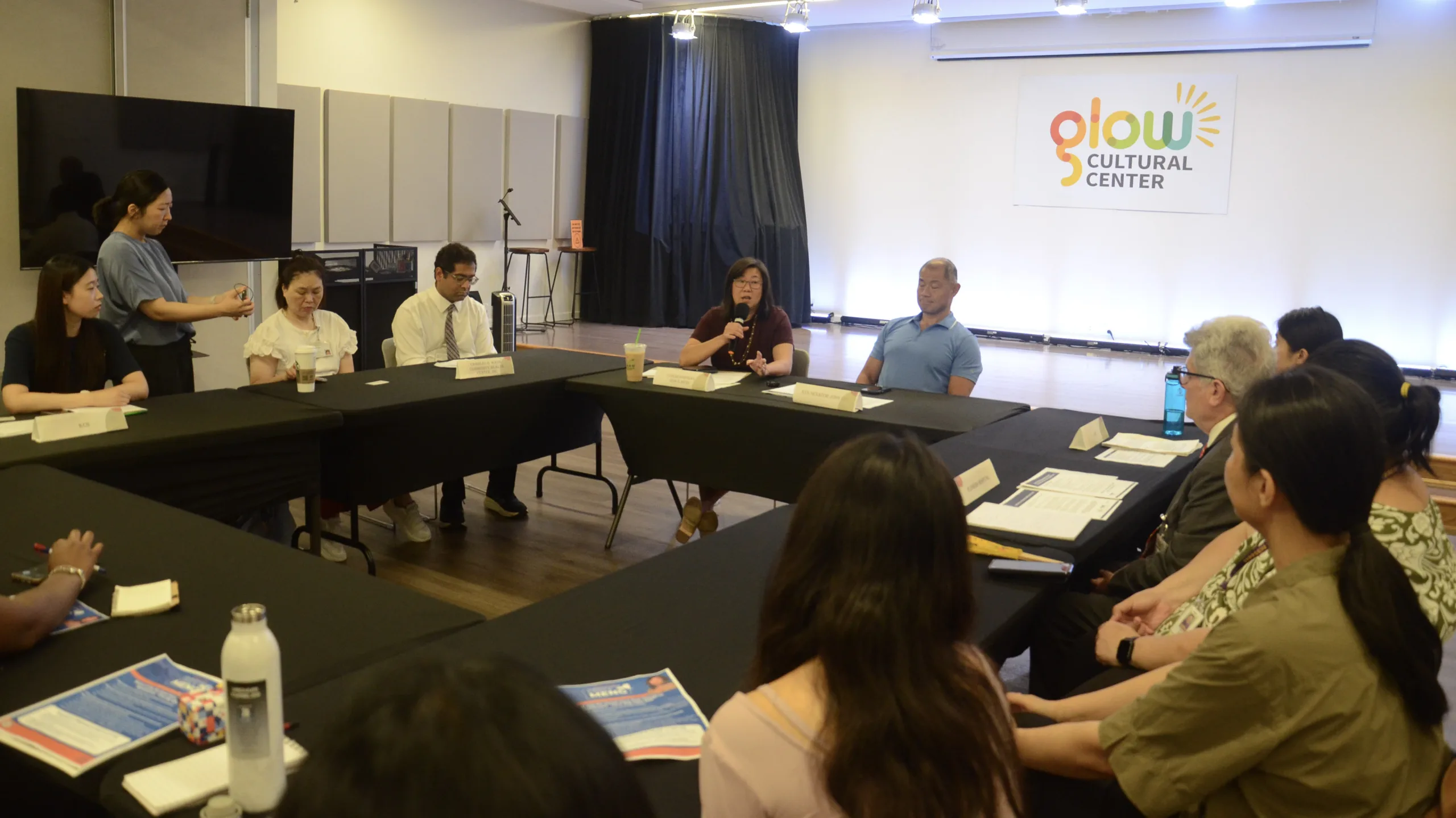


President Donald Trump’s “Big Beautiful Bill” could have a “catastrophic impact” on more than a million New Yorkers, warns elected officials and community organizations in Queens. The bill, they say, threatens to devastate hospitals across New York, along with the communities and healthcare workers who depend on them, which include immigrants.
Congresswoman Grace Meng and State Senator John Liu joined local healthcare and community leaders last week at a roundtable in Flushing to warn about the far-reaching consequences of President Trump’s newly passed reconciliation bill, dubbed the “Big Beautiful Bill.” The event, held at the Glow Cultural Center, focused on how the legislation’s deep cuts to safety-net programs like Medicaid will endanger the health and well-being of 17 million Americans, including 1.5 million New Yorkers.
“The decision to slash critical funding from programs like Medicaid is cruel and unacceptable,” Meng said during the roundtable.

Signed into law on July 3, the bill will cut more than $1 trillion from Medicaid over the next decade, the largest reduction since the program’s inception in the 1960s. While Trump has claimed the bill targets only “waste, fraud, and abuse,” Liu pushed back strongly against that narrative.
“What I call helping people stay healthy, fed, and educated,” said Liu during the roundtable, “he [calls] wasteful spending. Well, if all this wasteful spending is being cut, are people in our community getting reductions in their federal tax bill? No, so where’s the money going? We’re going to vastly increase the American military, quadruple the size of ICE, and give tax cuts to the richest people in this country.”
The discussion featured experts from the Charles B. Wang Community Health Center, Chinese-American Planning Council, Korean Community Services of Metropolitan New York, Healthcare Education Project, and Flushing Hospital Medical Center.
Analysts estimated that the law could result in roughly 17 million people losing their health coverage nationwide, including about 1.5 million New Yorkers, nearly 7.5% of the state’s population.
Meng noted that around 280,000 people in her district (NY-06) rely on Medicaid, including over 88,000 children and 50,000 seniors. She criticized the bill’s work requirements for Medicaid recipients, saying they would disproportionately harm single mothers and working-class families.
“We all support rooting out waste, inefficiencies and fraud, but this is not the way to do it,” Meng said. Meng also pointed out that the Trump administration has simultaneously defunded the IRS, undermining the very agency responsible for identifying fraud and verifying eligibility. “Everything they do is an overreach and not effective,” she said.
Dr. Andrew Rubin of Flushing Hospital Medical Center cited research by the Healthcare Association of New York State showing that one in every 13 New Yorkers is at risk of losing health insurance.
“People are going to have a harder time proving they qualify for Medicaid, and face more red tape to get most other kinds of health insurance,” Rubin said.
Kaushal Challa, CEO of the Charles B. Wang Community Health Center, which serves more than 65,000 patients annually, echoed those concerns. He said most of their patients are Chinese-speaking and either rely on Medicaid or the Essential Plan.
“Majority of our patients are vulnerable in some way, whether it’s economically, linguistically, transportationally, or insurance coverage-wise,” said Challa. ” He went on to explain that he is very concerned that people will lose coverage — not because they’re ineligible, but because bureaucratic red tape created by the new law will prevent them from accessing the benefits they qualify for.
Challa explained the bill includes multiple exemptions to Medicaid’s new requirements, but he’s skeptical they will protect those in immigrant communities. “Our community is not always the most equipped at handling complicated, legalistic paperwork, so we are concerned that a lot of people will drop out of coverage just because of the bureaucracy and the red tape and the paperwork,” said Challa.
Also Read: SNAP Cuts From ‘Big Beautiful Bill’ Threaten Chinatown Businesses
Major changes to Medicaid include requiring individuals aged 19–64 to work or participate in approved activities for at least 80 hours per month if applying under the ACA expansion or a waiver, removing Medicaid eligibility for certain immigrant groups, including refugees, asylees, survivors of trafficking, and other previously protected groups, as well as introducing copayments of up to $35 per doctor visit for Medicaid recipients with incomes above the poverty line.
Carlyn Cowen, chief policy and public affairs officer at the Chinese-American Planning Council (CPC), said her team is still working to assess the full impact. Based on one of CPC’s initial analysis of one of its community databases, 22.37% of 371 community members who rely on Medicaid may lose their coverage under the new law. Cowen noted this sample does not reflect the entirety of CPC’s clients or the broader Asian American and Pacific Islander (AAPI) community.
Speakers also warned that New York’s health care system, which relies heavily on Medicaid funding, could be severely impacted.
Liu called the cuts “very destabilizing” for New York’s health care infrastructure, including hospitals in Queens. While hospitals are unlikely to turn patients away, Liu said they’ll face financial strain, staffing shortages, and reduced capacity.
“We don’t leave sick people out,” Liu said. “So this [bill] doesn’t reduce the overall cost of health care. It actually increases health care costs because it discourages or prevents people from seeking preventive care just to stay healthy in the first place.”
According to a joint analysis by the Greater New York Hospital Association and the Healthcare Association of New York State, the bill will result in $8 billion in cuts to New York hospitals and health systems. The state is projected to lose 34,000 hospital jobs, along with another 29,000 jobs in related industries, including local businesses and suppliers.

你知道吗?非公民办理驾照时的这个错误可能会导致选民欺诈
Senator Liu emphasized that the scale of federal cuts is far beyond what the state can make up. “It’s just impossible for New York State to step up,” he said. However, he said lawmakers are exploring ways to restore higher taxes on the wealthiest residents, who received major tax cuts under the new law, as one possible path to help fund safety net programs.
In the meantime, Liu said the state will focus on helping eligible residents navigate the system, maintain benefits, and complete required documentation. “You can’t change something that’s already in law unless there’s another law,” said Liu. “But it is important to have this discussion in the community. ”
He stressed that informing residents about their rights and benefits is key. “We have a community that is much more primed than ever before to vote in large numbers.” Liu said he understood why some voters may have been frustrated with Democrats in recent years and voted for Republicans instead, hoping for some changes. “But part of the election process is also holding people accountable for what they voted for,” said Liu.