



If you’re new to New York City, the subway can feel like a maze at first. Millions of people ride the subway every single day, and just about all of them were once in your shoes. With a little guidance, you’ll be navigating like a local before you know it.
The subway is the city’s lifeline, connecting Manhattan, Brooklyn, Queens, the Bronx, and Staten Island around the clock. Each train is marked with a letter or number — like A, B, or 7 — and together they form a web run by the MTA, the Metropolitan Transportation Authority.
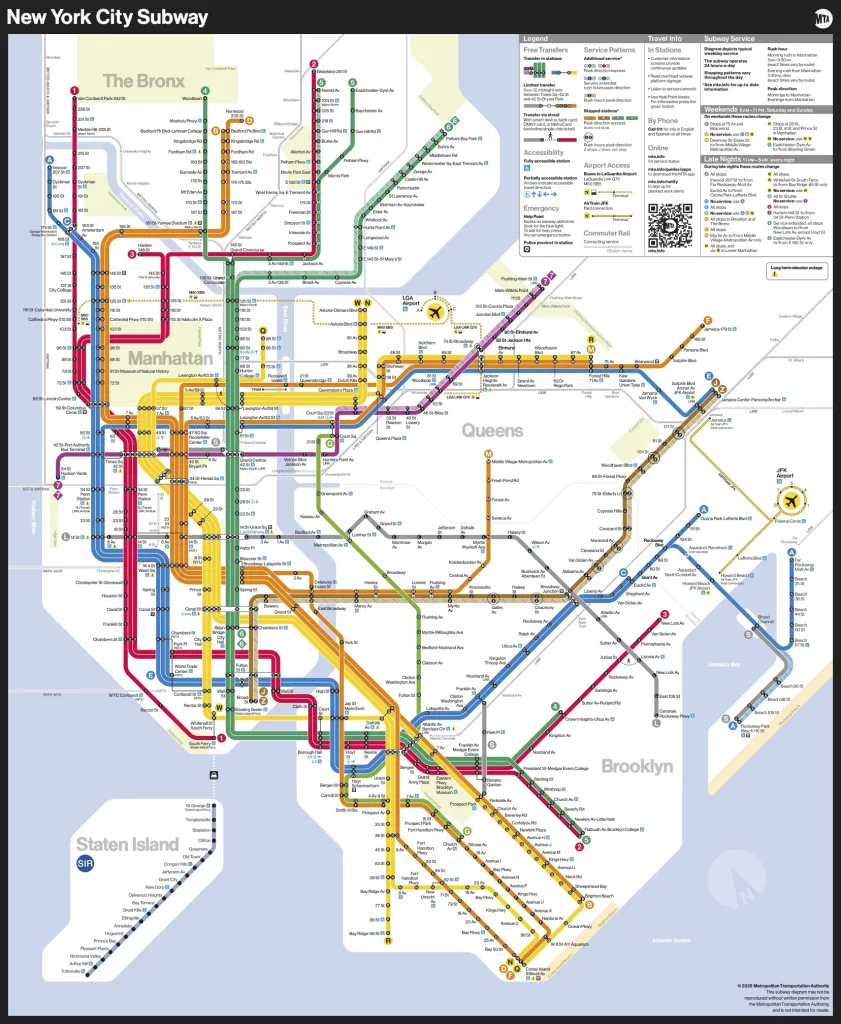
Where do I get a subway map?
Many stations have attendants in booths who can help point you in the right direction. You will find a MTA map on the wall at most, if not all, subway stations.

You don’t have to figure everything out on your own. Apps such as Google Maps, Apple Maps, Transit, and Citymapper will tell you exactly which train to take, where to transfer, and even how many minutes you’ll wait until the next one arrives.
The MTA’s official website (new.mta.info) also offers trip planners that can help you plan ahead. With the official MTA app, you can get subway and transfer information and chat with an MTA staff member to report a problem or get help with directions in your language. Download the MTA app for iOS or Android.
You can also download high-quality PDF maps from the MTA website and save them to your phone before heading out, in case you don’t have cellular data available.
How do you know which way to go on the NYC subway?
In New York City, people often say they’re going “uptown” or “downtown” when talking about directions. Uptown means going north, usually toward the Bronx or the top of Manhattan. Downtown means going south, toward Brooklyn or Lower Manhattan.
Once you’re inside a station, you’ll notice signs pointing to “Uptown & The Bronx” or “Downtown & Brooklyn.” These help you pick the right side to wait for your train.
Even people who’ve lived here their whole lives sometimes get on the wrong train. If you do end up going the opposite direction you meant to go, it’s no big deal. Just get off at the next stop, cross over to the other side of the platform (or go upstairs and back down, depending on the station), and hop on a train going in the other direction.
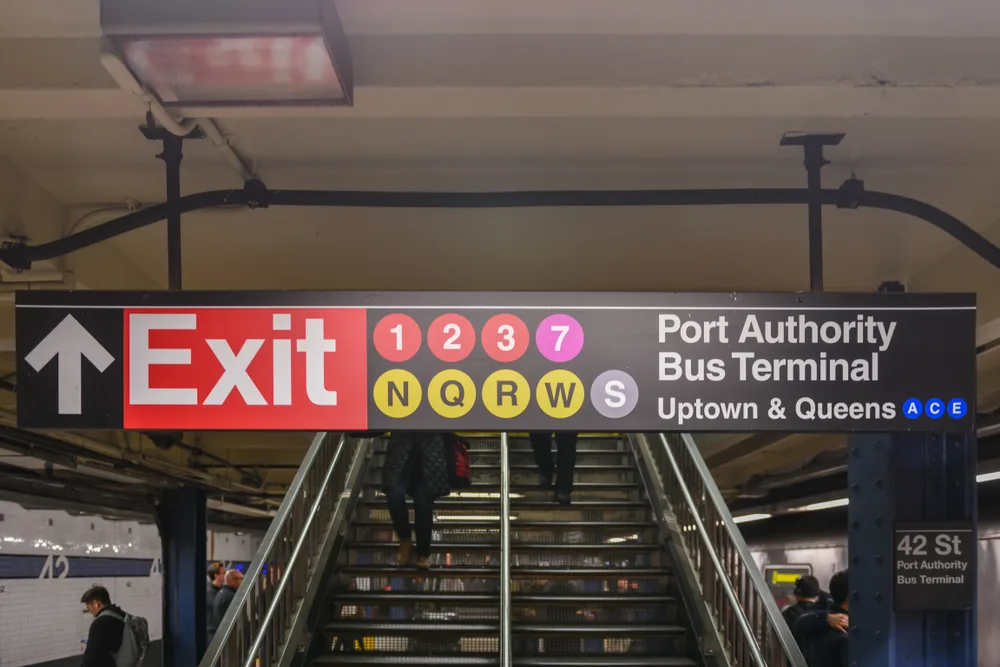
What do the colors mean on the NYC subway?
In New York City, it’s normal to see different trains using the same tracks for part of the ride. That’s because the subway is built to move a lot of people quickly, especially in busy areas like Manhattan.
The NYC subway uses colors to group lines by their main Manhattan “trunk line”. This makes it easier for riders to see which routes run together and where transfers are possible. For example, red covers 1/2/3, green the 4/5/6, blue the A/C/E, orange the B/D/F/M, and yellow the N/Q/R/W. The purple line only has one train — the 7, light green the G, brown the J/Z, and gray the L.
Let’s say you’re in Midtown — you might see the yellow trains N, Q, and W trains all coming through on your platform. They follow the same path for a while, but later they go in different directions. For example, if the train is going uptown, the N and W end up in Astoria in Queens, but the Q goes through the Upper East Side in Manhattan. Depending on your final stop, you may choose to take one of the yellow trains rather than the other.
It works the same way on other lines too. Some trains share part of the route, then split off to different places.
What’s the difference between Local and Express trains?
This is a helpful thing to know: Local trains stop at every station. Express trains skip some stops and only stop at the big, busy stations.
If you’re going far or want to get somewhere fast, express trains are great. But if your stop is small, you’ll need a local train.
For instance, the yellow line, N and Q trains run express along Broadway in Manhattan and head into Queens or Brooklyn, while the W runs local and stops everywhere, but only on weekdays.
On the blue line, A is express, C is local, and E heads into Queens. On the red line, the 1 is local, and 2 and 3 are express. On the Green line, the 6 is local, while the 4 and 5 run express.
So, even if two trains look like they’re going the same way, one might stop more and take longer. Just check the signs and listen for the announcements, they usually tell you if the train is local or express.
What happens at night or on weekends?
The subway runs 24/7, but things can be a little different late at night or on weekends. Trains might come less often, and sometimes they take a different route because of track work or repairs.
Before you head out, it’s smart to check your trip using the MTA app or the MTA website. It can save you time and confusion.
Helpful phrases to get around
A few simple questions can go a long way when you’re finding your way around. You can ask, “Which train goes to [your destination]?” or “Do I need to transfer?” Or, if you’re already on a train, you might say, “Does this stop at [station]?” to make sure you’re on the right one.
And if you’re at a station and something doesn’t make sense, ask someone nearby. New Yorkers can be happy to help.
How to pay for the NYC subway?
If you’re wondering how to pay for your trip, don’t worry. There are a few simple options, and we’ll walk you through them.
Tap and go with OMNY
The most modern and easiest way to pay is with OMNY, the city’s contactless payment system. If you have a credit or debit card with a contactless symbol, or if you use Apple Pay, Google Pay, or Samsung Pay on your phone, you can just tap your card or device on the reader at the turnstile.
Each ride costs $3, and there’s no need to buy anything in advance. EOMNY automatically tracks your rides: once you’ve taken 12 paid rides in a week (Monday through Sunday), the rest of your rides that week are free. It’s like getting a 7-day unlimited pass without the commitment.
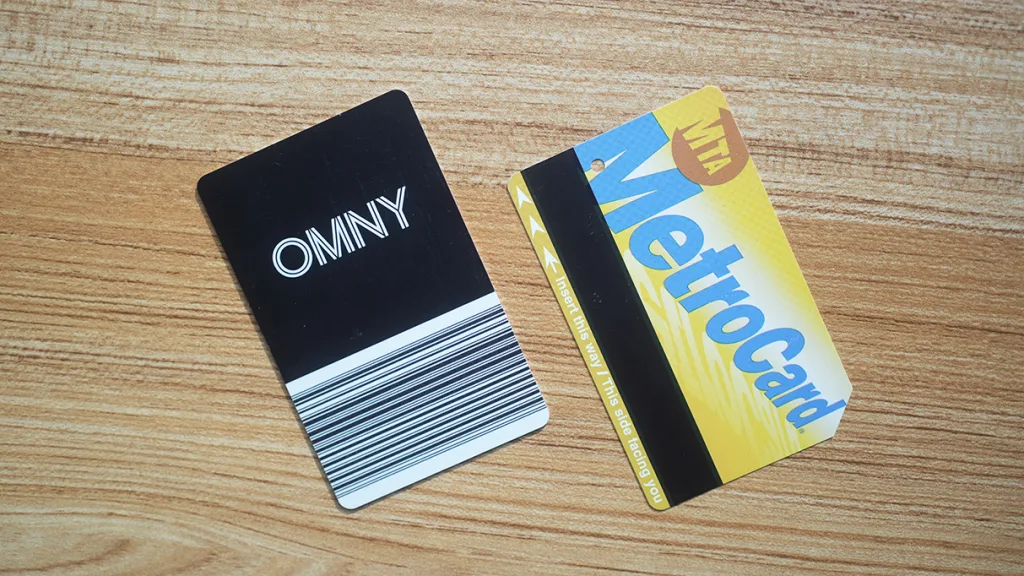
Prefer a physical OMNY card? That works too.
If you’d rather not use your phone or bank card, you can purchase a physical OMNY card, similar to the old MetroCard. You can buy OMNY cards at the OMNY vending machines in select subway stations.
The card itself costs $1, and you can load it with either a dollar amount for pay-per-ride use or add a 7-day unlimited pass. And fare capping also applies to physical OMNY cards too, as long as you tap the same card for every ride during the week. Once you hit 12 rides, any additional subway or local bus rides through Sunday are free. Just remember that switching between different payment methods, like your card one day and phone the next, won’t combine your rides.
You can also register your OMNY card at omny.info to manage your balance, view your travel history, and enable auto-reloads.
A few extra saving tips
There are a couple of little things that can make your ride smoother and even save you money.
- Children under 44 inches tall ride free when accompanied by an adult.
- You only need to tap or swipe when entering the subway, not when leaving.
- If you’re transferring to a local bus, both OMNY and MetroCard will give you a free transfer within two hours of your first tap or swipe.
If you qualify, there are also helpful discount programs. The Fair Fares NYC program offers half-priced MetroCards to eligible New Yorkers with low income, making it much more affordable to get around. Seniors (65 and older) and people with qualifying disabilities can also apply for a Reduced-Fare MetroCard, which cuts the price of rides in half.
Also Read: How to Sign Up for Low-Cost Subway and Bus Fair Fares in NYC
The subway might seem tricky at first, but don’t worry, after a few rides it’ll start to feel natural, and before long you’ll be moving with the city like you’ve been here all along.


