Ava Chin’s “Mott Street” Tells Us Why History Shouldn’t Repeat Itself
Chin's award-winning book provides a detailed experience of America's Chinese Exclusion Act of 1882, from her family's perspective. It shows how iterations of exclusion through immigration laws keep coming up over and over again.
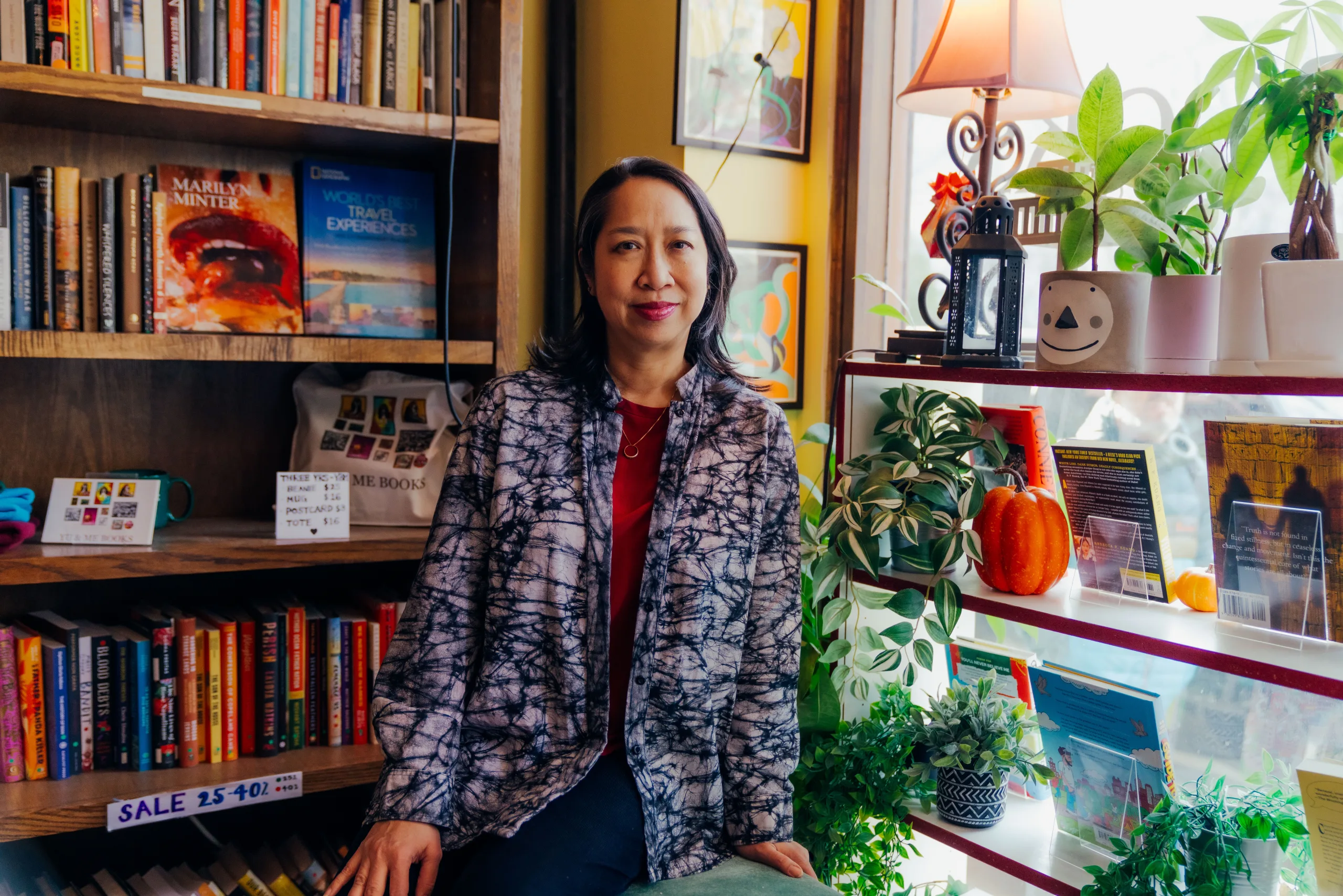
Portrait of Ava Chin, taken at Yu & Me Books on Mulberry Street. Photo: Janice Chung for Documented
Portrait of Ava Chin, taken at Yu & Me Books on Mulberry Street. Photo: Janice Chung for Documented
As part of Documented’s new “Our City” interview series, we are speaking to prominent and influential New Yorkers who have deep connections to New York’s immigrant communities, some of whom are immigrants themselves. We ask them about how they made New York City their own, where they feel most connected to in the city, current projects, and more.
Some of Ava Chin’s earliest memories are of Sunday mornings spent listening to her grandfather’s stories — not just about his ancestors or his childhood in China, but about his family’s largest contributions in American history.
The most captivating tales were of her grandfather’s grandfather, Yuan Son, who came to America as a teenager in the 1860s to work on the transcontinental railroad. When it was completed in 1869 after six years, the railroad was celebrated as an engineering feat in the 19th century, as it connected the American coasts for the first time. Of the 15,000 laborers hired to work on the railroad, 13,000 were Chinese.
Immigration News, Curated
Sign up to get our curation of news, insights on
big stories, job announcements, and events happening in immigration.
You're Subscribed!
Please check your email for further
instructions.
On May 10, 1869, politicians and officials held an event called the Golden Spike Ceremony to commemorate the completion of the railroad.In the official photo from the ceremony, which marked the completion of the first transcontinental railroad, Chinese workers are notably absent, while politicians and officials take center stage.
Nevertheless, Chin’s grandfather always recounted the story of Yuan working on the railroad with great pride. What he always failed to mention, though, was that shortly after Yuan Son and his fellow workers completed the railroad in 1869, a financial crisis struck Europe and America. The Vienna stock market crashed in May 1873, followed by the collapse of a major New York bank, triggering widespread panic. The New York Stock Exchange shut down for the first time, marking the start of the worst depression in U.S. history.
Amid economic turmoil, racism against the Chinese in America grew and violence against them escalated across the western United States. Congress, influenced by growing populist pressure, passed the Chinese Exclusion Act in 1882, banning the immigration of Chinese laborers and denying them citizenship in the U.S.
Nearly 30 years after arriving in America, Yuan Son was confronted at his home in Idaho by a mob of white residents demanding, “The Chinese must go!” They forced him to leave the house he had lived in for decades, Chin details in her book, “Mott Street: A Chinese American Family’s Story of Exclusion and Homecoming.” She says her grandfather avoided this heartbreaking part of the stories he told her, as it was too painful to recount to the preschooler she was at the time. But in her award-winning creative nonfiction book, she brings to light the difficult truths of history. Her book, published in 2023, was recently shortlisted in the top ten selections for One Maryland One Book 2025; it was also named a 2024 PEN America Open Book Award finalist.
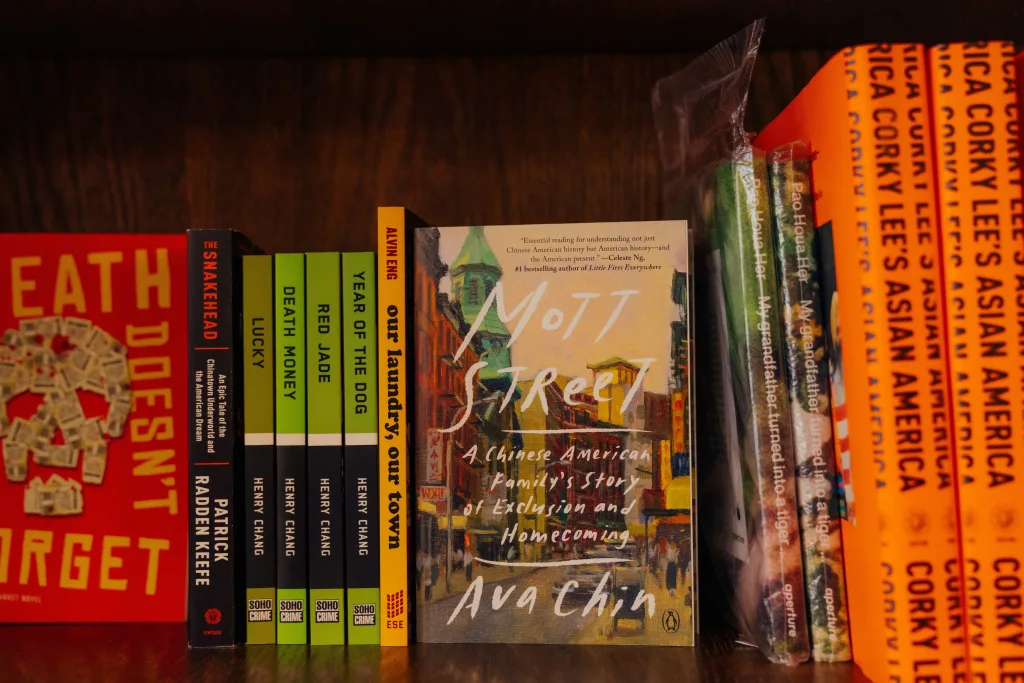
Tucked between other books on a shelf at a bookstore is Ava Chin’s “Mott Street: A Chinese American Family’s Story of Exclusion and Homecoming.” Photo: Janice Chung for Documented
“I was thinking about the community and the ways in which old-school Chinese Americans have held these feelings of shame because of Chinese exclusion,” Chin said, regarding what compelled her to write the book. “People, when their family members came over here because of Chinese exclusion, they had to come over under false identity because it was so restrictive. And because of living here under a false identity, there is a sense of shame, and this has affected families for generations, and people don’t want to talk about it.”
Chin — a 5th-generation Chinese American New Yorker born and raised in Queens — also wanted her daughter, 12-year-old Mei, to know this history. She didn’t want Mei to be blindsided by the truth if she came across it in class. Indeed, Chin says that Mei knows this history often better than her teachers. One time Mei’s second grade teacher brought up the famous railroad photo, and Mei pointed out the absence of the Chinese workers in the photo. When the teacher responded, “but everybody worked on the railroad,” her daughter knew otherwise, telling the teacher: “No, the majority was Chinese,” Chin recalled. This led to an invitation for her and her daughter to give a lesson to the class.
Chin currently teaches creative nonfiction and journalism at CUNY, directing the American Studies Certificate Program at the Graduate Center and teaching in the English department at the College of Staten Island. She is also a former slam poet — an experiencethat surely helped bring the audio versionof her book to life.
“Even when I was narrating the book, I thought, Mei Mei will be able to listen to this when she’s growing up,” Chin tells me. “When I’m gone or when I’m so old and infirm that I don’t know who I am, I told her she should just play the audiobook to me so I can kind of remember who I am.”
“What’s shocking about what’s happening now is that it has become so retrograde, the ways in which certain politicians ride the anti-immigrant bandwagon and that these iterations of exclusion just keep coming up over and over again”
That day at the Tenement Museum, when we were walking downstairs after you finished your spoken word performance of “Mott Street,” you made a comment about recording the audio version of the book. You called it an experience as painful as giving birth without an epidural.
[Laughs] Yes, in fact, I actually think going through labor and giving birth to a baby without an epidural is easier than narrating the audiobook.
[Laughs] Tell me about that. I ask because I use audiobooks to complement reading on deadline, often at 2x speed. While doing this for your book, I wondered if it was fair, knowing you compared recording it to giving birth without an epidural.
It was one of the hardest things I’ve ever had to do, almost up there with meeting my father for the first time. It felt like running a marathon. It took two weeks. We did about six sessions. It was real labor.
When you’re reading out loud, you’re using your breath, and it’s so connected to your body. Like an actor, you have to embody the words. As a writer, I often try to embody the characters and see the world through their point of view. In this case, the characters are my family members, so I’m breathing life into them, but I’m doing it on the page, so I’m conscious of having to breathe, but also breathe to finish writing the sentence. When narrating an audiobook, you must breathe to finish speaking the sentence. It was hard, but it was hands down one of the best things I’ve ever done.
That’s good. At the start of the book, you noted that back when you were a child, you grappled with so many questions: “Who were these pioneering family members who came before us? Who were they in relation to each other? Who was I in relation to them?” How would you describe the aggregate feeling you had in light of all the revelations you found in response to these questions?
I certainly felt a greater sense of connection to my family and a greater sense of myself as a Chinese American and Asian American. I have a much longer view than your average Chinese immigrant, Chinese American, or Asian American about our long history in this country and also what the legacy of being Chinese in America is.
Even though I grew up estranged from my father, and even though I have all of these difficult, conflicting feelings about him and the family members that I was estranged from, because of doing the work on the book, I feel I can understand them a little bit better. Understanding the pressures that they had to undergo — just as a Chinese person living not undocumented but living here documented under a false identity — puts so many kinds of pressure on you because it’s the same as being undocumented in the sense that when immigration raids happen, people are fearful of living here in this country under those conditions. They had papers, but they were still under suspicion by the government.
Our community was the first community that had to have papers. It was also in that period when this whole paper system was being introduced that any white person on the street could ask you for your papers, whether they were an official or not. If you didn’t have your papers, you were at risk for deportation, a year of hard work, hard labor, and deportation. This happened in the late 19th century, right in the 1880s and continued into the 1940s. Most of the family members that I write about in the book lived here under that period, under those conditions. And not that long ago, I was talking to a college classroom, and one of the questions they asked me was about Chin On, my great grandfather — head of the On Leong tong (an organization composed of the earliest established businessmen and merchants in Chinatown) womanizer, opium smoker, general bad boy, but also, very violent, angry and violent towards his wife and children. The students were like, ‘He was so violent towards his wife and the children. How could this be?’ They were really struck by this.
I told them I cannot condone how violent he was and how mean he was to the children and family, but after doing the research, I could understand that as a man living in the country under these conditions where you’re totally disenfranchised, you don’t have access to the vote, you cannot become a citizen, that means you cannot become professionalized. You cannot vote out these egregious laws. Given all of those pressures, maybe the one thing you can control are the more vulnerable people underneath you and in your family. It’s complicated.
“What I didn’t realize is that the earliest roots of Chinatown were that it was a place of refuge for Chinese fleeing the violence out West. That totally changed my view,” Chin said. Photo: Janice Chung for Documented
With that, you’ve sort of answered a question I have about the history of patriarchy in Chinatown.
You wrote that, “The farthest Mak Lin had been out of the village was Toisan City, but now she found herself in this New York enclave of Toisan folks, and a society more patriarchal than the one she left behind.”
What would you say were the contributing factors to how solidified patriarchy was, and how it defined society in Chinatown?
Chinatown was as patriarchal as society was in China, but it was amped up to a greater degree because of the immigration laws. The immigration laws made it very difficult for women, even married women, to come over into this country and that was on purpose.
It was an insidious part of these immigration restrictions.
By only allowing men to come in — and then trying to make sure not even those men or the descendants could come in — it was a way of keeping the population small and weak. And, if you’re only allowing men in and you’re not allowing their wives or women to come in, a generation of Americans cannot be born, and that is the reason — before the immigration laws, before Chinese exclusion — there were a great number of Chinese people out on the West Coast. Because of the Gold Rush, the railroad.
But because of these laws, and anti-Chinese, anti-immigrant sentiment in that time period, it kept the community very small. When you have only men living here, you’re going to have a patriarchal society.
“I have been very conscious of talking to our daughter about Chinese exclusion and what it was back then, but also the ways in which we exclude certain people, depending on the political whims of the time period.”
There was a section in the book where you mentioned walking past 44 Mott Street in recent years and you remembered a traumatic experience that happened to a relative there a long time ago. At the same time, your daughter Mei is passing that street but completely unaware. What do you think about the dichotomy between being fully aware and just being able to live your life without the burden or weight of being so aware of history? As they say, ignorance is bliss.
On one hand, as a parent, you want your child to grow up and believe in equality and fairness and you want to think that these are principles that we want to live our lives by. But we also know that inequality and discrimination and racism exist. I was working on this book before the pandemic and before the election of Trump’s first presidency, and it was really difficult talking to our daughter about what was happening in the country.
I have been very conscious of talking to our daughter about Chinese exclusion and what it was back then, but also the ways in which we exclude certain people, depending on the political whims of the time period. It’s equally as important for kids to know as the adults, because if we don’t reckon with history, it keeps coming back and always comes up during election cycles.
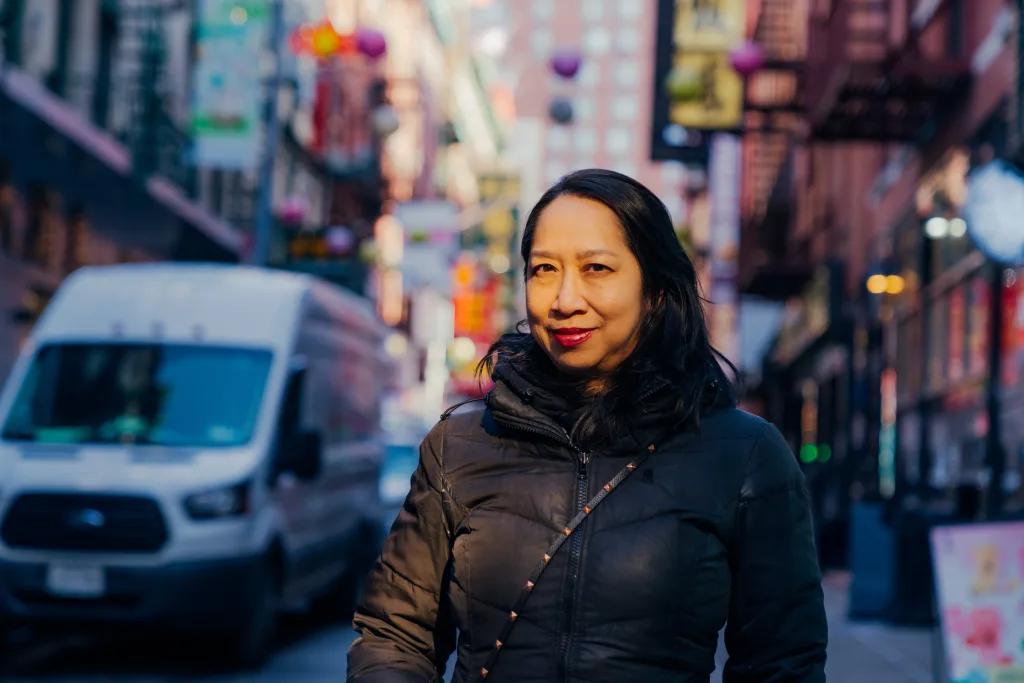
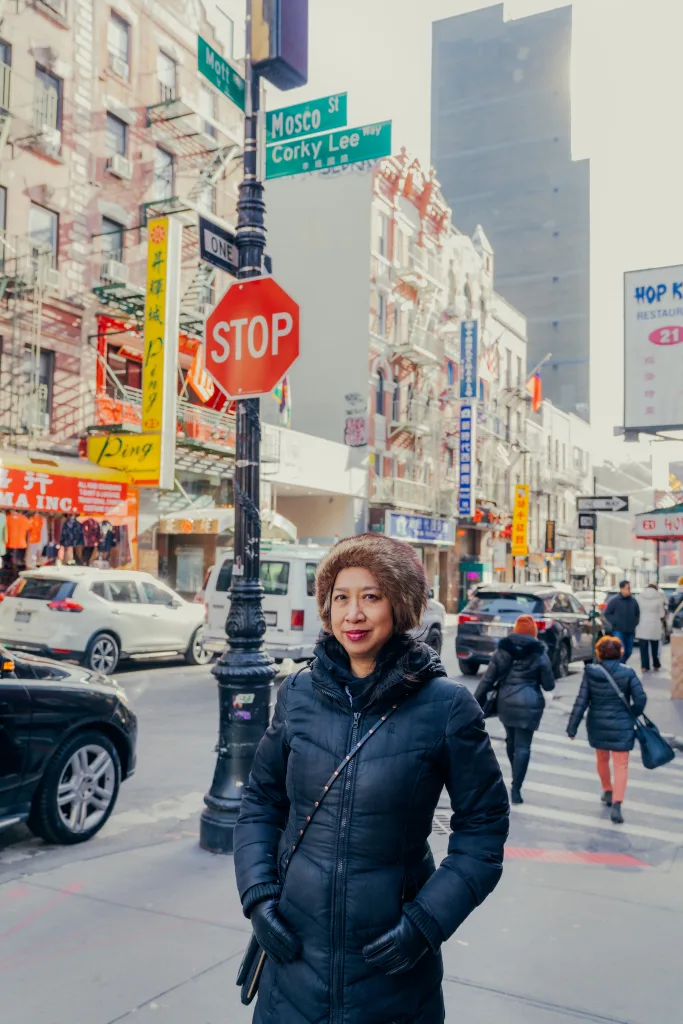
Ava Chin on Mott Street in Chinatown. Photo: Janice Chung for Documented
Indeed. Here’s a sample paragraph from your book that made me think of how easy it is for human beings to put humanity aside completely. It says “white immigrants searching for jobs arrived in droves from the East, transported by the very railroad that Chinese had been so instrumental in building. Many of the recent arrivals themselves, new to America, grew resentful when they discovered that the large contract jobs were dominated by Chinese workers, and not just in silver and quartz mining, but also in manufacturing, fishing, farming and lumbering.” They joined several organizations “stoking the fires for Chinese expulsion. Many local judges, politicians, and business owners joined these anti-Chinese movements” as well.
Similar exclusionary and discriminatory actions are still happening today. Given the amount of research you did, what surprised you most about how people rationalize exclusionary laws and sentiments?
Well, number one: that new immigrants to the country from Europe, people who had hated each other back home, all of a sudden in this country — because of issues of labor, job insecurity, a depression that was going on at that time — banded together and saw themselves under this identity as being white men and white workers and they couldn’t see people of a different race as also needing to provide money back home for their families. They saw them as being completely othered, and, to the point of seeing them not as human beings. That was shocking to me.
It was not just laborers, it would be the mayor of the town and the sheriff and his deputies. It would be the storefront owners, like merchants who knew the other Chinese merchants in town. The immense hatred was so intense that journalists and newspaper owners jumped on the bandwagon, and that this kind of nativism was so potent that people who wanted to become politicians would just jump on this anti-Chinese sentiment and riot it all the way into office.
What’s shocking about what’s happening now is that it has become so retrograde, the ways in which certain politicians ride the anti-immigrant bandwagon and that these iterations of exclusion just keep coming up over and over again. I was appalled and deeply saddened when J.D.Vance made that statement against Haitian immigrants in Ohio. I was angry but also it felt so personal because it was the exact same kinds of things that were said about my people, going back to the 19th century, and those iterations of exclusion, that rhetoric still continues. The moment where they start comparing you to animals or saying that you’re eating people’s pets, that’s when it’s like we have really gone backwards. I was glad that Edwidge — I saw you interviewed Edwidge — I was glad Edwidge wrote editorials against it.
Thank you. I’m glad as well. Were you worried about the accuracy of the narrative parts of the book that had to do with what your imagination was describing, and how did you resolve it? For example, Elva’s wedding night with her first husband.
I was trained as a journalist, so I never believed in even writing quotes unless I had taken notes. But I realized that because I’m writing about people who lived and died so long ago — and in order to bring these family stories to life so that a reader can really understand who these people were and really understand the struggles that immigrants back then went through — the only way I could do it was to turn it into a narrative.
Let me also say what I tried to do was interview a lot of people, cross check, get corroboration for their stories, read what was published in other people’s books, look at the documents that family members left behind. Look through the Chinese Exclusion Act files.
However, Chinese exclusion turned the whole paradigm on its head, and here’s how: Official documents would typically hold the facts better than what the oral stories do because oral stories change through speakers and through time. But Chinese exclusion turns that all on its head because much of the information in the documents are a kind of fiction. So really, in order to tell the truth of the experience of these people that I’m writing about, I have the privilege of the oral stories that were told to me, because that’s where the truth of the hardship of what Chinese Americans went through in that time period lies. It does not lie in the official documents. Official documents treat every Chinese person in that period as being a suspicious character.
Ava Chin’s family opened Chinatown’s first coffee shop — the Sugar Bowl — decades ago. She walked us to the site. Photo: Janice Chung for Documented
“Chinatown was as patriarchal as society was in China, but it was amped up to a greater degree because of the immigration laws. The immigration laws made it very difficult for women, even married women, to come over into this country and that was on purpose.”
A quote in the epilogue of your book by Rodgers and Hart, “Manhattan” (1925), says, “And tell me what street compares with Mott Street in July.”
What makes Mott Street particularly special in July?
[Laughs] Well, I can tell you what makes Mott Street special. But I can tell you what makes Mott Street special in July too. Mott Street is the main artery of the community of old Chinatown. If you say Mott Street, to any Chinese American in the tri-state area, they know that means Chinatown. So, what makes Mott Street so special in July? The food; there’s a way when it’s warm out, doors are open on the streets. There’s a kind of indoor-outdoor way in which the pedestrians can kind of really walk into stores, where the storefront is totally open; the windows are open.
I have friends that Documented has profiled, Think!Chinatown. They do a block party right on Mott and Mosco. Even not in July, throughout the year, you can see people pushing all sorts of carts and little hand trucks up and down Mott Street. It’s just like the 19th century, you know, before vehicles, when everything was like horse and carriage and handcarts. People pushing their wares. It’s just like that.
Is there a place you often go to in the city that you’d say you feel most connected to or always feels like home to you?
I always thought Chinatown was a place where people got together because they needed to go grocery shopping, or, they could see their friends and have lunch, or, maybe people go to church here or see family. What I didn’t realize is that the earliest roots of Chinatown were that it was a place of refuge for Chinese fleeing the violence out West. That totally changed my view. When the pandemic happened, Chinatown was a refuge for me to just feel comfortable and not worry about random acts of violence — although they did happen here — but to just feel safer and more comfortable.
This interview has been edited for concision and clarity.
Fisayo writes Documented's "Early Arrival" newsletter, and has led other projects at Documented including an interview column "Our City," and a radio show, “Documented.” She is an award-winning multimedia journalist with degrees in Journalism and Mass Communication.