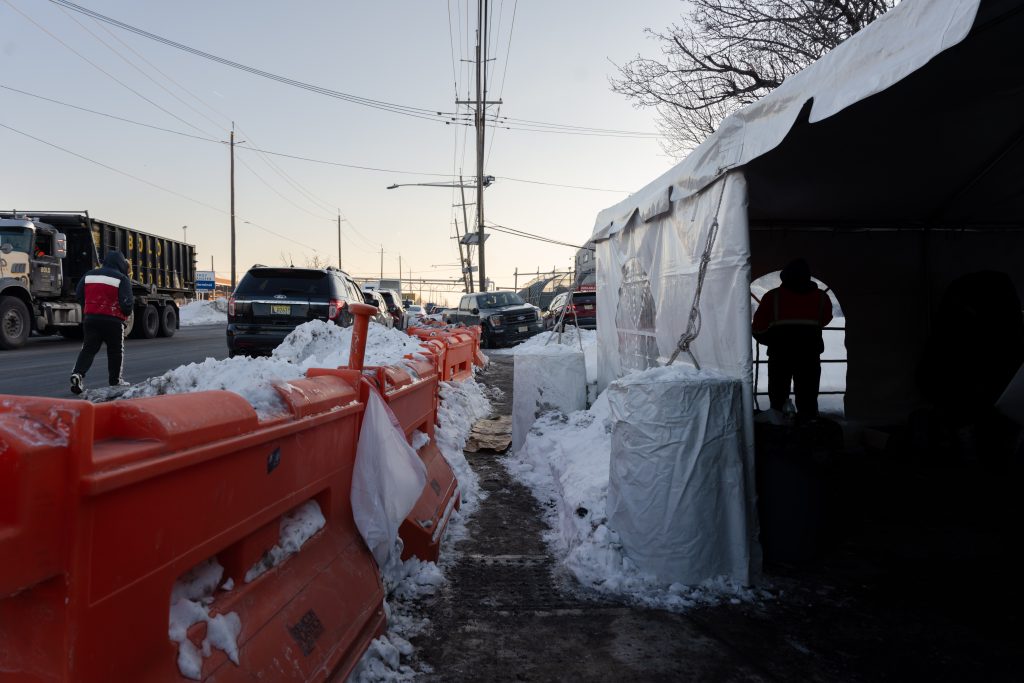


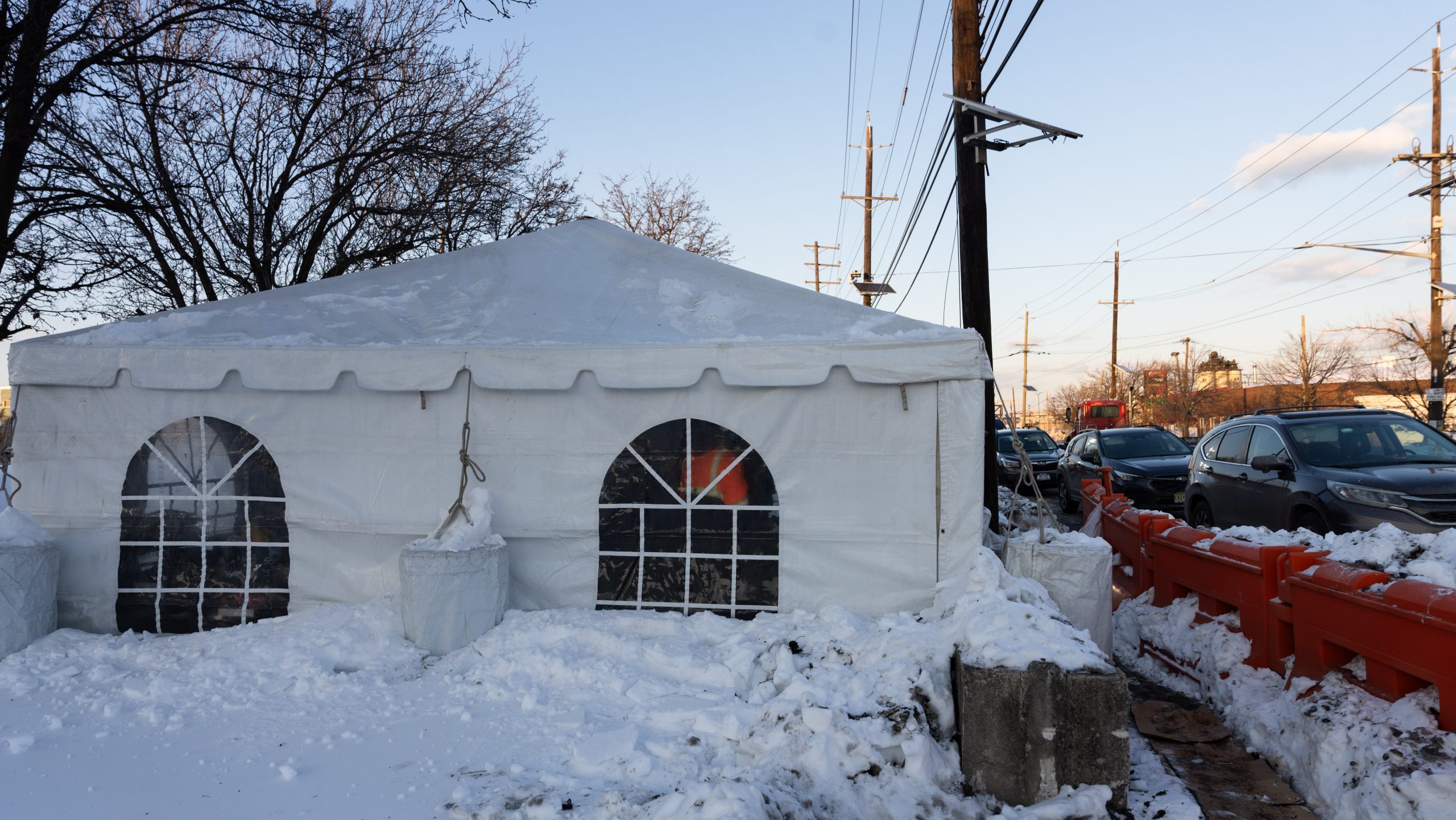


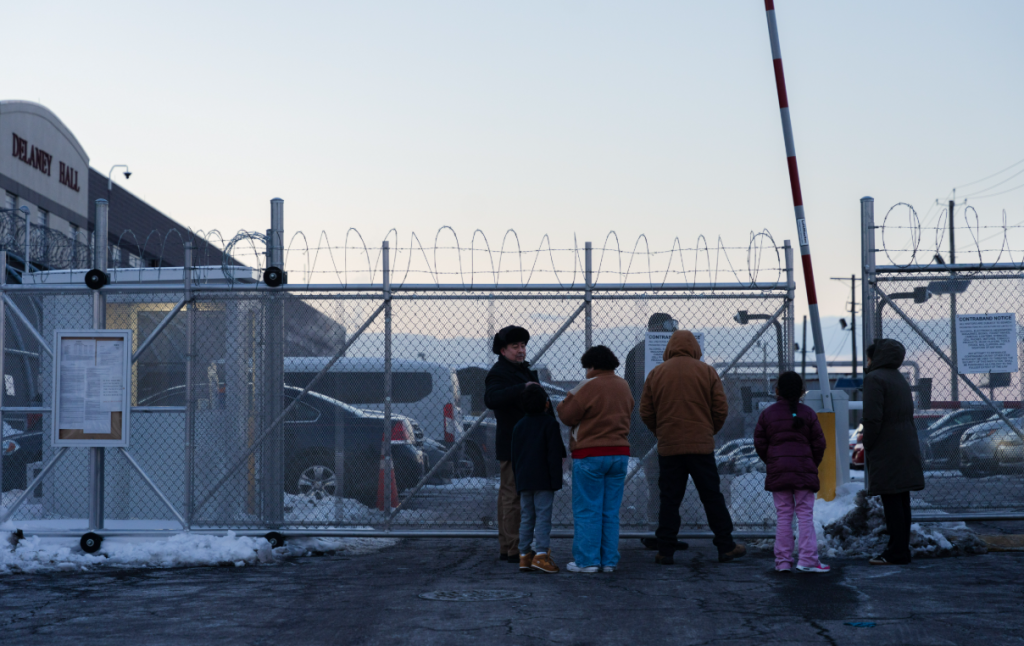
On a frigid day in late January, Rosa stepped over piles of snow into a large canopy tent that had been set up a few days earlier, down the street from the entrance to the privately-operated ICE detention facility at Delaney Hall.
The new structure, which fits around 30 people, was meant to address complaints that visitors had no protection from the freezing temperatures. But the unheated tent has done little to appease concerns from family members like Rosa, who have to stand outside braving the elements for hours to visit their detained relatives.
“It’s a bad situation,” Rosa said in Spanish, speaking about the cold as she clutched a cup of hot coffee prepared by volunteers. She was here to visit her brother, who has been detained for more than three weeks.

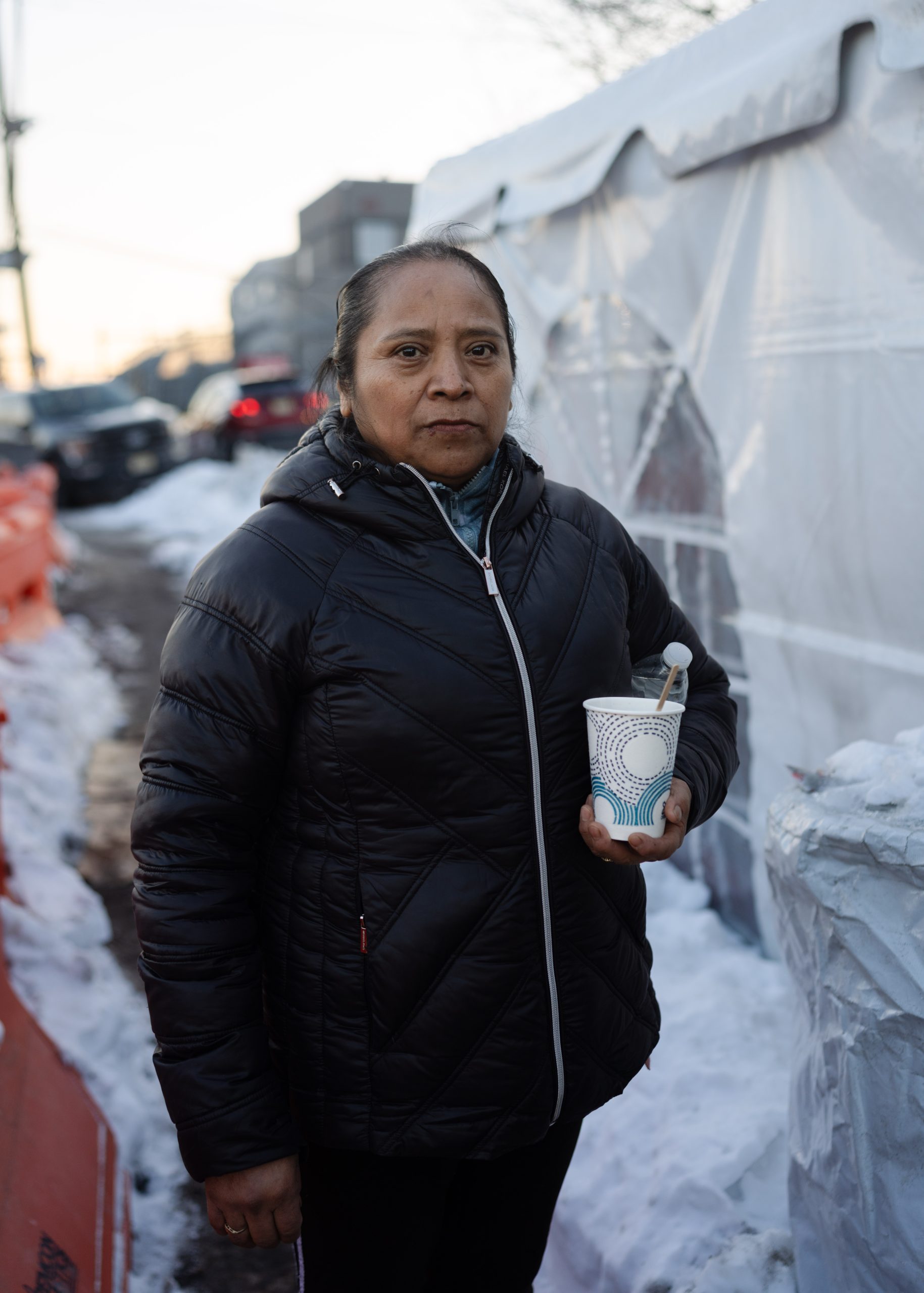
Rosa, who asked to be identified by only her first name in order to protect her brother, makes the two-hour drive from Camden, New Jersey, about once a week to check on her brother. He came to the U.S. 30 years ago from Guerrero, Mexico when he was 16, and does not have legal status.
Like dozens of visitors, she has waited hours in the cold to see him. In the summer, relatives sweltered in 100 degree, life-threatening heat. In winter, the conditions are dangerous, too – 17 people have died in New York City during the recent cold spell – making the already difficult situation even worse.
“But we have to do it, to give him strength – because if not, where do we go? He gets even more depressed,” she said. “If we don’t see him, he thinks we’ve forgotten him, but that’s not the case.”
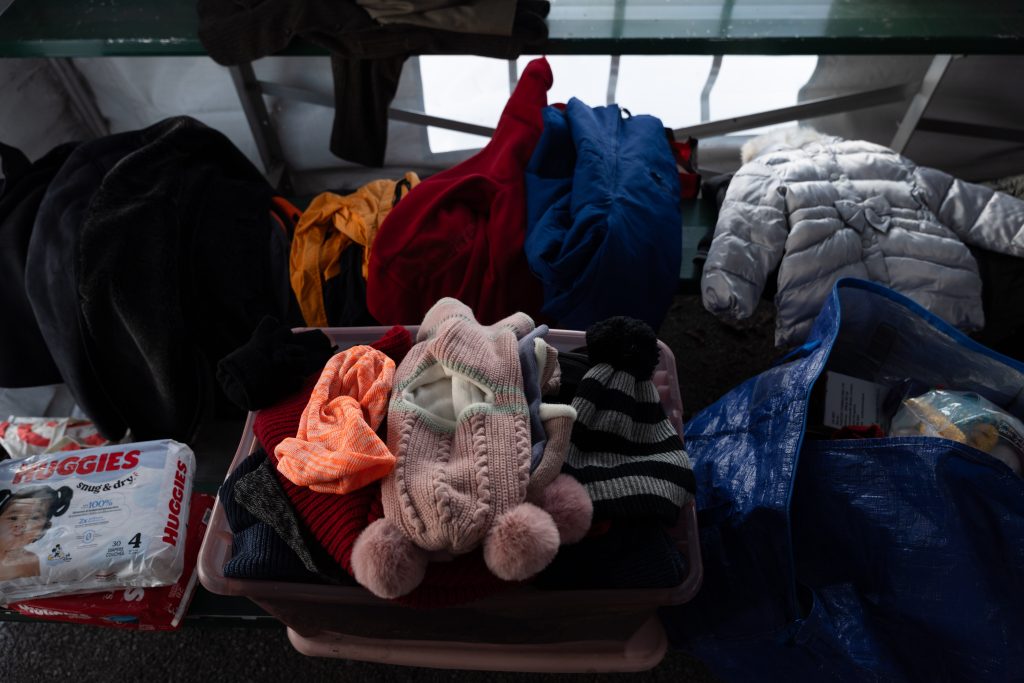
The Essex County government installed the large, unheated tent around 150 feet away from the barbed wire fence around Delaney Hall, one of the largest ICE facilities in the country with capacity for over 1,000 detained people. The change followed months of complaints and letters from advocates who spend their afternoons offering food, warm clothes and drinks to visitors.
But as a bitter cold snap plunges temperatures to dangerously low levels – Essex County officials have extended an emergency-level Code Blue through this week – advocates and visitors told Documented that the new measures do not go far enough to protect the facility’s visitors, who have to show up at least an hour before their scheduled visitation time.
The tent remains cold and is far enough away from the building’s entrance that visitors don’t always hear when their name is called, meaning they could lose their ability to visit.
“It depends on the guard and what kind of mood that specific guard’s in. Sometimes they’re nicer than others,” said Rebecca, a volunteer who was standing near boxes of clothes outside the entrance.
Advocates and families would prefer that visitors stay in the building’s gymnasium, as they did once, during a recent visit by a U.S. senator. That day, Delaney Hall administrators ushered visitors from their lines outside into the facility’s heated indoor gym. But since then, visitors have returned to waiting in the cold.
The ICE Field Office Director for Delaney Hall did not respond to a request for comment, including a question from Documented on why visitors are not permitted to wait in the empty gym.
“This is just totally inadequate and cruel,” said Terri Suess, a longtime member of a New Jersey-based group called Eyes on ICE. Suess has been observing the facility since it first opened in May 2025.
Delaney Hall lies in an industrial area about three miles southeast of Newark. The road is busy with heavy-duty trucks, and the facility does not allow visitors to park in the large parking lot adjoining the site. Instead, visitors park on the street.
The facility has a 15-year, $1.2 billion contract between ICE and GEO Group, the largest private prison operator in the country. In a February 2025 earnings call to shareholders announcing the contract, GEO Group CEO Donahue extolled the “unprecedented” financial potential of Trump’s immigration policies for the company’s profit. “We believe the scale of the opportunity before our company is unlike any we’ve previously experienced,” he said, as reported at the time by The City.
But since Delaney Hall opened, detainees have reported deplorable conditions, including spoiled food, undrinkable water, a lack of basic toiletries, and insufficient medical care. In December, Jean Wilson Brutus, a 41-year-old man from Haiti, died a day after his detention of “suspected natural causes” – leading to renewed calls from advocates, families, and lawmakers to close the facility.
On Feb. 5, advocates published a letter written by a Delaney Hall detainee, Leonardo Villalba.
“The ICE agents have arrested people with mental health issues, physical disabilities such as deaf and non-verbal, elderly individuals, and young people with juvenile status, with whom we have to live in the detention centers that are overcrowded,” Villalba wrote in Spanish.
“We feel vulnerable, in a way, kidnapped or detained without justification.”
Advocates say the conditions, moreover, are arbitrarily imposed by GEO Group, the facility’s operators. In December, when the facility was visited by U.S. Senator Andy Kim, visitors were allowed to wait inside the facility’s large gymnasium. They have not been allowed back since, even as temperatures have dropped.
“That’s the day we were like, ‘Oh, wait, people are just being moved and they’re being seated in the gym,’” said Sally Pillay, a longtime immigrant rights activist who has spent months coming to the facility. “Why can’t they do that all the time?”
GEO Group did not respond to questions from Documented about the gymnasium access, but a GEO Group spokesperson said in a statement that their services are monitored by ICE and other organizations with the Department of Homeland Security “to ensure compliance with ICE’s detention standards and contract requirements regarding the treatment and services ICE detainees receive.” The statement said GEO Group works to resolve any concerns brought by ICE. The spokesperson referred Documented to ICE for further information.
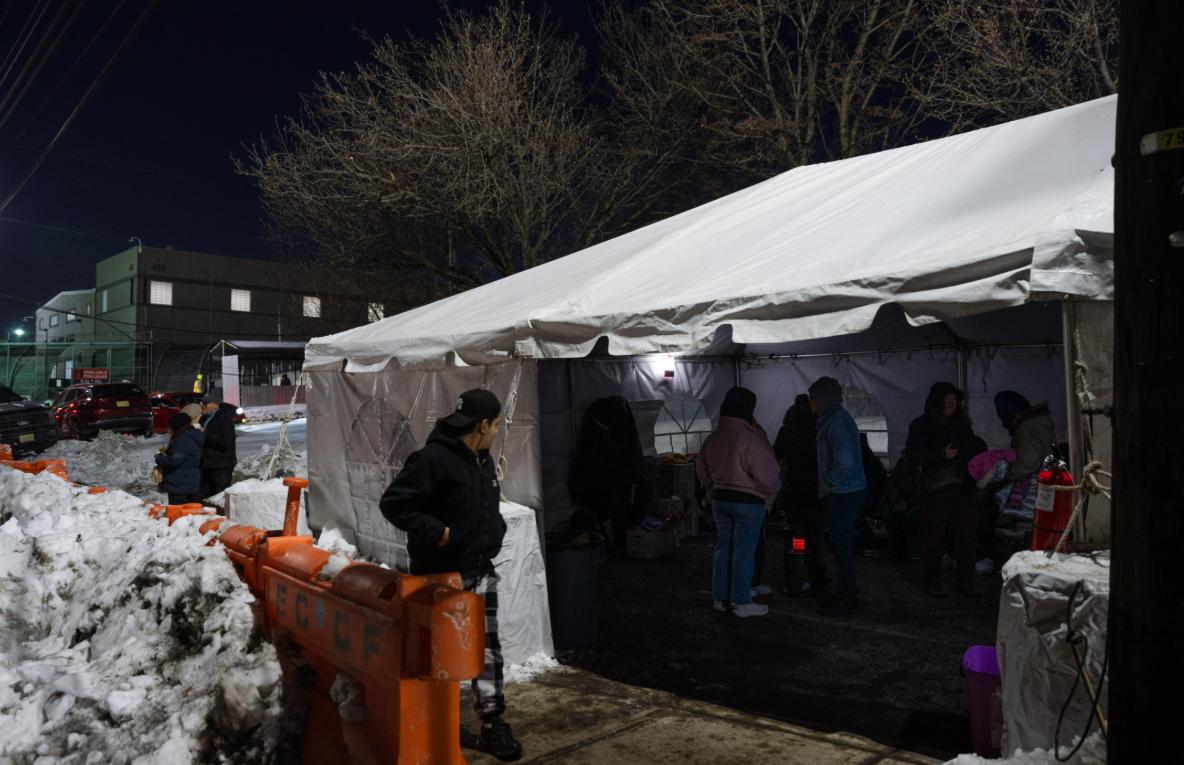
In January, following petitions, letters, and reports from advocates, Essex County administrators erected the unheated tent and port-a-potties on a narrow strip of road down the street from Delaney Hall.
In a statement at the time of the construction, the Essex County Executive, Joe DiVicenzo, said, “While we are not involved with Delaney Hall, I thought it was prudent to provide the tent and portable facilities so visitors could be treated with dignity and have some protection from the elements during the cold weather.”
DiVicenzo, who directs the county administration, did not respond to a request for comment about unresolved issues with the tent from Documented.
The president of the county’s Board of Commissioners, Carlos Pomares, has reached out twice to the ICE field office about conditions at Delaney Hall, most recently following the December death of a detainee, Public Information Officer Adam Tucker said. “While we may not agree on the current federal policy on the processing of undocumented people, I am appealing to you as a human being and as a man of faith to consider my request for a meeting, and to address the concerns raised about conditions in Delaney Hall,” he wrote. He received no reply.
The Board of Commissioners, Tucker said, “defers to the County Executive and his administration on adding heating to the County-provided waiting area. The Board generally supports the idea, but there are logistical and safety challenges to adding heating. The Board trusts the County administration to find the best solution.”
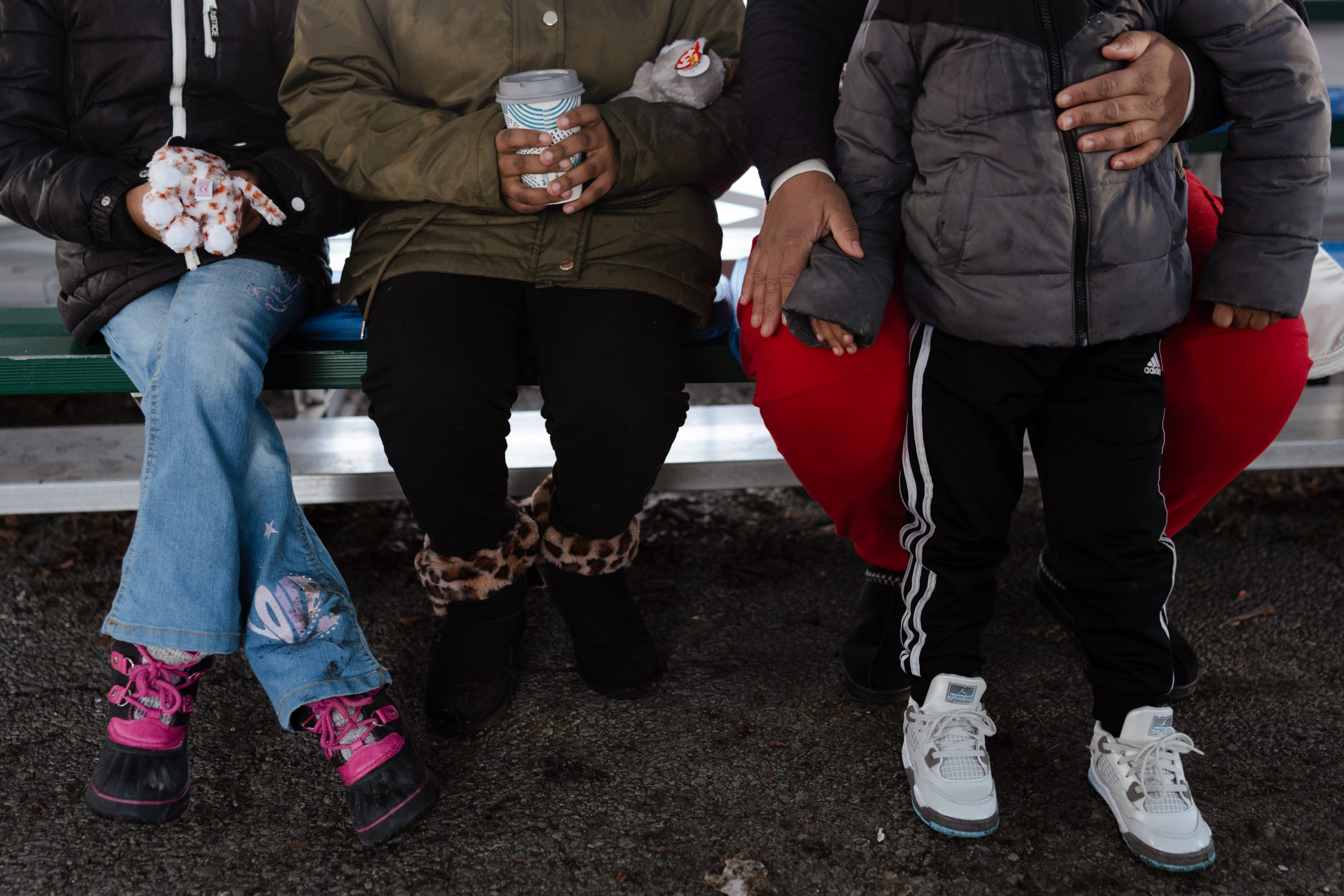
When visitors enter the tent, they are warmly greeted by a team of around a dozen volunteers. As children play on the benches, adults huddle over hot cups of coffee and tamales, near small donated portable heaters. Volunteers offer them hand warmers and gloves.
Still, the visiting process can still be disorienting and difficult to navigate.
And sometimes, relatives get crushing news:
“I came to drop off [a friend’s] passport this afternoon and I was supposed to visit him at 7. I arrived and they told me he’s not here anymore,” said one man, who declined to share his name with Documented.
He believes his friend, who is from Ecuador and requesting asylum along with his teenage daughter, had probably signed papers for self-removal.
“They told me he’s not here anymore. I’m going to break the news to the family now,” he said.